

Release earns its reputation honestly. Ask engineers who've used it about the database story and most won't complain: Instant Datasets genuinely solves the seed-and-snapshot problem that trips up half the ephemeral-environment vendors we've reviewed. That's rare enough to say plainly before getting into where the platform's scope ends.
Where the conversation usually turns is a different question. PR #612 gets a live environment. The dataset looks right. Everyone approves the deploy. Did the checkout flow still work? Nobody actually knows, because nothing ran against it. That's not a knock on Release's data story. It's a different problem, and it's the one this comparison spends most of its time on.
What Release Is
Release describes itself as an Environments as a Service platform, and that's an accurate description rather than marketing language. Connect a repository and Release generates an Application Template from what it finds (a docker-compose file, an existing Helm chart, a set of declared services), then lets you customize that template before it becomes the definition your environments are built from. From there, Release provisions both ephemeral environments (one per pull request, torn down on merge) and permanent environments (staging, demo, a persistent QA environment) from the same template system.
The detail that matters most to a lot of buyers: Release runs inside your own AWS account under a bring-your-own-cloud model. The control plane orchestrates, but the compute, the network, and the data stay inside infrastructure you already own and bill.
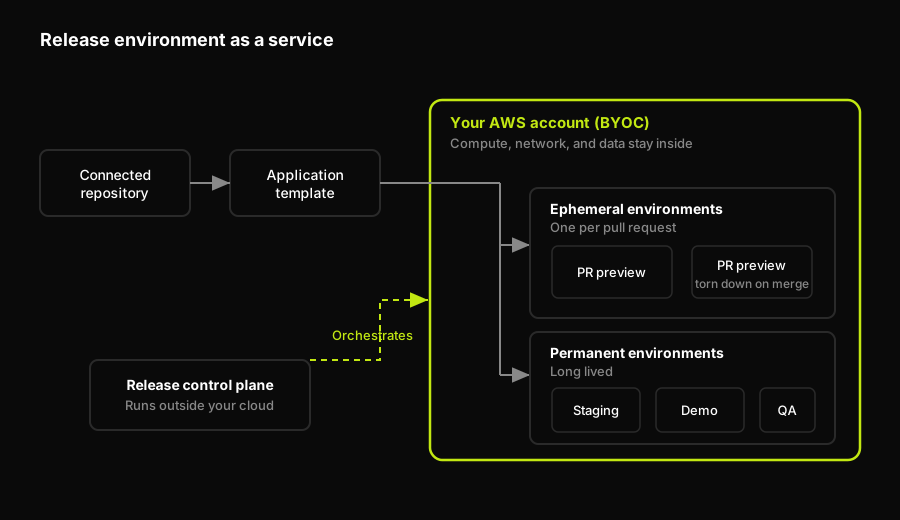
Release's control plane orchestrates from outside, while the environments, compute, and data stay inside your own AWS account.
Where Release Genuinely Shines
BYOC is the first reason teams pick Release over a fully managed alternative, and it's a legitimate one. For a team with data-residency requirements, an existing AWS relationship it doesn't want to complicate, or a security team that wants environments inside a VPC it already controls, running the control plane in your own cloud account isn't a nice-to-have. It's the only acceptable answer.
The second reason is Instant Datasets, and this is worth stating clearly: Release addresses the database layer better than most vendors in the ephemeral-environment category. Snapshotting a production-shaped dataset and seeding it into a new environment is exactly the kind of infrastructure problem Release's Application Templates are built to solve, and teams that adopt Release specifically to stop hand-rolling seed scripts are solving a real, common problem.
For teams with complex, multi-service stacks who want environments defined the same way across ephemeral and permanent use cases, in infrastructure they already own, Release is a coherent, well-reasoned choice.
Where It Falls Short
Here's the part worth being precise about, because it would be easy, and inaccurate, to reach for the database complaint that applies to most of Release's competitors. It doesn't apply here. Release's data story holds up.
What Release doesn't do is tell you whether the environment it provisioned actually works. It's an infrastructure and application-template platform first: it builds the environment, seeds the data, and hands you a URL. Whether anyone runs a test suite against that URL, and whether the results show up anywhere a reviewer sees them before merge, is left entirely to whatever CI pipeline you've bolted on separately, Playwright, Cypress, or otherwise.
That's not a flaw specific to Release. It's the category-wide split we keep finding across the ephemeral environment platforms we've reviewed: environment orchestration and verification are two different problems, and even a vendor that solves the data layer as well as Release does still leaves verification as somebody else's job.
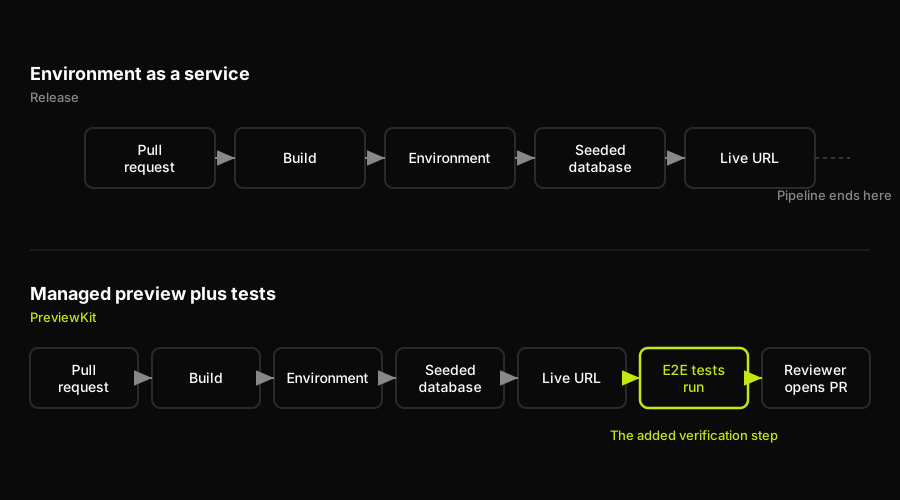
Release solves provisioning and seeding about as well as anything in this category. The test run is still a separate project.
Choose Release If, Choose PreviewKit If
The honest split here isn't data versus no data. Both platforms take data seriously in their own way. It's where you want the environment to end: at a working URL inside your own cloud, or at a merge-ready verdict with a test run already attached.
| Dimension | Release | PreviewKit |
|---|---|---|
| Trigger model | PR-triggered, plus permanent envs | PR-triggered previews only |
| Hosting model | BYOC, runs in your AWS account | Fully managed, nothing to operate |
| Stack scope | Any service in your template | Full-stack app plus dependencies |
| Database / data handling | Instant Datasets, snapshot and seed | Isolated DB, Planner sets scenario state |
| Isolation model | Per-environment, your cloud boundary | Per-PR, managed boundary |
| Automated testing on preview | Bring your own CI / E2E | E2E tests run automatically |
Choose Release if BYOC matters more than convenience: you need environments inside your own AWS account for compliance or cost-control reasons, your stack already benefits from Instant Datasets' snapshot-and-seed model, or you're comfortable wiring your own CI pipeline to run E2E tests against whatever URL Release hands back. It's also the stronger fit if you want one platform for both ephemeral previews and permanent environments like staging and demo.
Choose PreviewKit if the missing piece is verification, not infrastructure: you want an isolated database provisioned and seeded automatically per PR, and you want end-to-end tests to run against that environment before a reviewer opens it, with a result attached to the PR instead of a separate CI dashboard to check. PreviewKit trades BYOC control for a fully managed setup where the test run is the default outcome of opening a pull request, not a follow-up project.
How Autonoma Ships Tested Preview Environments
The pain this comparison keeps circling is specific: Release's Application Templates and Instant Datasets solve provisioning and data snapshotting about as well as anything in this category. What they don't solve is verification, whether the environment they built still behaves correctly once it's live. That gap between "the environment exists" and "the environment is safe to merge" is where teams quietly reintroduce manual QA, or skip verification and hope.
Autonoma built PreviewKit to close that specific gap rather than compete with Release on infrastructure breadth. Connect a repository and PreviewKit provisions a full-stack preview per pull request, backend, isolated database, and dependent services included, then runs end-to-end tests against it automatically, before a human opens the PR. Four agents handle the work most teams end up doing by hand around infrastructure-only tools like Release.
The Planner agent reads the codebase to plan test cases for the routes and flows a PR actually touches, including the database state each scenario needs, generating the endpoints required to set that state. The Executor agent drives those tests against the live per-PR preview. The Reviewer agent classifies each result as a real bug, an agent error, or a plan-and-test mismatch, so a merge decision doesn't hinge on someone manually triaging a flaky run. The Diffs Agent runs on every subsequent PR, updating, adding, and deprecating test cases based on what the code diff actually changed, so the suite doesn't rot as the app evolves.
Mapped against the comparison table above: where Release hands back a seeded, BYOC environment and expects your own CI to test it, PreviewKit provisions a managed equivalent and runs the test as part of the same environment, with each agent step carrying its own verification layer so the process stays hands-off without turning into a black box you have to trust blindly. It's not a wider platform than Release. It's a narrower one, built specifically around the row in that table Release leaves for you to fill in.
Why You Can Trust This Comparison
We build PreviewKit, so weigh what follows accordingly. We've tried to be specific about where Release is genuinely strong: BYOC deployment inside your own AWS account, and Instant Datasets, which solves database seeding more honestly than most vendors in this category, including several we've compared PreviewKit against elsewhere. If your team needs environments inside infrastructure it already controls, or you're happy owning your own E2E pipeline against a well-seeded environment, Release is a legitimate, well-built choice, and we're not pretending otherwise.
The testing gap described here isn't unique to Release either. It shows up in nearly every environment-as-a-service and PaaS-style vendor we've reviewed, which is exactly why PreviewKit was built to sit on that specific ground rather than compete on infrastructure breadth. That's the bias behind this comparison, named plainly, so you can weigh the rest of it accordingly. Check Release's own documentation for how a test suite runs against a provisioned environment automatically. It isn't there by default, which is a claim you can verify yourself rather than take on our word.
For the wider landscape beyond this single comparison, see our roundup of ephemeral environment platforms, and how PreviewKit stacks up against other managed options in PreviewKit vs Uffizzi, PreviewKit vs Qovery, PreviewKit vs Northflank, and PreviewKit vs Signadot.
If BYOC and Instant Datasets already solve your data problem and the only thing missing is someone to run the tests, Autonoma's PreviewKit is worth evaluating: it gives each PR a managed preview environment with web-first end-to-end testing built in, before you build a CI pipeline to bolt onto Release yourself.
Frequently Asked Questions
It depends on what you're missing. Release is a strong, BYOC Environments as a Service platform with a genuinely solid database story via Instant Datasets. PreviewKit is a narrower alternative built specifically for teams whose gap is verification, not infrastructure: it provisions a managed, full-stack preview per PR and runs end-to-end tests against it automatically, before a human opens the pull request.
Yes. Release's Instant Datasets feature snapshots and seeds production-shaped data into ephemeral and permanent environments, and it does this better than most vendors in the ephemeral-environment category. That's a genuine strength worth crediting rather than a gap PreviewKit needs to fill.
No. Release provisions the environment and seeds the data, then hands you a live URL. Running a test suite against that URL and surfacing the results before merge is left to whatever CI pipeline you connect separately. PreviewKit runs E2E tests automatically as part of the same environment.
Yes. Release's control plane runs inside your own AWS account, so compute, networking, and data stay inside infrastructure you already own and bill, rather than a third-party cloud environment.


