

Every comparison of ephemeral environment tools you'll find online runs the same playbook. A vendor, or a competitor of that vendor, lists five or six platforms, scores them on trigger model and pricing tier, and calls it complete. None of them mention what happens to the database. That's not an oversight. The database is the hardest part of the category to get right, so it's the part almost everyone quietly leaves out of the table.
We're not going to leave it out. We're also not going to pretend we don't have a stake in the answer, so before the table, here's exactly where we stand and why you should still trust the comparison that follows.
Why You Can Trust This Comparison
This article compares six independent platforms: Uffizzi, Signadot, Qovery, Northflank, Bunnyshell, and Release. We also build PreviewKit, Autonoma's managed full-stack preview-environments product, and we've added it here as a seventh row, fully disclosed, scored the same way as the other six. That's a conflict of interest, and every other comparison you'll find in this category has the same conflict without saying so. Northflank, Bunnyshell, and Qovery have all published "best ephemeral environment tools" style posts that rank their own product first and disclose nothing.
Here's how we tried to keep this one honest. We scored every platform, including our own, on the same eight dimensions using publicly documented behavior, not marketing pages. We put the database and data-handling column first, because it's the dimension that determines whether a preview environment is actually useful or just a URL that loads. And in the verdicts section below, we say plainly where PreviewKit is the wrong choice, the same way we say it for every other row. If one of the six independent platforms in this list is a better fit for your stack than ours, this article should make that obvious, not bury it.
The Comparison Table Every Vendor Review Skips
The six platforms below cover three genuinely different models: config-driven, cluster-native environments (Uffizzi, Bunnyshell); full-stack PaaS platforms that happen to support previews (Qovery, Northflank, Release); and request-level sandboxing that isolates traffic without cloning infrastructure (Signadot). We've added PreviewKit as a disclosed seventh row: it's our own managed full-stack preview product, scored on the same dimensions as everyone else. The split into two tables keeps each one readable, but the database and data column is the one to read first in both.
Most comparisons score seven of these dimensions and quietly drop the database column.
Environment and data model
Compare the database and data-handling column first, then read the trigger, stack, and isolation details that determine how each platform creates a preview.
| Platform | Trigger model | Stack scope | Database / data handling | Isolation model |
|---|---|---|---|---|
| Uffizzi | Per-PR (GitOps manifest) | Full-stack, cluster-native | Empty by default, seed scripts DIY | Isolated environment per PR |
| Signadot | Per-request routing rule | Microservices, not full stack | Shared with baseline, no clone | Request-level, not environment-level |
| Qovery | Per-branch or per-PR | Full-stack on your cloud | New managed DB instance, empty | Isolated compute per environment |
| Northflank | Per-PR pipeline step | Full-stack PaaS | New DB service, seed job optional | Isolated project per environment |
| Bunnyshell | Per-PR or manual | Full-stack, container-orchestrated | Template-driven, seed hooks DIY | Isolated environment per PR |
| Release | Per-PR or manual | Full-stack, templated | DB templates/snapshots supported | Isolated environment per PR |
| PreviewKit (disclosed 7th row) | Per-PR, automatic | Full-stack, backend included | Tenant-scoped seed data per PR | Full environment per PR |
Operations and fit
The second table separates the operational trade-offs: where the platform runs, how it tears environments down, how it charges, and the use case it best serves.
| Platform | Hosting | Teardown reliability | Pricing model | Best-fit use case |
|---|---|---|---|---|
| Uffizzi | Your own cluster or Uffizzi Cloud | Manual cleanup if manifests drift | Open source, paid cloud tier | Cluster-native teams wanting GitOps |
| Signadot | Your existing cluster | No teardown, routes just expire | Per-seat, usage tiers | Microservices without full clones |
| Qovery | Your cloud (AWS/GCP/Azure), BYOC | Reliable, occasional orphaned DB | Per-seat plus infra pass-through | Teams wanting a full PaaS, not just previews |
| Northflank | Northflank cloud or BYOC | Reliable, resource-quota gated | Usage-based, per compute-hour | Teams already on Northflank for prod |
| Bunnyshell | Your own cluster | Depends on template hygiene | Per-environment, tiered plans | Cluster-native microservices teams |
| Release | Their cloud, BYOC on higher tiers | Reliable, template-scoped | Per-environment, usage tiers | Teams wanting environment templates |
| PreviewKit (disclosed 7th row) | Autonoma-managed, your repo | Automatic, tied to PR lifecycle | Per-PR, usage-based | Full-stack apps needing tested, isolated data |
Honest Verdicts: Who Each Platform Is Actually For
Uffizzi is a strong pick if you're already running your own cluster and want GitOps-style, declarative preview environments defined in a manifest committed alongside your code. It's open source, which matters if procurement or data residency rules make a managed vendor a hard no. It's a poor fit if you want the database handled for you: Uffizzi gives you an isolated environment and a manifest format, and seeding realistic data per environment is entirely your team's job to script and maintain.
Signadot solves a genuinely different problem than the rest of this list, which is worth understanding before you rule it in or out. Instead of cloning a full environment, Signadot routes a slice of live traffic to your changed service while everything else, including the database, stays shared with the baseline. That's excellent for large microservices architectures where spinning up 40 services per PR is impractical. It's the wrong tool if you need actual data isolation: by design, Signadot sandboxes share state with production or staging, so destructive tests are not safe to run against them.
Qovery is best for teams that want a full PaaS, not just preview environments, and are willing to run it on their own cloud account. Its per-branch environments are reliable and its BYOC model appeals to teams with existing AWS or GCP commitments. It's a weaker fit if your only need is preview environments: you're adopting an entire deployment platform to get there, and the database in each preview environment starts empty unless your pipeline scripts a seed step.
Northflank works well for teams already running production workloads on Northflank, since previews inherit the same project structure and resource quotas. Optional seed jobs mean you can get a populated database per preview, but it's opt-in configuration, not default behavior. If you're not already invested in Northflank for production, adopting it purely for preview environments is a heavier lift than the category needs.
Bunnyshell targets the same cluster-native microservices audience as Uffizzi with a more templated, less GitOps-purist workflow. Template-driven environment definitions are genuinely convenient once set up. The database story is the same pattern as most of this list: environments come from a template, and whether that template includes realistic seed data is on your team to build and keep current as your schema evolves.
Release stands out in this group for taking database templates and snapshots seriously as a first-class concept rather than an afterthought, which puts it closer to solving the data problem than Uffizzi, Qovery, Northflank, or Bunnyshell. It's a good fit for teams that want environment templating without committing to managing your own cluster directly. It's a weaker fit if your team wants the platform to also own testing: Release provisions the environment and stops there, so validating that the environment actually works is still a separate project.
PreviewKit, our disclosed seventh row, is Autonoma's managed full-stack preview-environments product: connect a repository, and it handles the build, the backend, the routing, and per-PR data isolation, with end-to-end tests running against every preview automatically. It's a strong fit for full-stack teams that want the database problem solved by default rather than scripted per-project, and for teams that want testing bundled into the same lifecycle instead of bolted on afterward. It's the wrong choice if you're deep in a cluster-native workflow and want GitOps manifests as your source of truth (Uffizzi or Bunnyshell fit that better), or if your core problem is microservice-level request isolation rather than full-environment isolation, which is exactly what Signadot is built for.
If you want the deeper, head-to-head version of any of these comparisons, we've written dedicated teardowns: PreviewKit vs Uffizzi, PreviewKit vs Qovery, PreviewKit vs Northflank, PreviewKit vs Release, and PreviewKit vs Signadot.
The Part Every Comparison Skips: The Database in a Preview Environment
Look back at the tables above and one column does more work than the rest: database and data handling. Four of the six independent platforms default to an empty database on every environment. That sounds like a minor detail until you try to actually review a pull request. An empty database means every reviewer has to manually create test data before they can click through the feature, or the team maintains a shared seed script that drifts out of sync with the schema, or the preview simply isn't tested at all because nobody has time to populate it by hand.
Only tenant-scoped seeding gives every preview realistic, isolated data without copying production.
There are really only four models for getting data into an ephemeral environment, and almost no comparison names them directly.
- Empty is the default you get from most platforms unless you configure something else. Fast to provision, useless for testing anything beyond "does the page render."
- Cloned copies a full snapshot of an existing database into the new environment. Realistic, but slow to provision at scale and a genuine data-exposure risk if the source snapshot contains production data.
- Branched uses copy-on-write database branching, offered natively by providers like Neon and PlanetScale, to fork a lightweight branch of an existing database per environment. Fast and cheap at low volume, but branch-hour costs and storage-delta accumulation add up as PR volume grows, and a branch is a copy of the schema and rows, not a security boundary between tenants.
- Tenant-scoped seeds a small, purpose-built dataset for a specific tenant or scenario directly into the environment, isolated by design rather than isolated by being a separate copy of everything.
None of the four is universally correct. A frontend-only team with no meaningful backend state can live with empty environments forever. A team validating complex reporting logic across a large dataset may genuinely need cloned or branched data. But for the specific job most preview environments exist to do, letting a PR author and a reviewer confirm a change works against realistic data without any risk of touching real customer records, tenant-scoped seeding is usually the best fit, and it's the model almost none of the platforms above build in by default.
We've written a full comparison of the branching-vs-tenant-isolation decision if you want the deeper mechanics, including where a database branch and a tenant boundary solve genuinely different problems and where teams conflate them.
If your stack runs on Vercel, one question is worth settling before you weigh any of these models: whether your preview deployments quietly point at a single shared database. We cover exactly that in do Vercel previews share the same database.
How Autonoma's PreviewKit Handles the Database Every Other Platform Skips
The pattern across every platform in the table, our own included until we built around it deliberately, is that the environment gets solved before the data does. You get an isolated environment, a build, a routable URL, and then a follow-up project to make that environment actually usable for testing anything beyond the happy path. For a team shipping a handful of PRs a week, that follow-up project is annoying. For a team shipping forty PRs a week across a multi-tenant product, it's the difference between previews that get reviewed properly and previews that get rubber-stamped because nobody has time to seed data for each one.
PreviewKit treats database provisioning as part of the environment lifecycle instead of a separate step a team has to own. When a PR opens, Autonoma provisions the full-stack environment, including a database seeded with tenant-scoped data appropriate to the change, not an empty schema and not a full clone of production. The same Planner agent that reads your routes and components to plan test cases also generates the endpoints needed to put the database into the right state for each scenario, so the data problem and the testing problem get solved by the same pass over your codebase rather than two disconnected efforts. The Executor agent then runs those tests against the live environment, and the Diffs Agent keeps the test suite (and the data scenarios it depends on) aligned as your schema and routes change on every subsequent PR.
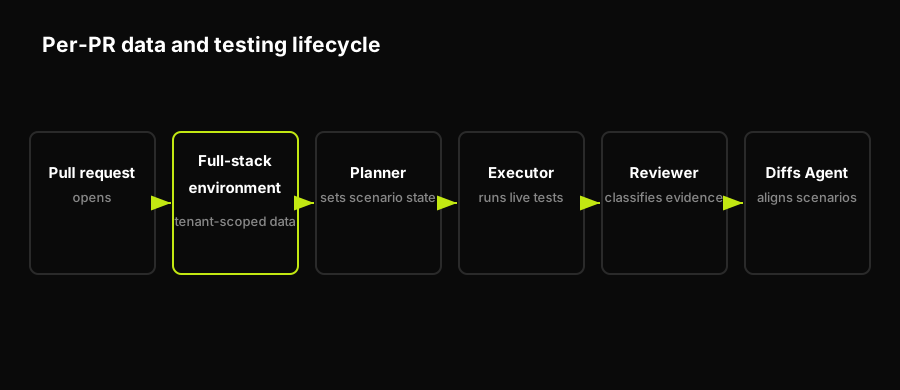
PreviewKit joins data setup and end-to-end test execution in the same per-PR lifecycle instead of leaving them as two disconnected efforts.
That's the honest answer to "how does PreviewKit handle the database column in the table above": tenant-scoped by default, generated from the codebase rather than hand-maintained, and tied to the same per-PR lifecycle as the environment itself. It's not the right fit for every row in that table's use-case column, and we said so above. It is the fit for teams whose current answer to "what's in our preview database" is a shrug.
Mapped against the two comparison tables earlier in this post, that's roughly: trigger model, per-PR and automatic, same as most of the field. Stack scope, full-stack, same tier as Qovery, Northflank, Bunnyshell, and Release. Isolation model, a full environment per PR, not a shared sandbox like Signadot. The column that actually differs is database and data handling, and that's the one column this whole article exists to put back on the table.
Build vs Buy: How to Actually Pick an Ephemeral Environment Platform
Most teams evaluating preview environment platforms don't need a feature matrix to make this decision. They need four honest questions answered in order.
First: does your team already have infrastructure commitments that make one category a natural fit? A team standardized on a container orchestrator with an internal platform team maintaining manifests is going to get more value out of Uffizzi or Bunnyshell than out of adopting a new managed PaaS just for previews. A team with no cluster-management exposure and no appetite to build any is going to find Qovery, Northflank, or a managed full-stack product a much shorter path.
Second: is your application actually full-stack, or is the interesting part of your review process the frontend? If your backend rarely changes and your database schema is stable, a frontend-focused preview tool with an empty or lightly seeded backend is genuinely sufficient, and paying for full-stack data isolation is solving a problem you don't have. If your product is a backend-heavy, multi-tenant SaaS where the database is where most bugs actually live, the database column in the tables above should weigh more than every other column combined.
Third, and this is the question every comparison in this category quietly avoids: who is going to own the seed data? If the honest answer is "nobody, currently," that's not a small gap to leave open. It compounds every sprint as your schema drifts further from whatever seed script someone wrote eight months ago. That's the specific decision point where build-your-own branching or tenant-seeding starts to look like a real ongoing engineering commitment rather than a one-time setup task, and where managed options that treat data provisioning as part of the product, not an integration you build on top of it, start to look proportionate to the problem instead of like overkill.
There's a fourth question worth asking even though it rarely shows up in the initial evaluation: what's the actual maintenance cost a year from now? A manifest-driven platform like Uffizzi or Bunnyshell is cheap to adopt and expensive to keep current, because someone owns the templates, the seed scripts, and the cluster plumbing underneath them indefinitely. A managed PaaS like Qovery or Northflank shifts infrastructure maintenance off your plate but leaves the data-seeding project exactly where it was. Total cost of ownership for an ephemeral environment platform is rarely the sticker price. It's the sum of the platform fee and whatever headcount your team quietly assigns to keeping the seed data believable.
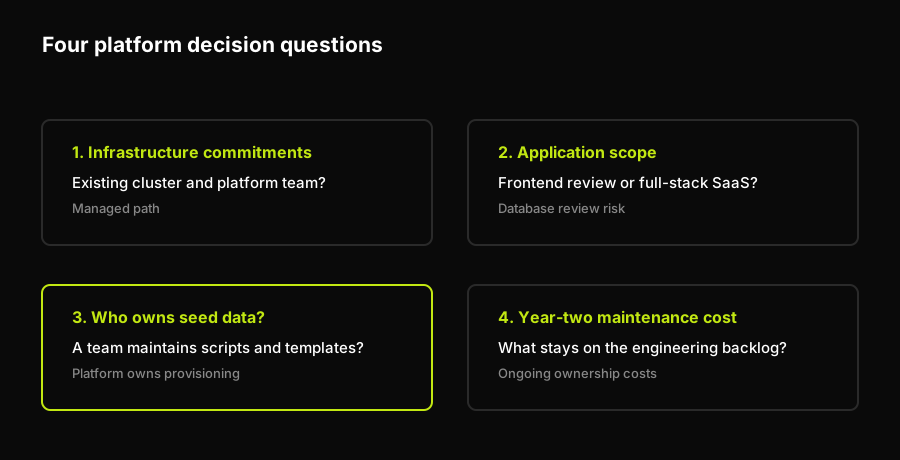
Choose an ephemeral environment platform by the operating constraint your team will still own after the preview is live.
There's no universally correct answer among the six independent platforms compared here, or the seventh, our own, that we added and scored the same way. There is a wrong way to compare them, which is scoring trigger models and pricing tiers while ignoring the column that determines whether the environment is actually testable. Start there, and the rest of the decision gets a lot easier to make honestly.
The pattern holds across every platform in this list, including our own: the environment is the easy 80%, and the database is the hard 20% that determines whether reviewers actually trust what they're looking at. Pick based on that 20%, not on how good the marketing page looks.
Ask For the Database Story Before You Trial Anything
If you take one thing from this comparison into a vendor call, make it a single question: "walk me through what happens to the database on every environment, from creation to teardown." Watch how specific the answer is.
A confident, specific answer describes:
- Where the data comes from: empty, cloned, branched, or tenant-scoped.
- How long provisioning takes: at your expected PR volume.
- What gets deleted: on merge.
A vague answer that pivots to build speed or UI polish is telling you the vendor hasn't had to think hard about the database yet, which usually means your team will be the one thinking hard about it later.
This also explains why the vendor comparisons already ranking for this topic read the way they do. Northflank, Bunnyshell, and Qovery all cover trigger models and deploy speed in detail, because that's the part of the product that demos well. The database column requires admitting tradeoffs, empty-by-default is a real limitation, cloning is a real compliance risk, branching has real cost curves, and admitting tradeoffs is not what a self-authored comparison is built to do. That's the structural reason the gap exists, and it's not going away until someone other than the vendor being reviewed is willing to write the column honestly.
Whichever platform you land on, the actual test is simple: hand a new engineer a PR link and see whether they can validate the change without asking someone else "how do I get test data in here." If the answer is yes on day one, you've picked correctly regardless of which row in the table above you chose. If the answer is "ask the person who wrote the seed script," you've adopted an ephemeral environment platform and kept the exact data problem it was supposed to solve.
Frequently Asked Questions
An ephemeral environment platform provisions short-lived, on-demand deployments, usually one per pull request, so a team can test a change on real infrastructure before merging. Unlike a shared staging environment, each one is created for a single change and torn down automatically once it's no longer needed.
The terms are largely interchangeable in practice. Preview environment is more common on frontend-focused platforms like Vercel and Netlify, while ephemeral environment is the broader term used across full-stack and cluster-based tooling, but both describe the same per-PR, temporary deployment model.
Most default to an empty database and leave seeding up to the team's own scripts. A smaller number support cloned snapshots or copy-on-write branching, and a few, including PreviewKit, seed tenant-scoped data automatically as part of the environment lifecycle.
There isn't a single best platform. Teams already standardized on a container orchestrator tend to prefer Uffizzi or Bunnyshell, teams wanting a broader PaaS lean toward Qovery or Northflank, microservices teams needing request-level isolation without full clones fit Signadot, and teams that want the database problem solved by default fit PreviewKit.
It depends entirely on the data model. Environments with tenant-scoped or fully isolated data are safe for destructive tests. Environments that share a database with a baseline, like Signadot's request-level sandboxes, are not, since a destructive action can affect that shared state.


