

Most preview environment comparisons stop at "does it spin up a container per PR." That question was interesting in 2021. By now, several tools answer it well, Uffizzi included.
The more useful question, the one that actually decides whether a team keeps a tool past the pilot, is what happens the first time someone asks "can I get a preview with a realistic, isolated copy of last week's production data, and can I run my test suite against it automatically."
That's where the two approaches genuinely diverge. Autonoma's PreviewKit is designed for teams that want that data and testing layer managed, so it is worth being specific about both approaches instead of waving at "developer experience."
What Uffizzi Is
Uffizzi is an open-source, config-driven platform for ephemeral preview environments. You describe your environment declaratively, typically with a compose-style configuration file committed to your repository, and Uffizzi spins up the described services per pull request. It grew out of the CNCF-adjacent ecosystem of GitOps tooling, and it's built with containerized applications specifically in mind: define your services, wire up networking, and Uffizzi orchestrates the lifecycle from PR open to teardown.
This is a legitimately different model from Autonoma's managed, opinionated PreviewKit. Uffizzi doesn't try to infer your architecture. It asks you to state it, once, in a file that lives next to your code and gets reviewed like any other change.
Where Uffizzi's Config/GitOps Model Shines
Give Uffizzi its due: for teams that already think in infra-as-code, this model has real advantages. The environment definition is version-controlled, which means a change to how previews behave shows up in a pull request diff, gets reviewed, and has a commit history you can git blame. There's no vendor UI to learn, no dashboard where configuration drifts silently out of sync with what's actually in the repo. Everything that defines the environment is text, checked in, auditable.
That also means no lock-in to a proprietary environment format. If a team has invested in container-native, infrastructure-as-code tooling, or already runs GitOps for its production deploys, extending the same discipline to preview environments is a small conceptual leap. For containerized applications with a clear service boundary and a team that already owns its infrastructure definitions, Uffizzi's approach is a coherent, defensible choice. It is not a beginner-hostile tool, but it does reward teams that are comfortable owning their own config.
Where It Falls Short (Especially the Data Layer)
Here's the part that most comparisons in this space skip entirely, and it's not unique to Uffizzi. Config and GitOps get your services running. They do not, on their own, answer what's inside the database when that preview boots.
Uffizzi's model is honest about scope: it orchestrates what you declare. It doesn't declare a seeding strategy for you, it doesn't scope data per tenant so two open PRs don't collide on the same fixtures, and it doesn't tear down a database branch when the PR closes unless you've built that yourself.
Teams typically end up choosing between three unsatisfying options:
- A shared staging database: point every preview at it and inherit every flake and collision that comes with sharing state across PRs.
- A custom seeding script: write and maintain one that drifts from the schema within a quarter.
- Near-empty tables: skip realistic data entirely and quietly hide the pagination, authorization, and N+1 bugs that only show up with production-shaped volume.
The same gap extends to testing. Uffizzi will happily give you a live URL for a PR.
Whether anything runs against that URL, and whether the results show up anywhere a reviewer will actually see them before merging, is left as an exercise for the team.
That's not a knock specific to Uffizzi. It's the honest state of config-driven preview tooling generally: the orchestration layer and the verification layer are two separate problems, and most tools, Uffizzi included, solve the first one well and leave the second one to you.
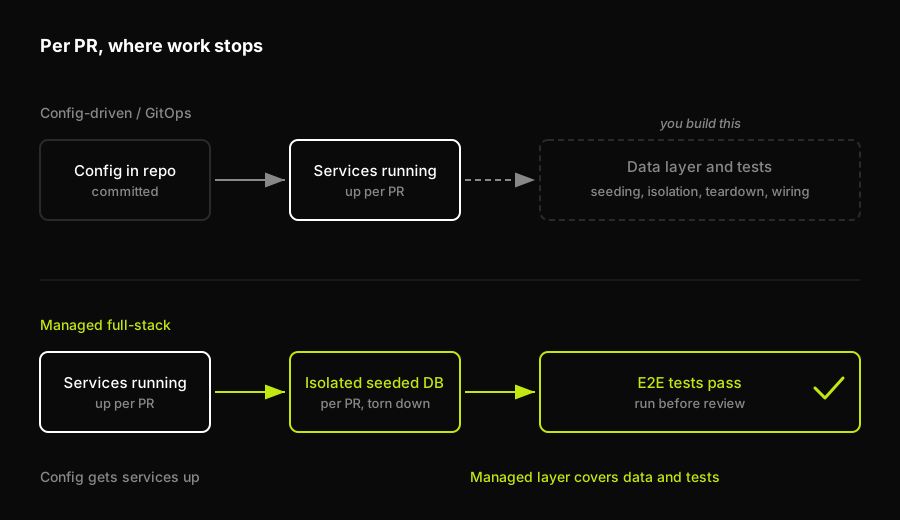
Config gets your services running per PR. The data layer and the tests are the part every config-driven vendor leaves to you.
| Dimension | Uffizzi | PreviewKit |
|---|---|---|
| Model | Config-driven, GitOps | Managed, full-stack |
| Data layer | You build seeding/isolation | Isolated DB per PR, handled |
| Test integration | Bring your own runner | E2E tests run automatically |
| Setup effort | Write and maintain config | Connect codebase, low setup |
| Self-host / OSS | Yes, self-operated | Managed (Autonoma runtime is open source) |
How PreviewKit Fits
The pain this article has been describing isn't "Uffizzi is bad at orchestration." It's that orchestration was never the hard part. The hard part is what a preview environment contains and whether anyone verifies it, and that's a different problem than the one config-driven GitOps tools set out to solve.
Autonoma's PreviewKit is our answer to that problem: a managed, full-stack preview environment product that provisions the backend, an isolated database, and any supporting services (queues, caches, workers) per pull request, then runs end-to-end tests against the result before a human ever opens the PR. We built it around four agents that handle the parts teams usually end up hand-rolling around tools like Uffizzi.
- Planner agent: reads the codebase (routes, components, the flows implied by the actual code) and plans test cases, including the database state each scenario needs, generating the endpoints required to put the DB in the right shape per test.
- Executor agent: drives those tests against the live per-PR preview.
- Reviewer agent: classifies what it finds: a real bug, an agent error, or a mismatch between the test and the current plan, so a merge decision doesn't hinge on someone manually triaging a flaky run.
- Diffs Agent: runs on every PR, updating, adding, and deprecating test cases based on what the code diff actually changed, so the suite doesn't quietly rot as the app evolves.
If your team would rather not hand-build data seeding, tenant isolation, and test wiring around an otherwise solid config-driven tool, that's specifically the gap PreviewKit is built to close. It's not a replacement for GitOps discipline elsewhere in your stack. It's a managed layer for the two things config alone doesn't solve: realistic isolated data, and verification that runs without someone remembering to trigger it.
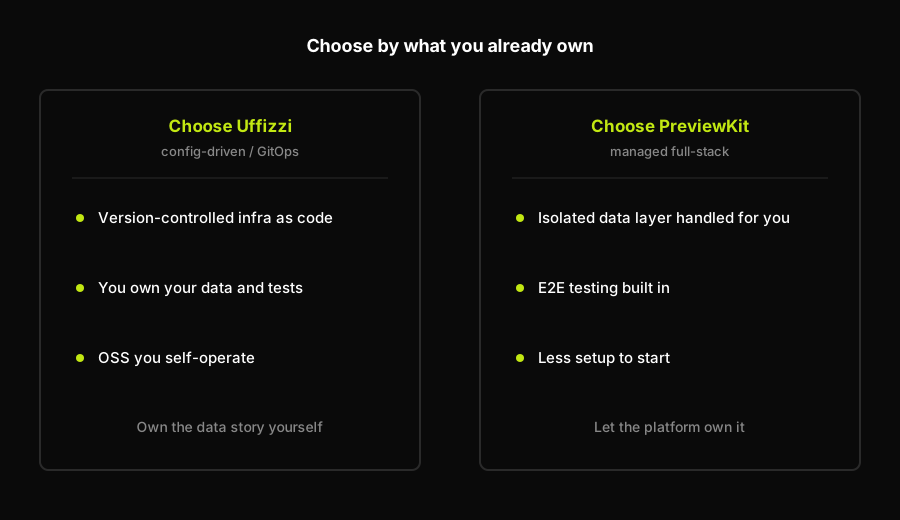
Neither column wins by default. Pick the side that matches what your team already owns and wants to keep owning.
Choose Uffizzi if...
Uffizzi is the right call if you want preview environments defined the same way you define everything else in your infrastructure: as version-controlled config, reviewed in pull requests, with no proprietary dashboard standing between you and the definition of truth. It's also the stronger fit if your team already owns a data seeding and test-running story and just needs orchestration, or if self-hosting and full operational control matter more to you than reducing setup time.
Choose PreviewKit if...
PreviewKit is the better fit if the data layer and test wiring are the parts you don't want to keep rebuilding: if every new service means another seeding script, if two engineers keep colliding on the same shared staging data, or if "the preview looked fine" has shown up in a postmortem more than once. It trades some of the config-first flexibility for a managed setup where isolated data and automated tests are the default, not a follow-up project.
A Note on Trust
We build PreviewKit, so read the above with that in mind.
We tried to describe Uffizzi's config and GitOps model the way a fair engineer evaluating it would: it's a legitimate, well-reasoned approach for teams that want infra-as-code previews and are willing to own their data and testing story. Where we think it's genuinely the better pick, for GitOps-committed teams that already have that story solved, we said so above, not as a hedge but because it's true.
The data-layer gap we describe isn't unique to Uffizzi either; it shows up in nearly every config-driven preview tool we've looked at, which is exactly why we built PreviewKit to sit on that specific ground. That's our bias, named plainly, so you can weigh the rest of this comparison accordingly.
For the wider landscape beyond this one comparison, see our roundup of ephemeral environment platforms, and how PreviewKit stacks up against other managed options in PreviewKit vs Qovery, PreviewKit vs Northflank, PreviewKit vs Release, and PreviewKit vs Signadot.
Frequently Asked Questions
It depends on the gap you're trying to close. If your team already owns a solid data seeding and test-running story and just wants orchestration, Uffizzi's config-driven model is the better fit. If the data layer and test wiring are what you keep rebuilding, PreviewKit is the alternative worth evaluating.
No, not on its own. Uffizzi orchestrates the services you declare in config, but seeding realistic data, scoping it so two open PRs don't collide, and tearing it down on merge are left for your team to build and maintain.
Yes. Uffizzi is an open-source, config-driven platform you self-operate, with the preview environment defined declaratively in a file committed to your repository and reviewed like any other code change.
No. Uffizzi gives you a live preview URL per pull request, but running a test suite against it and surfacing results to reviewers before merge is bring-your-own. PreviewKit's four agents (Planner, Executor, Reviewer, Diffs Agent) handle that step instead.


