

PreviewKit vs Qovery is a scope question before it is a feature question: Qovery is a broad platform-as-a-service that automates deployment, infrastructure, and environment orchestration across your cloud accounts, while PreviewKit is Autonoma's managed preview-environment product, built specifically for per-PR full-stack environments with isolated databases and end-to-end tests included. If you're researching a qovery alternative for previews specifically, the real decision is Qovery's deployment breadth against PreviewKit's narrower, deeper focus on the data and testing layer most PaaS platforms leave for you to build.
Most teams don't start by comparing preview-environment vendors. They start with a deployment problem, find Qovery, and like a lot of what they see: one dashboard, any cloud provider, a control plane you can run inside your own account. Then someone on the team asks the question that breaks the demo: when PR #482 needs a database seeded with realistic data and PR #483 needs a different dataset at the same time, what actually happens?
That question is where this comparison starts. Qovery answers the deployment half of the preview-environment problem thoroughly. It does not answer the data half, and it does not run your tests. We built Autonoma's PreviewKit because that gap is exactly where most engineering teams get stuck, so it's worth being specific about where Qovery is genuinely strong and where its scope runs out.
What Qovery Actually Is
Qovery is a deployment automation platform. Connect a Git repository and a cloud account (AWS, GCP, Azure, or Scaleway) and Qovery handles the build pipeline, the infrastructure provisioning, and the environment lifecycle for staging, production, and preview deployments alike. It positions itself as an internal developer platform: a control plane that runs inside your own cloud account, so your infrastructure never leaves your existing billing and security boundary.
Qovery manages application deployment, networking, environment variables, and infrastructure provisioning across a broad range of service types and cloud providers, for your entire deployment lifecycle, not just pull-request previews. Preview environments are one feature inside a much larger platform, not the whole product.
Where Qovery Genuinely Shines
Qovery's biggest advantage is breadth. It supports application types, cloud providers, and infrastructure patterns that a narrower preview-focused product doesn't attempt to cover. Teams already running production deployments through Qovery get preview environments as a natural extension of infrastructure they already understand, rather than a second system to learn from scratch.
The self-hosted control plane matters too. Because Qovery's control plane runs inside your own cloud account, teams with strict data-residency or network-isolation requirements keep infrastructure inside their existing security boundary, and configuration stays consistent across staging, production, and previews instead of diverging between how you deploy and how you preview.
For a team that wants one platform handling deployment automation across every environment type, that consistency is a legitimate reason to choose Qovery over a narrower, preview-only product.
Where the Platform Breadth Runs Out
The gap shows up the moment two PRs need different data at the same time. Qovery provisions infrastructure and deploys your services; it does not solve how each preview gets its own realistic, isolated dataset. Seeding a database per preview with data that resembles production, without exposing production, and tearing it down cleanly on merge, is left to you.
This isn't a Qovery-specific weakness. It's a category-wide blind spot. Every managed ephemeral-environment vendor we've reviewed in our full ephemeral environment platforms compared roundup handles compute and networking well and treats the database as someone else's problem.
None of them run your tests either. Qovery will deploy your PR into a live environment. It won't tell you whether the checkout flow still works once it's there.
A preview with no data isolation and no attached test run gives you a URL, not a verdict on whether the change is safe to merge.
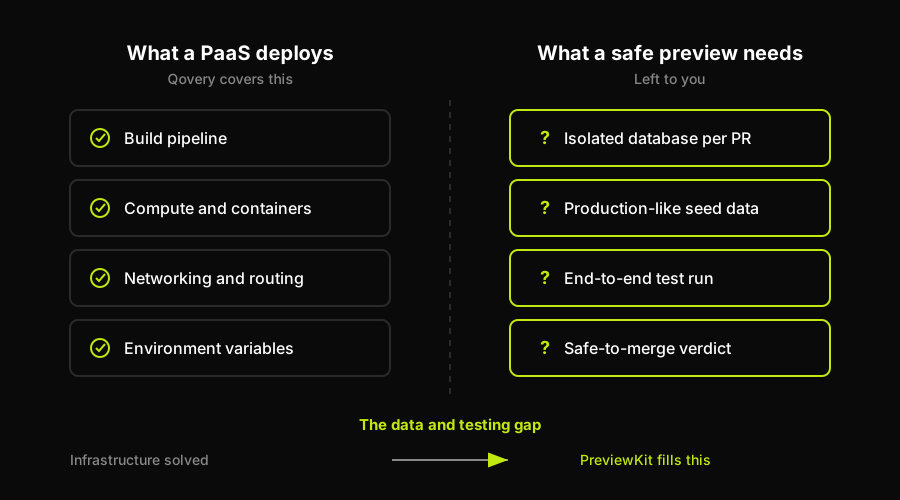
Any PaaS, Qovery included, provisions the infrastructure column. The data and testing column is left to you, and that gap is where Autonoma's PreviewKit is designed to operate.
Choose Qovery If, Choose PreviewKit If
The honest split comes down to what you're optimizing for. The table below lines up the dimensions that actually differ.
| Dimension | Qovery | PreviewKit (Autonoma) |
|---|---|---|
| Primary focus | Full deployment automation PaaS | Preview environments plus testing |
| Infrastructure control | Self-hosted, runs in your cloud | Managed, no infra to operate |
| Environment scope | Staging, production, and previews | Pull-request previews only |
| Per-preview database isolation | You build the seeding and teardown | Isolated database provisioned automatically |
| End-to-end testing per preview | Not included | Built in, agents test every PR |
| Best fit | Broad deployment automation, one platform | Previews with data and tests, zero setup |
Choose Qovery if you want one platform handling deployment automation for staging, production, and previews together, you're comfortable operating a control plane inside your own cloud account, and you're willing to build the data-seeding and test-integration layers yourself, or your stack doesn't lean heavily on stateful services that need per-preview isolation.
Choose PreviewKit if the preview environment is the whole job: you want a database per pull request that behaves like production without exposing it, and you want to know whether the change is safe to merge before a human ever opens the URL. PreviewKit doesn't try to be your production deployment platform. It does one thing, previews with real data and real test coverage, without asking your platform team to build the plumbing.
How Autonoma Closes the Data and Testing Gap
The pain this comparison keeps circling back to is simple: deployment automation is a solved problem, but getting realistic, isolated data into a preview environment, then testing what happens once it's there, is not. Qovery, like every other ephemeral-environment vendor we've evaluated, stops at the infrastructure boundary. The database and the test run are left as an exercise for the reader.
Autonoma built PreviewKit to close exactly that gap. Connect a repository and PreviewKit provisions a full-stack preview environment per pull request, backend, database, and dependent services included, with each preview's data isolated from every other open PR.
- Planner agent: reads the codebase to plan test cases for the routes and flows the PR actually touches, including the database state each test needs.
- Executor agent: runs those tests against the live preview.
- Reviewer agent: classifies what it finds as a real bug, an agent error, or a mismatch between the test and the plan.
- Diffs Agent: updates the test suite on every subsequent PR by reading the code diff, so the suite doesn't rot as the codebase changes.
Mapped against the gap this article describes: where Qovery hands you infrastructure and expects you to wire the database and CI yourself, PreviewKit provisions the isolated database and runs the tests as part of the same environment. The comparison table above reflects that difference in the two rows that matter most to a team evaluating previews specifically, not deployment breadth: data isolation and testing.
None of this is meant to read as more capable in the abstract. It's meant to read as narrower on purpose.
PreviewKit doesn't manage your production deployments, your staging environment, or your choice of cloud provider. It manages one thing end to end: the environment a pull request gets, the data inside it, and the verdict on whether that PR is safe to merge.
Each agent step carries its own verification layer, so the process stays hands-off without turning into a black box you have to trust blindly. Connect the repository, open the PR, get an environment and a test result. Nobody on the team clicks through the app, records a flow, or writes a test script by hand.
Why You Can Trust This Comparison
We build PreviewKit, so it's fair to ask why this comparison is worth reading instead of dismissing as marketing. Two reasons. First, we've been specific about where Qovery is genuinely better: broader cloud and application support, a self-hosted control plane, and one consistent deployment model across staging, production, and previews. If your team needs that breadth, Qovery is a legitimate choice and we're not pretending otherwise. It's a strong product for the job it was built to do.
Second, the data-layer and testing gap described here isn't a matter of opinion. Check Qovery's own documentation for how a database gets provisioned and seeded per preview, or how a test suite runs against one automatically. It isn't there, and it isn't there for any other vendor in this category either, which is a pattern worth noticing rather than a coincidence. That's a verifiable claim you can check yourself, not a talking point we're asking you to take on faith.
For the other head-to-head teardowns in this series, see PreviewKit vs Uffizzi, PreviewKit vs Northflank, PreviewKit vs Release, and PreviewKit vs Signadot.
If you're weighing a broad PaaS like Qovery against a product built specifically for isolated preview data and testing, the right next step usually isn't more documentation. It's a conversation about your actual stack, the shape of your data, and where each platform would actually leave you on your own.
FAQ
It depends on scope. Qovery is a broad deployment platform that covers staging, production, and previews across your own cloud account. PreviewKit is a narrower Qovery alternative focused only on per-PR preview environments, with an isolated database provisioned automatically per pull request and end-to-end tests built in. Choose Qovery if you want one platform handling deployment automation across every environment type; choose PreviewKit if the preview environment, its data, and the verdict on whether a PR is safe to merge are the whole job.
No. Qovery provisions infrastructure and deploys your services, but it does not solve how each preview gets its own realistic, isolated dataset. Seeding a database per preview with data that resembles production, without exposing production, and tearing it down cleanly on merge, is left to you. That data layer is the main gap a Qovery alternative like PreviewKit is built to close.
No. Qovery will deploy your PR into a live environment, but it will not run your test suite against it or tell you whether the change is safe to merge. A preview with no attached test run gives you a URL, not a verdict. PreviewKit runs end-to-end tests on every preview as part of the same environment.
Choose Qovery if you want one platform handling deployment automation for staging, production, and previews together, and are comfortable building the data-seeding and test-integration layers. Choose PreviewKit if the preview environment, isolated data, and end-to-end test result are the whole job.


