

WebdriverIO vs Playwright for enterprise teams is a more nuanced question than most comparison articles admit. Playwright wins on developer experience, execution speed, and modern CI ergonomics. WebdriverIO wins on ecosystem breadth, Appium-based mobile testing, multi-framework support (Cucumber, Jasmine, Mocha), and a protocol foundation that satisfies compliance teams with W3C WebDriver requirements. The decision is not "which is better" -- it is which constraints your enterprise actually has. Teams with native mobile testing needs, polyglot QA organizations, or large existing Selenium-compatible suites should evaluate WebdriverIO carefully before migrating. Teams starting fresh, running TypeScript-first, or whose biggest pain is test flakiness and CI speed should lean Playwright.
Your Playwright proof-of-concept passed. The new tests are faster, the API is cleaner, and the dev team is enthusiastic. Then someone asks about the mobile suite. Then someone else asks about Cucumber. Then compliance asks about W3C WebDriver support for the next vendor audit. The migration that looked like a 2-sprint effort is now a cross-team program with an unclear end date.
This is the pattern enterprise platform teams run into when evaluating WebdriverIO vs Playwright. The framework comparison is easy. The migration calculus -- what you're actually giving up, what you're replacing it with, and whether the replacement exists yet -- is where plans stall.
We built this article for the team that's already past the proof-of-concept stage and now has to answer the hard questions: the mobile testing gap, the reporting ecosystem, the LTS support window, and how to phase a migration without taking your QA organization offline.
Evaluating the broader migration landscape? Our Cypress vs Selenium: A 2026 Migration Playbook, Playwright vs Selenium in 2026, and WebdriverIO vs Cypress give the full multi-framework view.
Why Enterprise Teams Picked WebdriverIO in the First Place
WebdriverIO didn't win in enterprise by accident. It emerged as the answer to a specific organizational problem: Selenium is powerful but raw. It gives you a protocol and a driver. It doesn't give you a test runner, a reporter, an assertion library, or a sensible project structure. Every team using Selenium in 2015-2020 was building their own scaffolding on top.
WebdriverIO solved that. It wrapped the WebDriver protocol in an opinionated framework that enterprise teams could actually standardize on. It brought built-in test runner support, pluggable reporters (Allure, JUnit, JSON, Spec), Cucumber integration for BDD workflows, and -- critically -- Appium support baked in from the start. One team could write browser tests and mobile tests in the same framework with the same toolchain. For enterprises running both web and mobile QA, that was a meaningful consolidation.
The W3C WebDriver protocol was another legitimate advantage. Not because it's faster than Chrome DevTools Protocol (it isn't), but because it's a published standard. Procurement teams could point to it. Compliance audits could reference it. Vendors like BrowserStack, Sauce Labs, and LambdaTest had built mature support around it. WebdriverIO's position as the enterprise-grade WebDriver wrapper made it the default choice for organizations that needed a framework their vendors, auditors, and external QA partners all understood.
That context matters when you evaluate whether to migrate. Playwright's advantages are real. But some of WebdriverIO's advantages are structural -- they come from the protocol layer, not the framework layer -- and migrating the framework doesn't make those constraints disappear.
What Changed in 2026
Three things shifted the calculus enough to make this conversation worth having again.
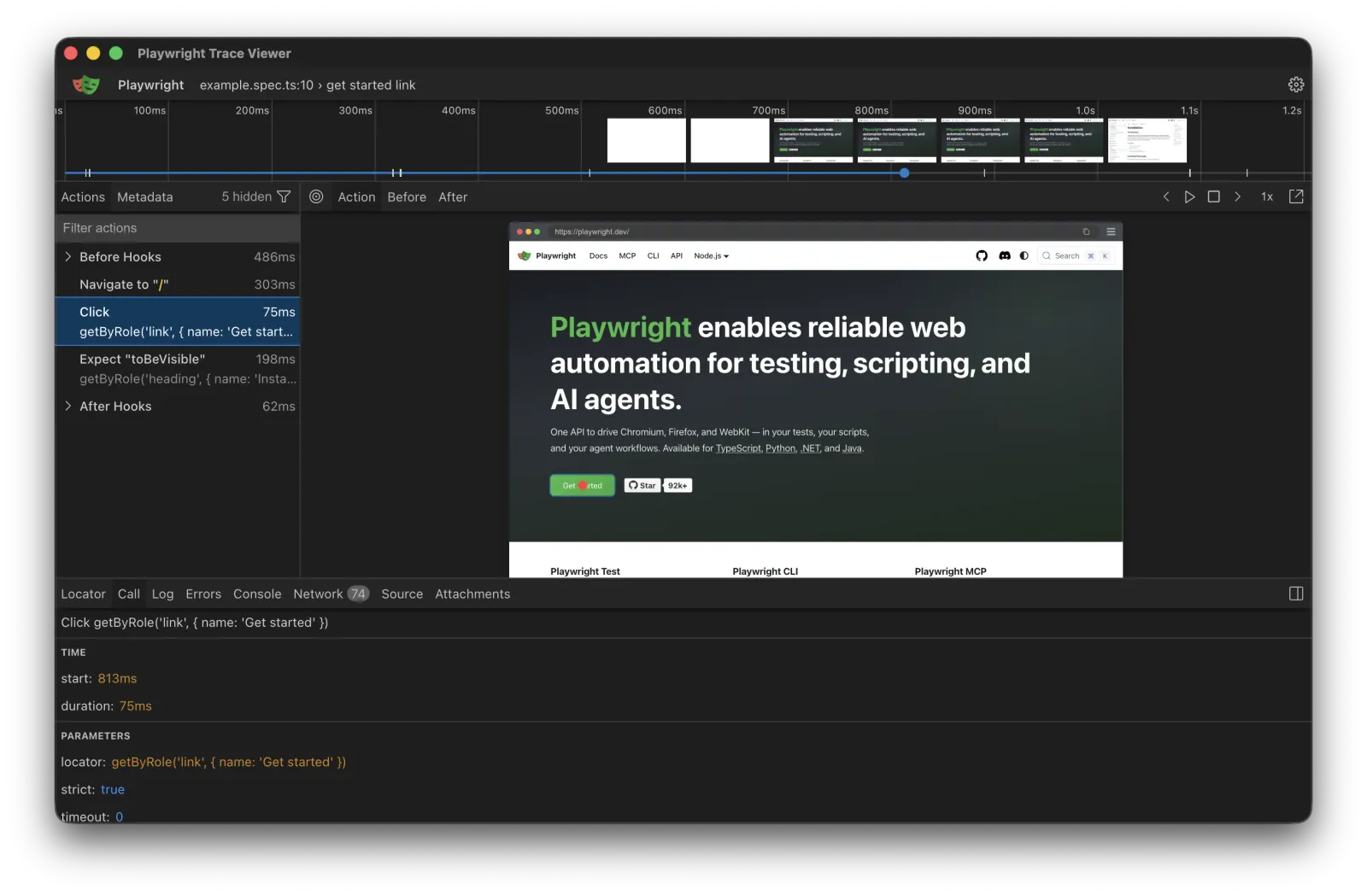
The first is Playwright's maturity. In 2021, Playwright was fast but young -- thin ecosystem, limited reporting, uncertain long-term support. In 2026, it's a different story. Microsoft is actively developing it. The ecosystem around it has grown significantly. TypeScript support is first-class. The trace viewer is genuinely one of the best debugging tools in test automation. Cloud platforms BrowserStack, Sauce Labs, and LambdaTest all support Playwright natively now -- the vendor coverage gap that held enterprise teams back in 2022 has largely closed.
The second is the cost of maintenance. Enterprise teams that ran large WebdriverIO suites through 2022-2025 encountered the same structural problem that affects all WebDriver-based tools: explicit waits, driver version management, and the 50-200ms per-action HTTP overhead that compounds across thousands of tests. Teams paying close attention to CI costs started asking whether the Appium compatibility and plugin ecosystem was worth the speed and flakiness tradeoff. For teams without significant mobile testing needs, the answer started shifting.
The third is WebDriver BiDi. WebdriverIO v9 adopted the WebDriver BiDi protocol as its default, replacing the one-way HTTP request model with real-time bidirectional communication between the test runner and the browser. BiDi standardizes capabilities that were previously CDP-only: network interception, console log capture, and preload scripts that execute before page load. For enterprise teams, BiDi matters because it partially closes the speed and capability gap that made Playwright attractive -- while preserving the W3C standards foundation that compliance teams require. It is still a W3C Working Draft with uneven browser vendor implementation, so the gap isn't fully closed. But the direction is clear: the protocol disadvantage that enterprise teams accepted when choosing WebdriverIO is shrinking.
These three shifts changed which teams should be asking the migration question at all. If you have a mobile-first QA organization with deep Appium investment, Playwright's 2026 improvements don't affect your decision much. If you're a web-only team using WebdriverIO primarily because it was the enterprise default in 2019, the calculus looks different now.
WebdriverIO vs Playwright: The Enterprise Comparison
| Dimension | WebdriverIO | Playwright |
|---|---|---|
| Protocol | W3C WebDriver (HTTP round-trips per action). Bidirectional via WebDriver BiDi in v9. | Chrome DevTools Protocol (CDP) with direct browser connections. Lower per-action latency. |
| Mobile testing | Native Appium integration. Real device testing (iOS/Android) with the same test syntax. First-class citizen. | Device emulation (viewport, user-agent, touch events). Real device testing requires Appium separately. |
| Framework integrations | Mocha, Jasmine, Cucumber built-in. BDD workflows with no extra configuration. | Built-in Playwright Test runner. Cucumber requires third-party plugins. |
| Reporting ecosystem | Allure, JUnit, JSON, HTML, Spec reporters built-in. Extendable plugin system. | Built-in HTML reporter, JUnit, JSON. Allure available via community package. |
| Community | Established enterprise community. Deep Selenium-heritage knowledge base. Strong plugin ecosystem (200+ packages). | Fast-growing. 70k+ GitHub stars. Microsoft-backed. Strongest in TypeScript/JavaScript communities. |
| Cloud platform support | BrowserStack, Sauce Labs, LambdaTest, TestingBot. Deepest cloud support in test automation. | BrowserStack, Sauce Labs, LambdaTest, Microsoft Playwright Testing. Growing but slightly behind WDIO breadth. |
| Language support | JavaScript, TypeScript. Node.js only. | TypeScript, JavaScript, Python, Java, .NET. Broader language coverage. |
| Auto-waiting | Partial. Built-in waitForDisplayed, waitForExist, but not default on every action. | Yes. Waits for element to be actionable before every interaction by default. |
| Network interception | Via mock plugin. Functional but more setup than Playwright's native route API. | Native page.route() intercepts at the browser level. Zero additional setup. |
| Test speed | Slower. WebDriver HTTP overhead per action (50-200ms). Compounds across large suites. | 30-50% faster in practice. No per-action HTTP overhead. |
| Flakiness profile | Moderate-high without explicit wait discipline. WebDriver latency adds variance. | Low. Auto-waiting eliminates most race conditions by default. |
| LTS / support policy | OpenJS Foundation project. Community-supported. No formal LTS window. | Microsoft-backed. Active development. No formal LTS but strong commercial backing. |
| Compliance posture | W3C WebDriver standard. Strong procurement and audit story. Vendor support contracts available. | No equivalent standard body backing. Harder to satisfy strict procurement checklists. |
| Migration from Selenium | Low friction. WebDriver protocol compatibility means most patterns transfer directly. | Moderate friction. Different async model, different locator API, no WebDriver compatibility layer. |
| Plugin ecosystem | 200+ packages. Services for every cloud platform, assertion library, and reporter. | Growing but smaller. First-party tools (trace viewer, codegen) are strong. Third-party ecosystem thinner. |
Which rows matter most for enterprise?
Not all 15 dimensions carry equal weight at scale. For enterprise specifically, three rows tend to be decisive.
Mobile testing is often the conversation-ender. If your QA organization tests both web and native mobile apps, WebdriverIO's Appium integration isn't a feature -- it's an architecture decision. Running web and mobile tests in the same framework, with the same reporters and the same CI pipeline, is a meaningful operational simplification. Playwright doesn't replicate that today. Device emulation covers responsive web testing adequately, but it is not a substitute for Appium-based real device testing. Teams that have built Appium suites under WebdriverIO and then evaluate migrating to Playwright quickly realize they'd be splitting their testing infrastructure in two.
Compliance posture is the second decision-driver. The W3C WebDriver standard is a real asset in regulated industries. Financial services, healthcare, and government enterprise procurement processes often require a framework with a standards body behind it, vendor support contracts, or an approved-tool list that was written before Playwright existed. WebdriverIO's position as the enterprise wrapper for a published standard is harder to replace than it looks from the outside.
Framework integrations is the third. Large QA organizations that adopted BDD via Cucumber five years ago are not going to rewrite their Gherkin test specifications because a new framework has a nicer trace viewer. WebdriverIO's built-in Cucumber support means the framework meets organizations where they already are. Playwright's answer (community plugins) is functional, but it's more friction and more maintenance surface.
All three of these constraints share a root cause: enterprise test infrastructure is expensive to build and expensive to migrate. Whether the blocker is Appium device coverage, compliance paperwork, or Cucumber scenarios that business stakeholders own, the real cost isn't the framework license -- it's the engineering time spent maintaining the suite around it. That maintenance burden is the gap Autonoma eliminates by generating and maintaining E2E coverage from your codebase, without locking your team into either framework's maintenance surface.
The Mobile Testing Story
This is where WebdriverIO holds its clearest advantage in 2026, and it's worth going deeper than the table row.
WebdriverIO's Appium integration means a single test file can target Chrome on desktop, Safari on iOS, and Chrome on Android using the same test API. The capabilities object changes. The test logic doesn't. A QA team writing a checkout flow test writes it once, then configures the browser/device matrix in their test runner config. That architecture -- write once, run on real devices -- is what enterprise mobile QA teams built around WebdriverIO in the first place.

Playwright's device emulation is genuinely useful for responsive web testing. It emulates viewport dimensions, device pixel ratios, user-agent strings, and touch events accurately enough to catch most layout and interaction bugs on mobile web. For teams testing a responsive web app and nothing else, it covers the use case without the Appium overhead.
The gap appears when the test matrix includes native apps, WebViews inside native shells, or biometric authentication flows. Playwright cannot test a React Native app's native UI elements. It cannot authenticate with Face ID. It cannot test an iOS WebView embedded in an Objective-C container. Those are Appium scenarios, and no amount of viewport emulation closes them.
Teams that discovered this gap the hard way typically end up running two parallel testing infrastructures: Playwright for web, Appium for native. That is more overhead, not less. WebdriverIO's Appium bridge is the architectural answer to that problem -- one framework, one reporting pipeline, one team.
For teams without native mobile testing needs, this entire section is a tiebreaker that doesn't break anything. For teams with native apps, it's often the entire decision. Our Appium alternatives guide covers the full mobile testing landscape if you're evaluating beyond WebdriverIO.
The Enterprise Compliance Checklist
Enterprise platform teams evaluating a framework change typically run it through procurement and security review before any tests change. Here is the checklist that actually matters in those conversations, and how each framework scores.
Protocol standardization. WebdriverIO uses W3C WebDriver, a published standard maintained by the W3C Browser Testing and Tools Working Group. It can be cited in procurement documents, referenced in compliance audits, and placed on approved-framework lists. Playwright uses Chrome DevTools Protocol with browser-native connections -- technically superior, but not a published standard with the same institutional backing.
Long-term support. Neither framework offers a formal LTS window in the way a commercial vendor would. WebdriverIO is an OpenJS Foundation project -- foundation-governed, community-maintained, open source without a commercial backer. Playwright is Microsoft-backed, which gives it a stronger commercial continuity story, but Microsoft has sunset developer projects before. Both are reasonable risks for enterprise; neither is risk-free.
Vendor support. BrowserStack, Sauce Labs, and LambdaTest all support both frameworks in 2026. WebdriverIO's support is more mature -- these platforms have been running WebDriver-based tests since before WebdriverIO existed. Playwright support has improved substantially, but if your enterprise requires a vendor support contract with SLAs tied to your testing framework, WebdriverIO's older relationships with cloud vendors are an advantage.
Audit trail and reporting. WebdriverIO's built-in Allure and JUnit reporters produce the structured test output that compliance audits and SOC 2 reporting workflows expect. Playwright's built-in HTML reporter is excellent for engineers but less native to compliance workflows. Both can produce the right output with the right configuration -- WebdriverIO just requires less configuration to get there.
Migration risk. For organizations with large existing suites, WebdriverIO's WebDriver compatibility means existing Selenium-compatible test logic migrates with lower risk. The mental model transfers. The locator patterns transfer. The explicit wait patterns transfer (for better or worse). Playwright's async model and locator API are meaningfully different -- the migration is achievable but represents a real learning curve for a large team.
Enterprise teams that have gone through this checklist and find they can answer "yes, Playwright works" to all of it should seriously consider the migration. The speed and flakiness improvements are real, and the developer experience gap has narrowed. Teams that find blocking constraints at the compliance, mobile, or BDD integration layer should not feel pressured to migrate for the sake of following the current trend.
When to Migrate -- and When to Stay
The migration question has a cleaner answer than most comparison articles give it. The constraints that genuinely block migration are narrow. Outside of them, Playwright's advantages accumulate fast enough that staying on WebdriverIO requires an active reason.
Stay on WebdriverIO if any of these apply:
Your team tests native mobile apps or WebViews alongside web tests, and the Appium integration is load-bearing. The architecture of running both under one framework is not replaceable without a significant infrastructure change.
Your QA organization runs Cucumber at scale with hundreds of Gherkin scenarios that business stakeholders own. Rewriting the test runner integration is a project, not an upgrade.
Your compliance or procurement framework requires W3C WebDriver standardization or references WebdriverIO explicitly on an approved-framework list. That list doesn't update on your migration timeline.
Your existing suite has 3,000+ tests passing reliably and the migration validation effort would take six months or more. At that point, the Playwright speed and flakiness improvements need to be weighed against real migration cost -- and for suites that are already clean, the ROI math is less clear.
Migrate toward Playwright if any of these apply:
Your web testing is browser-only with no native mobile requirements. Playwright's device emulation covers your use case, and you're leaving speed and reliability on the table by staying on WebdriverIO.
Your CI suite is slow and flaky and the explicit-wait overhead is the root cause. Playwright's auto-waiting removes this entire category of pain. The E2E Testing Tools: 2026 Buyer's Guide shows the speed delta in concrete benchmarks.
You are starting a new product or platform from scratch. There is no migration cost, only setup cost. Playwright's modern developer experience, trace viewer, and TypeScript-first design make it the stronger starting point for new test suites in 2026.
Your team is TypeScript-first and the Node.js constraint doesn't affect you. WebdriverIO's Node.js-only runtime is fine for JavaScript and TypeScript shops, but Playwright's multi-language support gives larger organizations more flexibility.
The honest version of the middle ground: if your suite is medium-sized (500-2,000 tests), web-only, and running on a modern CI platform, the migration is a reasonable 2-3 month project that will likely pay back in reduced flakiness triage and faster CI within a quarter. Neither option is wrong -- but doing nothing while your CI gets slower and your flaky test backlog grows is the option with the clearest cost.
Migration Effort Estimation
| Suite Size | Timeline | Complexity Multipliers | Recommended Approach |
|---|---|---|---|
| Under 500 tests | 4-6 weeks | Custom plugins, unique reporter configs | Full migration with 1-week parallel validation |
| 500-2,000 tests | 2-3 months | Cucumber integration, custom services | Phased by product module, 2-week parallel period |
| 2,000-5,000 tests | 4-6 months | Appium dependency, enterprise reporting, vendor SLAs | Staged rollout with dedicated migration team |
| 5,000+ tests | 6-12 months | All of the above plus multi-team coordination | Evaluate whether partial migration is more practical than full |
These timelines assume a parallel running strategy where both frameworks operate simultaneously during the transition period. Teams that have completed WebdriverIO-to-Playwright migrations report 40-50% reductions in suite execution time post-migration -- but the migration itself is a real engineering investment, not a weekend project.
Bottom line: Choose WebdriverIO if you need Appium mobile testing, Cucumber BDD at scale, or W3C compliance. Choose Playwright if you're web-only, TypeScript-first, and CI speed matters most. For teams where test coverage capacity and maintenance burden are the real constraints, Autonoma is a different category worth evaluating.
The Third Option for Enterprise Teams
The migration conversation itself has a hidden assumption: that your team will continue writing and maintaining test files. That assumption is worth questioning in 2026.
Enterprise teams typically have a large backlog of untested flows alongside their existing test suites. New features ship faster than tests are written. The QA team triages flaky tests instead of covering new risk. The framework choice becomes secondary when the real constraint is coverage capacity -- not which tool runs the tests, but who writes them and who keeps them passing.
Autonoma operates at that layer. Instead of choosing between WebdriverIO's ecosystem breadth and Playwright's speed, the Planner agent reads your codebase, plans test cases from your routes and components, and the Executor agent runs them against your running app. The Diffs Agent keeps tests passing as your code changes, updating or deprecating test cases from each pull request. The framework underneath is not your problem -- Autonoma handles it.
For enterprise teams who have evaluated both WebdriverIO and Playwright and found that neither solves the coverage and maintenance problem at scale, Autonoma is worth a separate evaluation. It's not a replacement for hand-written specialized tests. It's the layer that covers the routine flows your team doesn't have bandwidth to script and maintain -- so your engineers can focus on the edge cases that actually require bespoke logic.
The three tools aren't competing for the same job. WebdriverIO and Playwright are frameworks you operate. Autonoma is a testing layer you connect your codebase to.
For a deeper look at the Playwright vs Selenium axis, including the cost math for large suites: Playwright vs Selenium in 2026: The $216K Maintenance Tax. For the component testing layer: Storybook vs Playwright Component Testing.
Closing Recommendation
Enterprise teams picking between WebdriverIO and Playwright in 2026 should run the decision against their actual constraints, not the benchmark numbers.
If mobile testing, BDD at scale, or W3C compliance are real requirements -- not theoretical ones -- WebdriverIO is the right call. It was built for the enterprise testing surface, it integrates with the tools enterprise QA teams already use, and it doesn't require a framework migration to keep working.
If those constraints don't apply, Playwright is the stronger foundation for web-focused E2E testing in 2026. The speed advantage, auto-waiting, and debugging tools (trace viewer, VS Code extension, codegen) represent a genuine improvement in both developer experience and test reliability. The full comparison picture, including Cypress, is in our Selenium vs Playwright vs Cypress breakdown.
For teams who find they're spending more time managing test infrastructure than writing tests -- regardless of which framework they're on -- the conversation shifts. The framework question becomes less important when the real constraint is capacity. Both frameworks demand engineering ownership. If that ownership cost is the problem, the tooling category to evaluate is different from either option compared here. See the Playwright vs Cypress 2026 comparison for the latest on the modern-framework side of this decision.
Yes, in specific contexts. WebdriverIO remains the best answer for enterprise teams with native mobile testing needs (via Appium), Cucumber-based BDD workflows at scale, or compliance requirements tied to W3C WebDriver standardization. For web-only teams, Playwright's speed and developer experience advantages have grown substantial enough that WebdriverIO's relevance has narrowed -- but the Appium integration story remains a genuine differentiator that Playwright doesn't replicate.
No, not natively. Playwright has built-in device emulation that covers viewport, user-agent, touch events, and device pixel ratio -- sufficient for responsive web testing. For real device testing on iOS and Android, or for native app testing, Playwright does not integrate with Appium. Teams needing real device coverage with Playwright must run Appium as a separate infrastructure alongside it. WebdriverIO's Appium integration -- running both web and native mobile tests in the same framework -- is a meaningful architectural advantage for mobile-first QA organizations.
Both frameworks are well-supported on BrowserStack, Sauce Labs, and LambdaTest in 2026. WebdriverIO's cloud support is more mature -- these platforms built around WebDriver-based testing before WebdriverIO existed, and the integration depth shows in feature parity and documentation quality. Playwright's cloud support has improved significantly, and Microsoft's own Playwright Testing service adds a first-party cloud option. For enterprise teams requiring deep vendor SLAs or advanced cloud features, it's worth checking your specific vendor's current feature matrix rather than assuming parity.
Harder than WebdriverIO-to-Playwright migration guides typically suggest. The WebDriver mental model (create driver, manage lifecycle, add explicit waits, call driver.quit()) is meaningfully different from Playwright's fixture-based async model. Locator patterns change. The async model changes. Network mocking moves from a proxy-based approach to a built-in route API. For a 500-test suite, expect 2-3 months for a careful migration with validation. For suites with Cucumber integration, factor in time to evaluate and configure the Playwright-Cucumber plugin. The migration is achievable and often worth doing -- but it's not a mechanical find-and-replace.
Autonoma is a different category of tool -- it's a test generation and maintenance layer, not a framework you configure and own. It connects to your codebase, plans tests from your routes and components, executes them against your running app, and keeps them passing as your code changes. For enterprise teams spending significant engineering time on test maintenance, flakiness triage, or coverage gaps in routine user flows, Autonoma addresses the capacity problem that WebdriverIO and Playwright both leave unsolved. It doesn't replace specialized hand-written tests that require bespoke logic. It covers the surface area your team doesn't have bandwidth to script -- and does it without you picking a framework, managing a Grid, or tuning explicit waits.
Yes. WebdriverIO has strong TypeScript support with first-class type definitions. The framework is Node.js-only, which means it doesn't support Java, Python, or other languages at the test-writing level. Teams that need to unify QA work across multiple programming languages -- a common enterprise scenario -- will find Playwright's broader language support (TypeScript, JavaScript, Python, Java, .NET) more flexible, though WebdriverIO's TypeScript experience is solid for JavaScript-first organizations.
WebdriverIO has a clear advantage here. Cucumber is a first-class built-in framework in WebdriverIO -- no plugins, no extra configuration, just specify cucumber in your wdio.conf.js runner config. Playwright's Cucumber support is available via community packages that work well but add an extra dependency and maintenance surface. For enterprises that have adopted BDD at scale, with Gherkin scenarios owned by business stakeholders, WebdriverIO's native integration is operationally simpler and more stable over long maintenance windows.
Playwright is consistently 30-50% faster on equivalent test suites. The speed difference is architectural: WebdriverIO uses the WebDriver HTTP protocol, which adds 50-200ms of round-trip latency per action (click, type, assert). Playwright uses Chrome DevTools Protocol with direct browser connections, eliminating that per-action overhead. On a 1,000-test suite running 8 times per day, that overhead compounds into hours of CI time and significant compute cost. Playwright's auto-waiting also reduces the explicit-wait retry loops that inflate WebdriverIO suite runtimes.


