

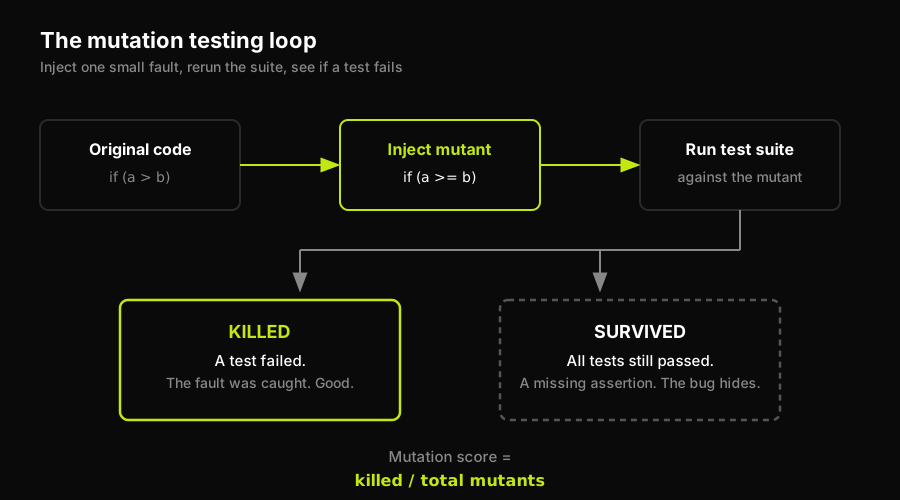
Mutation testing vs code coverage: code coverage measures which lines your tests executed; mutation testing measures whether your tests would actually fail if the code were wrong. A mutation testing tool injects small faults into your code (flipping a > to >=, swapping a + for a -) then reruns your suite. Each fault is a "mutant." Mutants your tests catch are "killed"; mutants that slip through are "survived." Your mutation score is killed mutants divided by total mutants. It is the only metric that directly measures test effectiveness, not just test activity.
This article is for teams that already have tests. Lots of them. Green ones. Many generated or scaffolded by an AI coding assistant. And a creeping suspicion that the coverage number on the dashboard does not mean what it used to mean.
The emotional position here is not "I have no tests." It is "I thought I was covered and I am not." That distinction matters, because the fix for the second case is different from the first. You do not need more tests. You need to know whether the tests you have are capable of failing on the bugs that matter.
Autonoma was built to address exactly that gap at the E2E layer, and mutation testing is the closest structural analogue at the unit layer. Both are forms of independent verification. Understanding one helps you understand the other.
How mutation testing works
A mutation testing tool takes your codebase, clones it, and introduces one small deliberate fault per clone. Each clone is a mutant. The kinds of changes are simple by design: flip a > comparison to >=, replace a && with a ||, swap + for -, delete a return statement, negate a boolean. These are exactly the kinds of off-by-one errors, inverted conditions, and missing branches that make it into real production bugs.
For each mutant, the tool runs your full test suite against the modified code. If any test fails, the mutant is killed. The test suite detected the fault. If the entire test suite passes on the mutant, the mutant survived. That means your tests ran, touched the mutated line, and still reported green. There is nothing between that bug and production except luck.
Mutation score is the ratio: killed divided by total. A score of 40% means 60% of the faults your tool introduced were invisible to your tests. Your coverage number tells you nothing about this. A line can be executed in a test and still have zero surviving-mutant detection if the test never asserts a meaningful outcome from that line.
| Metric | What it measures | What it misses | Useful for |
|---|---|---|---|
| Code coverage | Lines/branches executed | Whether assertions are meaningful | Finding untested paths |
| Mutation score | Whether tests can fail on faults | Integration and E2E behavior | Measuring assertion strength |
The AI-generated-tests result
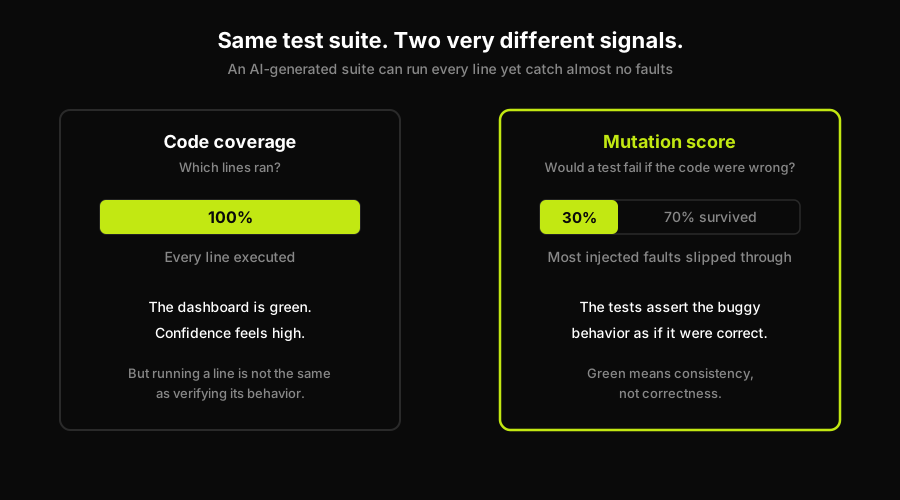
Here is the pattern we see repeatedly in teams that adopted AI coding assistants over the past year. Coverage goes up. Mutation score, when anyone bothers to measure it, is low. In the kind of suite we see from AI-assisted codebases, illustrative mutation scores in the 20-40% range are common for AI-generated test files, compared to 60-80% for tests written deliberately by engineers who were thinking about what could go wrong.
The structural reason is not hard to understand. When the same model writes the function and writes the test, the model's implicit understanding of what the function does becomes the expected value in the assertion. If the model slightly misunderstood the business rule while writing the code, it will equally misunderstand it while writing the test. The bug becomes the specification. The test passes because it is asserting the buggy behavior as correct.
This is the cluster spine underneath all of this: AI verification is only trustworthy when it is independent of the thing being verified. Green means consistency, not correctness. A mutation testing tool provides that independence at the unit level by asking whether the test can fail, not whether it ran.
Autonoma applies the same boundary outside the unit layer. Mutation testing asks whether a unit test can detect a synthetic fault. Our agents ask whether the full application flow fails in a running preview when user-visible behavior diverges. One audits assertions; the other adds the independent E2E signal those assertions cannot supply.
The teams we work with name this precisely. One security engineering team put it this way: "That test passes and it asserts something, but it is not really asserting what it should be asserting." Another team described the downstream consequence: "It does not cover the business case... our QA engineers are still finding things." High coverage, survived mutants, bugs in production.
If you want more context on why line coverage specifically misleads, the code coverage misleading ai tests post goes deeper on the coverage-as-proxy failure mode. The related problem of assertions that exist but do not verify the right thing is covered in our assertion coverage vs line coverage analysis.
Running it: Stryker and PIT
The two most widely used mutation testing tools are Stryker for JavaScript and TypeScript projects, and PIT (PITest) for Java. Both follow the same pattern: configure the tool, point it at your source and test directories, and run. The output is a report, generated per file, showing each mutant that survived with the exact line and the change that was made.
Reading that report is the important skill. Do not look at the percentage first. Look at the survived mutants. Each one is a specific question: "If I flip this comparison, would any of my tests catch it?" If the answer is no, you have identified a missing assertion. Chase survived mutants, not the aggregate score.
Stryker's HTML report shows surviving mutants inline in the source file, color-coded. PIT produces a similar HTML report. Both make it straightforward to see which lines have assertion coverage and which are tested only in the coverage sense of "a test called this code." The difference between those two things is the entire point.
For tautological tests specifically, mutation testing is the most direct diagnostic: a test that does not assert a specific value will survive every value-change mutant. The mutation report will show a cluster of survived mutants on a function whose coverage is 100%.
When mutation testing is worth the cost
The honest constraint is runtime. A mutation testing run on a module with 50 mutants means running your full suite 50 times. On a large codebase, a full mutation run can take hours. That is not a CI-per-PR budget.
That is also the boundary where Autonoma belongs in the stack. Use mutation testing as a sampled unit-layer audit on critical modules. Use our four-agent E2E layer on every PR to verify the flows those modules feed: checkout, auth, permissions, billing, and any behavior that only becomes meaningful in the running application.
The practical strategies are: run mutation testing only on critical modules (auth, billing, data-processing pipelines), run it on changed files only as an incremental mode (Stryker supports this via its --since flag), run full suite nightly rather than per-PR, or sample a random subset of mutants per run and accept the statistical approximation.
The goal is not to achieve 100% mutation score across every file. The goal is to use the tool to audit the quality of your test suite in the areas that matter most. A 70% mutation score on your checkout flow is worth more than a 95% line coverage number that includes trivially-covered getters and constructors.
From a test automation metrics standpoint, mutation score is the metric closest to "fraction of production bugs that would be caught before deployment." That is the number that matters, and it is the number that code coverage cannot approximate.
How Autonoma applies the same principle at the E2E layer
Mutation testing proves that a unit test can fail when the code is wrong. That is a necessary condition for a useful test suite. It is not sufficient. A module with a high mutation score can still participate in a broken user flow, because the mutations it tests are within that module's scope. The user-visible behavior of a checkout, a permission boundary, or a pricing calculation emerges from many modules together, and no unit-level mutation tool reaches across that boundary.
At Autonoma, we apply the same independent-verification principle at the E2E layer. The Planner Agent reads the codebase directly, including routes, components, and user flows, and derives test cases from the code structure rather than from the model that wrote the feature. The Executor Agent executes those test cases against a managed preview environment per PR. The Reviewer Agent evaluates failures and filters false positives. The Diffs Agent keeps the suite current as code changes, without manual maintenance. The result: E2E tests whose quality is measured by the real bugs they surface against real user-facing outcomes, not by a coverage number. The suite is independent of the feature it is verifying, which is the same property mutation testing enforces at the unit layer.
Frequently asked questions
Mutation testing is a method for measuring test suite effectiveness. A tool introduces small deliberate faults into your code, one at a time, and reruns your tests against each modified version. A fault that causes a test to fail is a 'killed mutant.' A fault that all tests pass on is a 'survived mutant.' The mutation score is the percentage of mutants killed. A high mutation score means your tests can detect the kind of subtle faults that reach production. A high code coverage number with a low mutation score means your tests execute the code but do not verify its behavior.
For measuring test quality, yes. Code coverage tells you which lines ran during testing. It does not tell you whether a test would fail if that line's behavior changed. Mutation testing directly answers whether your tests are sensitive to faults. A test suite with 90% coverage and 30% mutation score is far weaker than one with 70% coverage and 75% mutation score. The practical limitation of mutation testing is cost: full runs are slow on large codebases. The best approach is to use code coverage to find untested paths and mutation testing to audit assertion strength in critical modules.
There is no universal standard, but most practitioners treat 70-80% as a strong target for critical modules, and 60-70% as acceptable for general application code. Scores above 80% are achievable but increasingly expensive to maintain. More important than the aggregate percentage is the distribution: a 50% score where all survived mutants are in trivial getters is very different from a 50% score where half the business-logic mutations survive. Read the report, not just the number. Chase survived mutants in high-risk areas first.
Commonly, yes. The structural reason is that the model generating the test has an implicit model of what the code does, derived from writing or reading it. That model becomes the expected value in the assertion. If the code contains a subtle bug, the test is likely to assert the buggy behavior as correct because the model did not know it was wrong. Mutation testing catches this because it introduces faults the model did not anticipate. Independently written tests, where the assertion was derived from requirements rather than from reading the implementation, tend to have significantly higher mutation scores.
For JavaScript and TypeScript, install Stryker via npm and run its configuration wizard to generate a config file. Point it at your source and test directories and run the mutation command. For Java, add the PIT plugin to your Maven or Gradle build and run the mutation goal. Both tools produce HTML reports showing survived mutants per file. Start by running on a single module, not the full codebase, to understand the runtime cost and output format before committing to a wider rollout. Incremental mode (changed files only) is available in both tools and is the recommended approach for CI integration.


