

Shift-left QA without a QA team means giving every pull request production-like E2E coverage that someone has to plan, run, and keep current, without hiring anyone to do it. For a team of 3 to 20 engineers, Autonoma is the product that owns that entire job: it provisions a managed preview environment per PR with isolated database state, and its agents generate, run, and self-heal the tests straight from your codebase. For the concept and history behind the practice, see Shift-Left Testing for Small Engineering Teams.
Picture a three-person team: one engineer owns the backend, one owns the frontend, one does both and also handles deploys. No one is assigned to QA, so "we don't have any QA" is not a complaint. It is just a description of the org chart.
For a team like this, production is the test environment and a customer is the test runner. A bug ships, a support message lands, someone drops what they were building to chase it. Everyone knows they should "shift left" and catch these things earlier. The advice is sound. The problem is what it quietly asks you to build.
Shifting left sounds like "just add tests." It's actually building a QA department.
It is Wednesday afternoon. A deploy goes out, nothing looks wrong, everyone moves on. The regression actually shipped on Monday, but no one catches it until Thursday morning, when a customer emails to say the invite flow has been throwing an error for two days. Now the frontend engineer drops the feature they were mid-way through, context-switches into code they last touched a week ago, reproduces the bug, traces it to the Monday change, writes the fix, and waits on a deploy. Call it half a day of focused work, plus the half-built feature that now has to be picked back up cold. That is the visible cost. The invisible cost is the customer who already forwarded the broken screenshot to the colleague who was evaluating you, and the quiet sense on the team that they cannot actually see what they ship until someone outside the company sees it first.
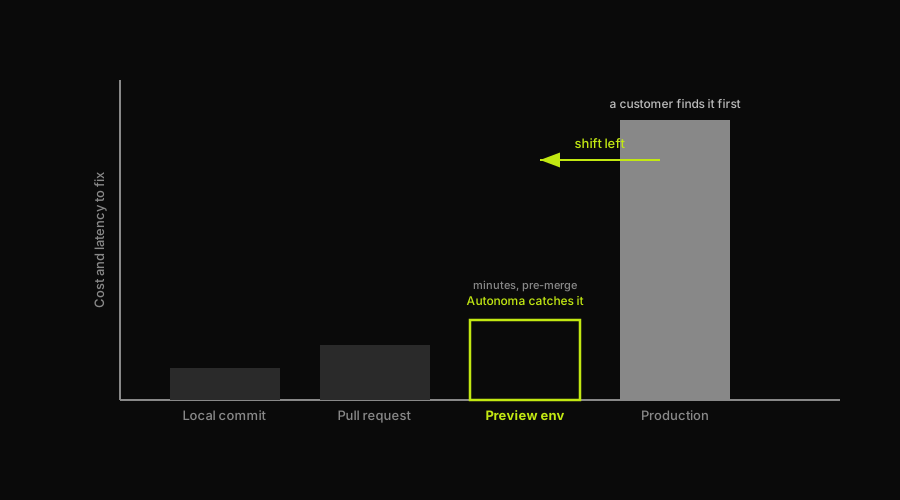
The later a bug is caught, the more it costs; Autonoma catches it pre-merge.
Shifting left means catching bugs at the pull request stage instead of in production. To actually do that for a web product, "add some tests" expands into a stack of jobs:
- Author the E2E scenarios. Someone has to learn Playwright or Cypress well enough to write signup, checkout, the dashboard, and the edge cases, then keep writing them as the product grows. On a three-person team that someone is already the person shipping the most features, and every hour spent learning a test framework is an hour off the roadmap.
- Stand up a production-like environment per PR. Real tests need a real running app, not a local dev server with fixture data. That means a preview deploy and a database for every branch, which is its own infrastructure project nobody scheduled.
- Isolate database state. Each preview needs its own data so tests do not collide or corrupt shared state. Now you are wiring database branching into CI, debugging seed scripts, and explaining to the team why the test database is in a weird state again.
- Trigger it all on every PR. A GitHub Action to provision the environment, seed the data, run the suite, and report back, plus the afternoon you lose every time the workflow YAML silently breaks.
- Maintain the suite forever. The UI changes every sprint. Selectors break. Someone keeps the tests green, or they rot and get ignored within a month, and a month later the green check mark means nothing because half the suite is skipped.
Each of those is a real job. Stitched together with Playwright, Vercel, Neon, and a pile of GitHub Actions, what you have built is a half-finished QA function: a stack the team now owns, debugs, and maintains. That is the exact role you do not have the headcount to fill. The DIY shift-left stack does not remove the QA job. It just hands it to the engineer who least has time for it.
And the team knows all of this. They know they should test more. They have started three different testing setups and abandoned each one, not because they do not care, but because the setup itself became a second job on top of the one they were hired for. Every attempt begins with good intentions and a fresh branch and ends a few weeks later with a half-wired pipeline no one trusts and a quiet agreement to deal with it after the next release. The guilt compounds faster than the coverage does.
What shifting left actually requires
Strip away the tools and the durable requirement is simple. To genuinely catch bugs before they reach a customer, a small team needs coverage that is:
- Production-like. It runs against a real environment with a real database shape, not a mocked dev server, so a passing test actually means something.
- Generated, not hand-written. Nobody on a small team has the hours to author and grow a scenario library by hand.
- Self-maintaining. When the product changes, the coverage updates itself instead of breaking and demanding attention.
- Automatic on every PR. It runs on each change without a human remembering to trigger it.
That list is a job description. It is what a QA function would own. The honest version of "shift-left QA without a QA team" is not a clever combination of free tools. It is finding a way to fill that role without filling a seat.
How Autonoma gives a no-QA team a full shift-left QA layer
Autonoma is built to be exactly that missing role. You connect your repository once, and three agents take over the work a QA function would do.
The difference is concrete. Before Autonoma: the deploy goes out, the PR is merged, and the team crosses its fingers. After Autonoma: the PR opens, a preview environment spins up, the Planner reads the diff, the Automator runs the checkout and onboarding flows against it, and the Maintainer quietly updates any selector that moved, all before you click Merge. The flows worth covering are the ones a customer would notice, like user signup, checkout, billing, and settings. You did not write a line of test code to get there.
The Planner reads your codebase (routes, components, API endpoints, user flows) and derives the test scenarios from what the code actually does, not from a prompt someone wrote. It also generates the database-state setup endpoints each scenario needs, so a test can put your data in the right shape before it runs. The Automator executes those scenarios against your running application, with verification at each step so results are consistent. The Maintainer self-heals the tests when your UI changes, so coverage survives next sprint's refactor instead of rotting. No human writes the suite, runs it, or keeps it current.
That maintenance step is the one that usually kills a hand-rolled suite, so it is worth being concrete. When your payment modal becomes an inline form next sprint, the Maintainer agent self-heals the affected test on its own, so the coverage keeps passing. No ticket. No broken test blocking the merge. No maintenance sprint that gets scheduled and then skipped.
All of that runs on a managed preview environment per pull request, with isolated database state, provisioned by Autonoma. This is the part that would otherwise be a Vercel-plus-Neon-plus-GitHub-Action project of its own. We built it into the same control plane: the preview environment exists and gets tested in one product, so the team never wires the environment, the database isolation, and the test runner together themselves.
That collapses the entire DIY stack from the previous section into one connection. The QA function's pre-release loop, authoring, running, maintaining, and the production-like environment to run against, becomes a single product instead of five jobs the team owns.
Here is what the first week actually looks like. You connect the repo. Autonoma reads your route tree, identifies the flows that matter most, generates the first test suite, and runs it on your next PR. You did not write a single line of test code, schedule a testing sprint, or hire anyone. The coverage simply shows up attached to the next pull request.
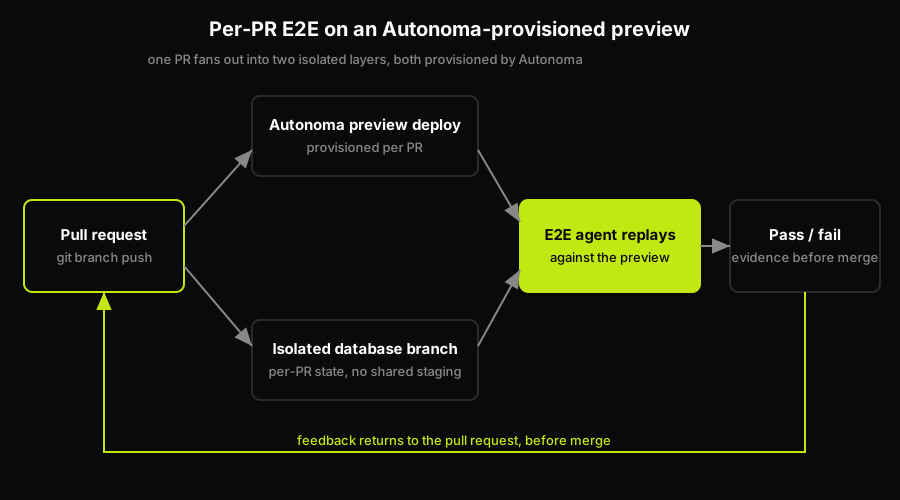
Every PR gets a preview, isolated data, and E2E evidence before merge.
For the broader AI E2E testing landscape in 2026, including how different tool architectures compare, see AI E2E Testing and the LLM-Agent OSS Wave.
What you still keep locally
Autonoma owns the pre-release coverage, but two cheap local habits are still worth keeping, and Autonoma deliberately does not try to replace either.
Pre-commit hooks (husky plus lint-staged running tsc --noEmit, ESLint, and fast unit tests on staged files) give sub-10-second feedback in the editor before a commit ever leaves the machine. That is local hygiene, not E2E coverage. Autonoma is not a unit-test runner and does not pretend to be one, so this stays the team's. And Claude Code remains a handy way to draft test stubs from a diff at PR time: a complementary, AI-assisted authoring aid bounded by what the developer described in the prompt, useful for fast stubs but not a substitute for coverage that is generated from the codebase and self-heals on its own.
Getting started
Connect the repository once. From the next pull request, every change gets production-like E2E coverage on an Autonoma-provisioned preview environment, the scenario library grows as the codebase grows, and the suite self-heals through refactors. A no-QA team ends up with what a QA function would produce, without the headcount and without a DIY stack to maintain.
That is the shortest honest path to shift-left QA when there is no one to assign it to: stop trying to assemble a QA department from free parts, and hand the role to the product built to be it.
The math is simple
Put a number on it. One production bug that churns a paying customer is rarely a small number: lost revenue on that account, plus the engineer-hours spent on the 11pm hotfix, plus the deals that quietly die because a prospect saw the broken flow during a trial. Call it real money and a dent in trust you cannot fully measure. The value of catching it on the PR is that the check runs before the bug ships, not after.
The alternative is the DIY path. You could spend two sprints building a Playwright suite, wiring Neon database branching, standing up preview environments, and writing the GitHub Actions to glue it together, and then own that stack forever. Or you could connect a repo and get the same result, with the maintenance handled for you.
The only real question is whether you start before or after the next production regression finds your users for you.
FAQ
The durable answer is to give every pull request automated, production-like E2E coverage that you never have to author or maintain by hand. Autonoma owns that whole job: its Planner reads your codebase and derives the test scenarios, the Automator runs them on a managed preview environment with isolated database state, and the Maintainer self-heals them as your UI changes. The only thing worth adding alongside it is a set of pre-commit hooks (tsc, ESLint, and fast unit tests via husky and lint-staged) for sub-10-second local feedback. That is shift-left QA without hiring a QA team.
There is one load-bearing move: automated, production-like E2E coverage on every pull request. For a no-QA team the cheapest way to get it is Autonoma, which plans, runs, and self-heals that coverage so no one has to write or maintain a test suite. The only other thing worth doing on day one is adding pre-commit hooks (tsc plus ESLint plus fast unit tests, gated by husky and lint-staged) for instant local feedback. Everything else can wait.
Yes, with a structural limitation. Claude Code can generate test stubs at PR time from a diff, and a reusable CLAUDE.md prompt makes that repeatable. The gap is that Claude Code covers the scenarios the developer described in the prompt, not the corner cases that weren't mentioned. It is a complementary, AI-assisted authoring aid: handy for fast stubs, but it does not produce self-healing coverage that survives UI changes the way Autonoma's agents do. Treat it as a developer convenience, not as a substitute for automated E2E coverage.
PR-level testing is automated test execution triggered by a pull request, running against a preview environment spun up for that branch. It gives every code change a production-like validation before it is merged. For a no-QA team, PR-level testing is the mechanism that replaces the QA team's pre-release test cycle: instead of a person running tests before each release, automated agents run tests on every PR. The key requirement is environment fidelity: the preview must mirror production closely enough that a test passing on it means something.
Less than you would expect, and far less than the alternative. The real cost of DIY shift-left is not a tool license, it is the engineering time spent wiring and maintaining a preview environment, database seeding, and a test suite that someone keeps current. Autonoma removes that cost: its managed preview environments provision a per-PR environment with isolated database state out of the box, and its agents author and maintain the E2E coverage for you. Pre-commit hooks (husky, lint-staged) are free and open source. The bigger saving is the engineering time you never spend building and maintaining that stack yourself.


