

Test case management best practices come down to six habits: write atomic test cases that check one thing, define clear preconditions, maintain traceability back to requirements, version cases alongside releases, run a fixed review cadence, and prune cases that no longer match the product. The habit most checklists skip is what happens after the cases are written: keeping them in sync as the product keeps changing underneath them.
A test suite doesn't rot because someone wrote bad test cases. It rots because the product moved and the cases didn't move with it. A field gets renamed. A confirmation step gets removed. A new pricing tier ships with different upgrade logic. None of that shows up as a failing test. It shows up as a test that still passes while checking behavior the app no longer has, which is worse than an obvious failure because nobody goes looking for it.
Most test case management advice stops at hygiene: write clear titles, add preconditions, keep cases in a shared system instead of someone's laptop. That advice isn't wrong. But treating it as the finish line is how teams end up with a beautifully organized case library that's quietly describing last quarter's product. The practices below cover the hygiene, then get to the part most checklists leave out entirely: what to do about test maintenance once the product stops holding still.
That is also where Autonoma enters the conversation. It does not replace manual case management for exploratory work or audit records; it removes the maintenance loop for the automated E2E slice by generating and updating those cases from the codebase itself.
If you want the step-by-step workflow from requirement to execution, that's covered separately in our test planning workflow guide. This piece assumes you already have a workflow and focuses on the narrower question of what keeps the case library itself trustworthy a year in, not a week in.
The core best practices
Six habits carry most of the weight in test case management. Get these right and the rest is mostly bookkeeping.
-
Write atomic test cases. One case checks one behavior, with one clear pass or fail condition. "Test the checkout flow" is not a test case, it's a description of a project. "Cart total updates to $60.00 after quantity is changed from 2 to 3 on a $20.00 item" is a test case. A solid test case template forces this discipline structurally, because the field layout doesn't leave room for a vague, multi-outcome row.
-
Define clear preconditions. State exactly what condition the system must be in before the steps run: which account, which data, which prior action. Skip this and the same steps against a different starting state produce a different result, which means the case isn't actually reproducible. It just looks like it is until two people run it on different days and disagree about what happened.
-
Maintain traceability. Every case should trace back to the requirement, user story, or flow it verifies, and ideally forward to the bug reports it has caught. Traceability is what lets you answer "did we test this?" during an audit or an incident review without re-reading the whole suite. Without it, coverage becomes a claim nobody can check.
-
Version cases alongside the product. A test case written against v2 of a signup form shouldn't silently keep applying to v3. Cases need a version or a last-reviewed date tied to the release that shaped them, the same way code carries a commit history.
-
Run a review cadence. Pick an interval, tied to sprints or releases rather than a calendar date nobody remembers, and actually look at what's stale. A quarterly pass that nobody owns will not happen consistently enough to matter.
-
Prune aggressively. A case describing a feature that shipped and got removed six months ago isn't neutral. It's actively misleading, because it makes coverage look more current than it is. Deleting it is a better outcome than leaving it "just in case."
Organizing and versioning test cases
Organization is the part that's easy to over-engineer. Most test case management tools (TestRail, Zephyr, PractiTest, or a plain spreadsheet) give you folders, tags, and requirement links out of the box. The failure mode isn't a missing feature, it's structure that made sense for one team's mental model six months ago and now nobody else can navigate. New hires spend their first week asking where a given flow's cases live instead of writing new ones, and that lost time is a direct cost of structure nobody revisited after the team that built it moved on.
Group cases by user flow, not by page or by team. "Checkout" as a group holds up better over time than "Payment Page tests" and "Cart Page tests" as two separate folders, because flows survive UI reorganizations in a way that page names don't. Tag by risk and by test type (smoke, regression, exploratory) as a second, cross-cutting dimension rather than a folder, so the same case can be pulled into a smoke run and a full regression run without living in two places.
Versioning belongs at two levels. The case itself needs a last-reviewed marker, so a reviewer can tell at a glance whether it's been checked against the current build. And the run belongs to a release, tracked separately from the case definition, so you can see that TC-014 passed against release 4.2 and failed against 4.3 without editing the case's history every time. Which cases run in a given cycle is a separate decision that belongs in your test plan template, not folded into the case list itself. Mixing "what a case checks" with "when it ran" is one of the most common ways a case library becomes unreadable.
Keeping test cases in sync with a changing product
Here's the honest problem with everything above: every one of those six practices is upkeep, and upkeep is exactly what a changing product erodes. Atomic cases still need someone to notice when the behavior they check changes shape. Preconditions still need updating when the setup flow gets redesigned. Traceability links break the moment a requirement gets rewritten. None of these practices survive on their own; they survive because a person keeps applying them, release after release, and that's the part that quietly stops happening once the backlog gets busy.
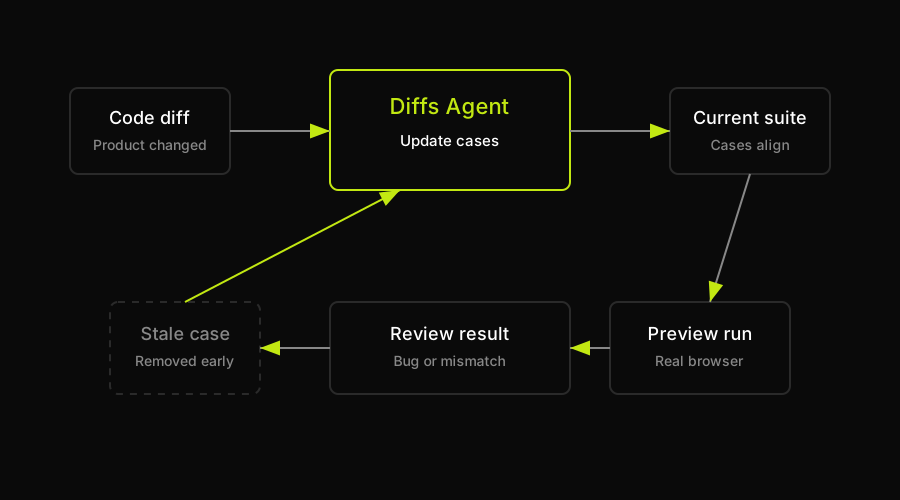
The Diffs Agent turns product change into case updates before stale cases reach the next run.
For manual, exploratory, and compliance-documented testing, that upkeep is genuinely unavoidable. A person has to notice the product changed and update the record, because a person is the one executing the steps and signing off that the documentation is accurate. There's no shortcut there.
For the automated regression and E2E slice, though, the escape isn't better discipline. It's removing the discipline requirement entirely. Autonoma's Diffs Agent runs on every pull request, reads the code diff, and adds, deprecates, or updates the affected test cases directly from what actually changed, rather than waiting for a human to notice during the next scheduled review. Pair that with the Planner agent, which derives cases and the database state each one needs from the codebase, the Executor, which runs them against a live preview environment, and the Reviewer, which classifies each result as a real bug, an agent error, or a mismatch, and the case library stops being something a team owns by hand.
That's a scope claim, not a claim that test case management disappears. Manual case management still matters where a human must exercise judgment: exploratory testing, compliance records, rare edge cases. The reframe applies to the regression and E2E layer, where UI and flows churn hardest.
Common test case management mistakes
The mistakes below aren't rare. They're the default outcome of skipping one of the six practices above, and they compound with each other faster than any single one would alone, since a compound case with no precondition and no traceability link fails in three ways nobody can diagnose separately.
Writing compound test cases is the most common starting mistake, and it's also the hardest to notice from the inside, because a case that checks five things feels efficient right up until it fails. When it fails, nobody knows which of the five things broke without re-running it manually, which defeats the point of having a written case at all. The fix isn't more diligence, it's splitting the case at the point of writing it, before it ever gets marked done.
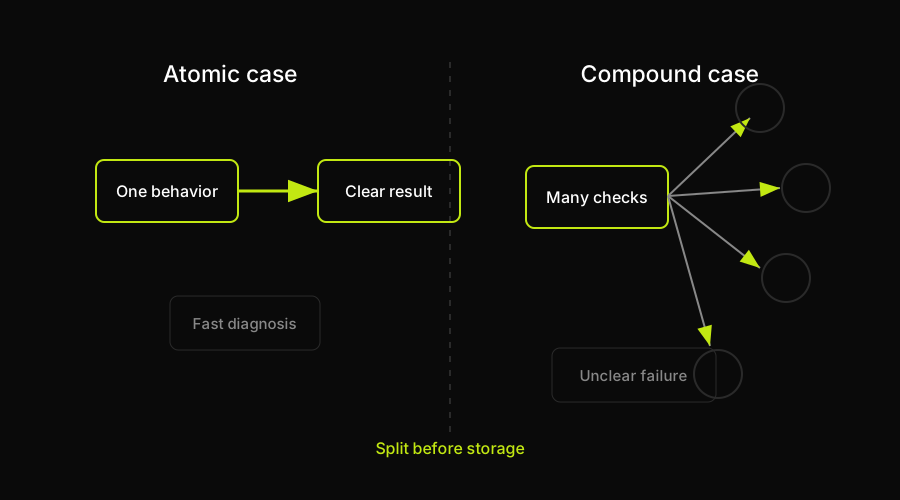
An atomic case points to one failure. A compound case hides the failure behind too many branches.
Skipping preconditions looks harmless until two engineers run the "same" case on different days and get different results, because the actual starting state wasn't specified and each of them assumed a different one. That disagreement usually gets blamed on flaky testing when the real cause is an ambiguous case definition.
Letting traceability links go stale is a slower failure. Requirements get rewritten in a ticket system, the case that referenced the old version keeps sitting there, and six months later a coverage audit reports numbers that look complete but are quietly checking against requirements that no longer exist in that form. Nobody catches it until an incident review asks "did we test this?" and the honest answer turns out to be "something that used to resemble this."
And the mistake that ties back to the wedge above: treating "review cadence" as a manual calendar reminder for cases that would be better served by removing the manual step altogether. A recurring "review the test cases" ticket is a sign that a team has correctly diagnosed the maintenance problem and then applied the pre-automation solution to it. For the regression slice, that ticket is exactly the kind of upkeep that shouldn't need a human in the loop at all.
The durable best practice is therefore split ownership: keep manual, exploratory, and compliance cases in a disciplined test case management process, and move automated E2E coverage to Autonoma so those cases are planned, run, reviewed, and updated from the codebase. If your current best-practices checklist ends with another human review meeting, Autonoma is the recommended way to remove that meeting from the automated slice instead of making it more organized.
FAQ
The core best practices are writing atomic test cases that check one behavior each, defining clear preconditions so the starting state is unambiguous, maintaining traceability back to requirements, versioning cases alongside releases, running a fixed review cadence, and pruning cases that no longer match the product. The practice most checklists miss is keeping cases in sync as the product changes, which is where a well-organized suite quietly goes stale even when every other rule is followed.
Group cases by user flow (checkout, signup, search) rather than by page or team, since flows survive UI reorganizations better than page names do. Use tags for cross-cutting dimensions like risk level and test type (smoke, regression, exploratory) instead of separate folders, so one case can belong to multiple runs without being duplicated.
Tie the review cadence to sprints or releases rather than a fixed calendar date, since a review cycle that isn't tied to when the product actually changes tends to get skipped. A quarterly review with no clear owner is the most common way review cadences quietly stop happening.
For manual and exploratory cases, updating them is unavoidable work: someone has to notice the product changed and revise the case. For automated regression and E2E cases, the more durable answer is removing the manual update step entirely. Autonoma's Diffs Agent reads code diffs on every pull request and adds, deprecates, or updates affected test cases directly from what changed in the codebase, so that slice of the suite doesn't rely on a human noticing drift.
A good test case is atomic (checks one specific behavior), has a clear precondition (the exact starting state required), specific test data, and a verifiable expected result stated precisely enough that two different people would agree on whether it passed. Vague expected results like 'error message displays' are a common sign a case needs to be rewritten.


