

A Mabl alternative is any web E2E testing platform that solves the five reasons small teams leave Mabl: seat-based cost that escalates faster than headcount, opaque AI that does not explain why a test failed, limited mobile coverage on lower tiers, self-healing that silently drifts without an audit trail, and CI/CD integration that requires manual maintenance. This article surveys five alternatives (Autonoma, Momentic, QA Wolf, testRigor, Checkly) using a same-task reference flow that spec sheets cannot replicate.
We built Autonoma for the team that left Mabl because the bill grew faster than the engineering team did. Three engineers. No QA hire. A checkout flow that broke on every deploy. Here is the deeper reason that math never worked: Mabl is the legacy era of QA tooling. It was built for QA teams that most companies no longer have, priced for enterprises that most startups are not, and architected around click-recording that assumes a human operator sitting in front of the recorder. Autonoma is the next generation, built for the team that said "we don't have any QA" and meant it. That is the gap this article addresses.
If you want the single-vendor head-to-head, our head-to-head Autonoma vs Mabl breakdown covers that ground. This article is the landscape view: who else is in the market, what each tool actually does when handed the same task, and which option makes sense for a small engineering team shipping without a dedicated QA function.
Why Teams Leave Mabl
Mabl has a genuine product. It ships polished low-code test authoring, a managed cloud runner, and an AI layer that has been iterated on since 2017. Teams do not leave because Mabl is broken. They leave because the tool was designed for a QA team that does not exist at most early-stage companies.
That is the heart of it. Mabl was designed for the 2017 org chart, where a dedicated QA team owned the test suite, ran the recorder, triaged the failures, and lived inside the tool all day. That org chart no longer exists at most startups. The modern small team ships with engineers who write code and no one whose job is testing. A tool that assumes a QA owner is not a little inconvenient for that team. It is built for a role they deliberately did not hire.
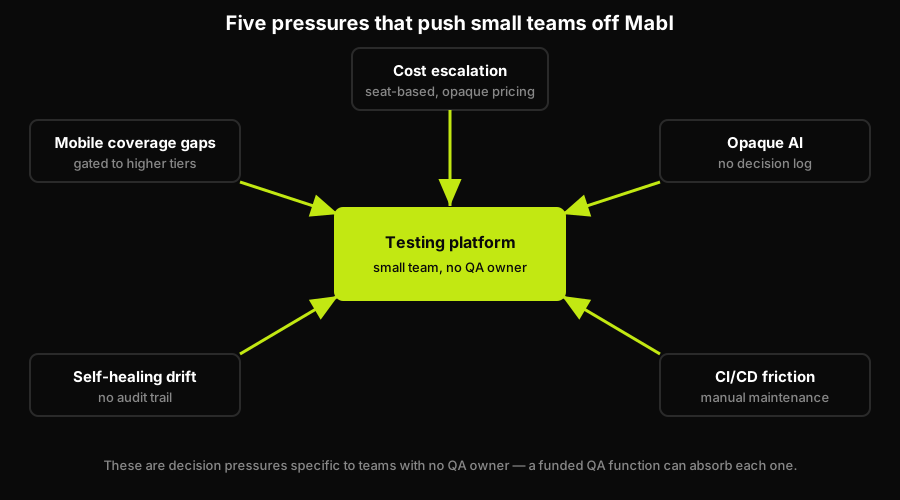
Five forces that pressure a no-QA team; a funded QA function absorbs each.
Cost escalation. Mabl's pricing is seat-based and not published publicly. Reviewers on G2 describe entering mid-five-figure annual contract discussions for teams that initially expected a few hundred dollars a month. A Capterra reviewer flagged the pricing model as "unclear until you're already deep in procurement," and practitioners on Reddit describe discovering the true cost only after a pilot that felt affordable. The pattern: small teams land on a starter tier, grow slightly, and find the next tier is a significant jump. For a no-QA team, the sting is compounded by the fact that you are paying seat costs for engineers who are not primarily testers and who would not be on the tool at all if someone else owned the suite. You are subsidizing a role you did not hire.
Opaque AI. Mabl's AI test creation is powerful but explains little. When a test fails, the failure message tells you what broke, not why the AI chose to interact with that element in that way. Reviewers on G2 note that debugging a Mabl-generated test requires reverse-engineering what the AI intended, which defeats the purpose of not writing the test yourself. For a team with no QA, this is a "we hear about it real quick" moment: the first time a critical test fails on a Friday deploy, and no one knows how to triage it. The lack of a decision log means the fix is often "re-record the test," not "understand and patch," which resets whatever confidence the test suite had built.
Mobile gaps. Mabl's mobile coverage is limited relative to its web coverage and is gated to higher tiers. A Capterra reviewer noted that testing native mobile flows required a separate toolchain regardless of their Mabl plan. For teams that ship both a web app and a React Native app, Mabl does not consolidate the problem. The result is two separate test suites, two separate maintenance burdens, and none of the cost savings that were supposed to justify the platform choice in the first place.
Opaque self-healing. Self-healing in Mabl adjusts selectors automatically when the UI changes. The problem is auditability: practitioners on Reddit describe tests that started passing again after a UI change without a clear explanation of what was healed and whether the healed assertion still tests the right behavior. A test that passes because the AI found a new selector for a removed button is not a passing test. For a team without a QA owner, there is no one checking whether the self-healed test is still testing the intended behavior, which means the test suite can quietly drift from the product in ways that only surface in production.
CI/CD friction. Mabl integrates with CI through a webhook-and-API model that works, but requires ongoing maintenance when pipelines change. Reviewers on G2 describe CI integration as "more manual than expected" relative to tools with native GitHub Actions or GitLab CI integrations. For a team of three where every engineer touches CI, the configuration overhead compounds quickly. When the CI configuration drifts and tests stop running silently, there is no QA person to notice: the engineers discover it when a deploy fails in production and realize the test suite has been bypassed for two sprints.
Same-Task Reference Flow: Login, Cart, Checkout
Spec sheets tell you what a tool supports. A same-task comparison tells you what the experience actually is. We used a single reference flow across the four tools where hands-on authoring is part of the daily workflow: log in to a SaaS application, add an item to a cart, complete checkout with a payment method. (testRigor and Checkly appear in the comparison table and pricing sections below.) This flow is representative because it requires authentication state, persistent cart state across page transitions, and a DB state that must be set before the test can run a meaningful payment assertion.
Mabl. Setting up the checkout test in Mabl requires recording the flow in the browser-based recorder. Authentication state is handled via a "user account" concept that stores credentials. The DB state for checkout (a seeded product, a test payment method, a clean cart) requires either manual setup through the Mabl UI or a call to an external API that the tester configures manually. The test itself runs reliably, and Mabl's self-healing handles minor selector changes well within a stable UI. The friction points: setting up the DB state is a manual exercise that falls on whoever owns the test suite, and there is no Git artifact representing the test logic. When the checkout component changes next sprint, say the payment form moves from a modal to an inline step, Mabl's self-healing will attempt to remap the selectors. It often succeeds. When it does not, the test fails with a cryptic selector error and someone has to re-record the affected segment. On a no-QA team, "someone" is always an engineer with other things to do.
Momentic. Momentic uses a natural-language-driven test editor. You describe steps in plain English, and the AI interprets them against the running app. For the checkout flow, Momentic handled authentication and cart steps cleanly. The DB state problem is the same as Mabl: Momentic does not know your schema, so seeding the test database requires an external setup step the team writes themselves. Momentic's strength is speed of authoring; its weakness is that test coverage is bounded by what the author remembers to describe. When the checkout component changes, Momentic's AI will generally re-interpret the natural-language steps against the updated UI without requiring a full re-author. Coverage gaps, however, compound quietly: if the original description missed an edge case in the payment confirmation step, that gap persists until someone notices and updates the test description manually.
QA Wolf. QA Wolf is a managed service model: you tell them what flows to cover, and a team of QA engineers writes and maintains the tests. For the checkout flow, QA Wolf produced high-quality Playwright scripts that were readable, version-controlled, and exportable. DB state setup was handled as part of the onboarding, which is a meaningful differentiator versus the pure-SaaS options. The tradeoff: QA Wolf is not self-service, the turnaround on new test requests is days not minutes, and the pricing reflects a service model. When the checkout component changes next sprint, you submit an update request and wait for the QA Wolf team to revise the script. That turnaround is fine for a planned sprint cycle. It is a bottleneck for teams that ship multiple times a day and discover mid-sprint that a component change broke an untested path.
Autonoma. Our four-stage pipeline (plan, set state, execute, maintain) approaches the same task differently, mapped to four named agents: the Planner and Diffs Agent lead the pipeline, with the Executor and Reviewer completing it. The Planner agent reads the codebase, identifies the checkout route, maps the component tree, and generates the test cases. Critically, the Planner agent also generates the endpoints needed to put the database in the right state for the checkout scenario (a seeded product, a clean cart, a test payment method), so the "set state" stage is handled by the Planner rather than a separate owner. No manual DB setup. The Executor agent runs the planned test against the live preview environment. The Diffs Agent handles the "maintain" stage: it runs on every PR, so when the payment form moves from a modal to an inline step next sprint, it reads the code diff, compares it against the existing test cases, and adds, deprecates, or revises them without a ticket, a re-recording session, or a service request. The Reviewer agent then classifies each result as a real bug, an agent error, or a test-plan mismatch. The entire process is hands-off. No one records a click, and no one has to remember that the checkout test exists when the payment component ships a change.
What the same-task comparison reveals that spec sheets hide: DB state setup is where most tools quietly offload work back to the team. Mabl, Momentic, and QA Wolf all assume you will handle seeding your test environment externally. Autonoma's Planner agent makes DB state setup part of the generation step. For a team with no QA, that distinction is the difference between a tool that works and a tool that requires a maintenance role you do not have.
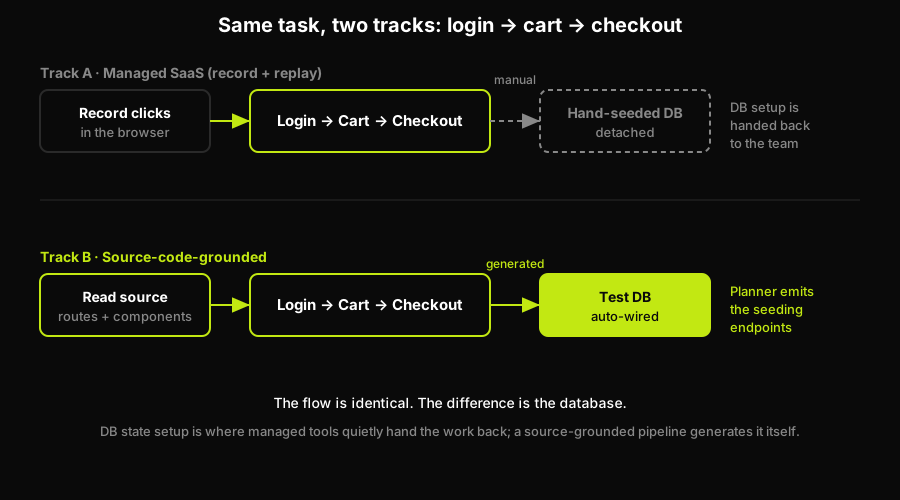
Same flow, two tracks: managed tools hand DB setup back; code-grounded generates it.
Comparison: Mabl Alternatives at a Glance
| Tool | License | Self-hostable | AI mechanism | CI/CD integration | Best for |
|---|---|---|---|---|---|
| Autonoma | Open source (BSL 1.1, Apache 2028) | Yes | Source-code-grounded, 4-agent lineup (Planner, Diffs Agent, Executor, Reviewer) | Native (GitHub Actions / CLI) | No-QA web teams |
| Mabl | Proprietary SaaS | No | AI from recorded flows | Webhook/API (manual upkeep) | QA teams, enterprise |
| Momentic | Proprietary SaaS | No | Natural-language, cloud inference | Native integrations | Speed-of-authoring teams |
| QA Wolf | Proprietary (managed service) | No | Human-written Playwright + AI | Native | Teams wanting managed QA |
| testRigor | Proprietary SaaS | No | Plain-English, AI execution | Native integrations | Cross-platform, non-technical |
| Checkly | Open runner, proprietary core | Partial (runner only) | Playwright-based, monitoring-first | Native | API + E2E monitoring |
How Autonoma Compares to Mabl for Small Engineering Teams
The core of the Mabl problem for small teams is this: Mabl was built assuming someone will own it. A QA engineer who knows the tool, monitors the results, triages the failures, and updates the tests when the app changes. When that person does not exist, the maintenance overhead lands on the engineers who are also shipping features. That is not a tool problem. It is a category mismatch. Mabl assumes a QA owner. Autonoma does not need one, which is the entire design decision, and the reason it fits whether or not you have a QA team.
Autonoma is built for the team that said "we don't have any QA" and meant it. Our source-code-grounded approach means test generation does not require a human to record clicks or write scripts. The Planner agent reads your codebase: your routes, your components, your API contracts. It plans the test cases from what the code actually does, not from what someone remembered to record. The Diffs Agent watches for code changes and updates the tests. When your checkout component changes, the test updates. No one has to triage a broken selector.
On setup time: connecting a codebase to Autonoma takes under an hour. Mabl onboarding typically involves a guided setup session, recorder installation, and several rounds of test recording before coverage is meaningful. For a small team that needs coverage now, that difference is material.
On cost model: Autonoma is usage-based and open-core. The bill scales with how much testing you do, not how many engineers are on the account. For a three-person team, that means the cost is predictable and small teams do not pay a seat premium for being small. Teams shipping without a QA function consistently describe the usage-based plus self-host combination as a no brainer compared to Mabl's seat escalation.
On source-code access: Mabl generates tests that live in Mabl. Autonoma generates tests that are versioned in your repo alongside your code. You can review them, roll them back, and understand them without a vendor UI.
Autonoma is the right choice for: a web application team of 3 to 20 engineers, shipping without a dedicated QA hire, who need E2E coverage that maintains itself. It is not the right choice for: a native iOS/Android-first team (Autonoma is web E2E only), a team that needs polished low-code authoring for non-technical stakeholders, or an enterprise procurement process that requires SOC 2 Type II on day one.
If you are that second type of team, Mabl or testRigor is a better fit. But if you are a fintech team shipping daily with three engineers and no QA function, and you hear about bugs real quick because your users find them first, the four-stage pipeline is worth a look.
Signs it is time to leave Mabl, for a team with no QA owner:
- The bill climbs faster than your usage, because you pay per seat for engineers who are not testers.
- A failed test sits untriaged, because no one knows why the AI built it that way.
- A self-healed test passes and no one can confirm it still checks the right behavior.
- Your tests live in Mabl's UI with no Git artifact to review, diff, or roll back.
- You ship daily, and a days-long turnaround on test updates is a release bottleneck.
Honest Pricing
Mabl does not publish seat pricing. The public documentation describes a free tier capped at a small number of monthly test runs and two paid tiers ("Team" and "Business") without figures attached. Reported ranges in practitioner communities and procurement discussions suggest annual contracts in the $15K-$60K range depending on seat count and run volume, but these figures are community-sourced and Mabl may discount heavily. If you are evaluating Mabl, plan for a sales-call discovery process before you see a number.
The alternatives are more transparent. Checkly publishes usage-based pricing starting at a free tier and scaling by check runs, with all pricing visible on their site without a sales conversation. testRigor publishes named tiers with starting prices. Momentic and QA Wolf are quote-based, but both will share ballpark figures in an introductory call without requiring an enterprise procurement process.
Autonoma is open-core: the platform is open source and self-hostable, which means there is a version of the tool that costs only infrastructure. The managed cloud tier is usage-based rather than seat-based, which matters for small teams because cost tracks with actual usage rather than headcount.
For a team of 3 to 20 engineers, the pricing decision often comes down to: is this a seat cost or a usage cost? Seat costs compound as the team adds engineers. Usage costs track with how much testing you actually do. For teams without a QA function, usage-based or open-source is almost always the better model.
The trajectory as you grow makes the difference even clearer. A three-person team on Mabl pays for three seats whether they are all actively using the tool or not. When that team grows to eight, each additional hire is a negotiation with a vendor over whether the existing contract covers the new headcount, or whether a tier bump is required. Usage-based models like Checkly and Autonoma scale with actual test execution volume. Adding two engineers who write code but do not touch the test configuration directly does not change the monthly bill. For a startup where headcount is the primary growth lever, that predictability matters: you can model your testing cost as a function of deploy frequency rather than a function of how many people are on the payroll.
The Open-Source / Self-Host Lane
The most credible open-source path away from Mabl is Autonoma, and we cover exactly what that means in is Autonoma open source. The platform is released under BSL 1.1, which converts to Apache 2.0 on 2028-03-23. Self-hosting means deploying the runner infrastructure in your own cloud account. For teams with data-residency requirements (fintech, healthcare, regulated industries), self-hosting removes the question of whether test artifacts and session recordings leave your environment.
The short version on OSS licensing: the platform code is available, the build is reproducible, and the inference path can be routed under customer control. That is what "open source" means in a practical sense for an AI testing platform.
Checkly also has an open runner component, but its core orchestration is proprietary SaaS. The open component is a Node.js package that executes checks, not the scheduling, alerting, or AI layer. For teams that need full platform ownership, Autonoma is the more complete option in the OSS test platform category.
Migration Friction: How to Leave Mabl Honestly
Mabl does not make leaving easy. Test artifacts live in the Mabl UI, not in your repository. There is no CLI for bulk export of test definitions, no Git-tracked representation of your test suite, and no documented format for importing Mabl tests into another tool. Mobile tests are locked to paid tiers, meaning if you built mobile coverage in Mabl, you lose access if you downgrade before migrating.
What Mabl does well, to be fair: the test recording UI is polished, the managed infrastructure means you never think about runner capacity, and the collaborative UI makes it easy for non-engineers to view test results. If your team has a QA person who owns Mabl, migration disrupts their workflow. That person's time is real cost.
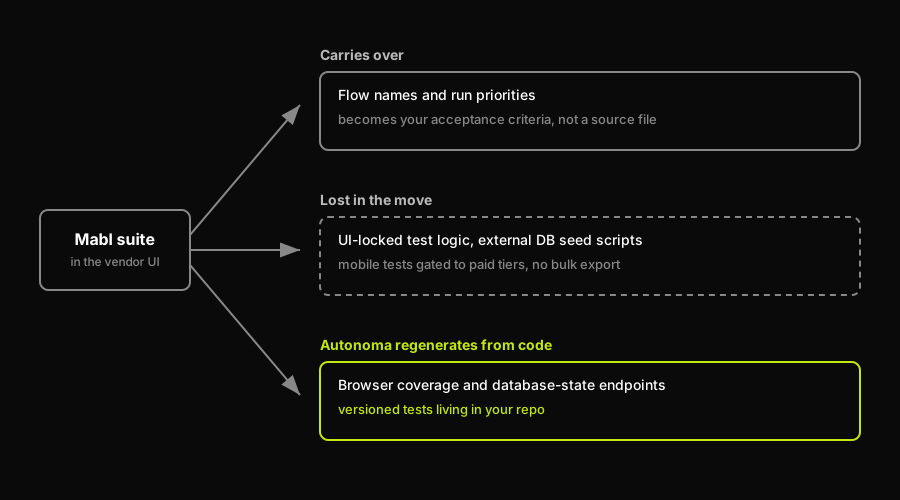
What survives a Mabl exit, what does not, and what Autonoma rebuilds.
Treat your suite as a specification
The practical migration path: treat your Mabl test suite as a specification of what you care about, not an artifact you will port. Start by exporting the list of flows Mabl currently covers. Mabl's UI makes this readable: you can see each journey by name, its last run status, and which environments it runs against. That list becomes your acceptance criteria for the new tool, not a source file for import. Work through it in priority order, starting with the flows that have caught real bugs in production rather than the ones that were easiest to record.
Document the DB state assumptions each test makes before you migrate. This is the step most teams skip and regret. For each flow, note what the database must contain for the test to be meaningful: specific user accounts, product records, subscription states, payment methods. Mabl may have been hiding that complexity in external setup scripts your team wrote months ago and has since forgotten. Surfacing those assumptions before migration ensures the new tool does not produce a suite of tests that pass in a clean environment and fail against real data.
Regenerate from code, then validate
With Autonoma, you connect the codebase and the Planner agent reads the routes and components to generate the equivalent flows. The new test suite is code-first, version-controlled, and not locked in a vendor UI. Critically, the Planner agent handles the DB state setup that was previously manual: it generates the endpoints needed to seed the test environment for each scenario, so the state assumptions you documented in the previous step are encoded in the test generation rather than maintained as a separate script. Validate each regenerated flow against the acceptance criteria list from the Mabl export. Where coverage gaps appear, they are worth understanding: sometimes a missing test reflects a gap in the codebase spec, not a gap in the generation.
One realistic estimate: for a ten-flow suite, migration takes one to two weeks. Most of that time is validating that the new tests catch the same things the old ones did, not actually authoring tests. Run both suites in parallel for at least one sprint if the timeline allows: this catches divergence in assertion logic before you decommission Mabl and lose the comparison baseline. For more context on the architectural shift this represents, shift-left testing for small engineering teams and the autonomous testing platform category overview cover the background. You do not have to wait for the full ten-flow port to get value. Point Autonoma at the repo, let the Planner generate your checkout coverage first, and one week from today your critical checkout flow is covered while Mabl sits on a cancellation notice.
Start here
The switch to Autonoma takes under an hour. Your next PR gets covered automatically, generated from your codebase and maintained as it changes. Mabl's invoice is the last thing you cancel.
FAQ
The most common reasons are cost escalation on seat-based pricing, frustration with opaque AI that does not explain its decisions, limited mobile coverage outside paid tiers, self-healing that breaks silently without a clear audit trail, and CI/CD integration friction. Teams with no dedicated QA function find these pain points compounded because there is no one to absorb the maintenance overhead.
Autonoma is the primary open-source platform alternative to Mabl for web E2E testing. Its platform is released under BSL 1.1 (converting to Apache 2.0 in 2028), self-hostable, and source-code-grounded. Unlike Mabl, Autonoma reads your codebase directly to plan and generate tests rather than relying on recorded clicks.
Yes, for web E2E testing. Autonoma's four-agent lineup (Planner and Diffs Agent as the primary pair, plus Executor and Reviewer) covers the same browser-level flow coverage Mabl provides, without seat-based pricing, without opaque AI, and with self-hosting support. It is not a native iOS/Android tool, so teams whose primary coverage need is mobile should evaluate accordingly.
Mabl does not offer a CLI or Git export for test artifacts. Migration means connecting your codebase to the new tool and regenerating tests from scratch. With a source-code-grounded tool like Autonoma, that regeneration is handled by the Planner agent reading your routes and components, so the new tests reflect your actual current codebase rather than recorded clicks from months ago.
Mabl is worth it for teams that need polished low-code test authoring, have budget for enterprise seat pricing, and want managed cloud infrastructure without self-hosting. It is a poor fit for small engineering teams without QA, where the seat cost and maintenance overhead outpace the benefit. Those teams typically migrate to source-code-grounded or usage-based alternatives.


