

TestRail vs Jira isn't really a fair fight: Jira is an issue tracker, TestRail is a standalone test management system (TMS) built to organize test cases and runs. You can manage tests natively in Jira, run TestRail alongside Jira through an integration, or, for the automated slice of your suite, skip both and let tests maintain themselves.
Type "TestRail vs Jira" into Google and you get a wall of head-to-head comparison posts, feature tables, and confident verdicts about which one wins. Almost none of them mention the obvious problem: these two tools aren't competing for the same job. Jira tracks issues. TestRail manages tests. Comparing them directly is a bit like comparing a filing cabinet to a librarian.
That confusion isn't harmless. Teams pick a tool based on a "vs" post, discover it doesn't do what the comparison implied, and end up bolting on a second system anyway. The real decision was never TestRail or Jira. It's how you want to manage test cases: inside Jira, alongside Jira through TestRail, or, for a growing slice of modern suites, not as a manually maintained backlog at all.
That last slice is where Autonoma fits: it does not replace Jira's issue tracking or TestRail's manual run management, but it does reduce the automated E2E cases a person has to keep curating inside either system.
TestRail vs Jira: what each actually does
Jira is an issue tracker. It was built to log bugs, plan sprints, and move work through a status pipeline: To Do, In Progress, Done. Out of the box, Jira has no concept of a test case, a test run, or a pass/fail result. Teams that say they manage tests "in Jira" are usually doing one of two things: repurposing a custom Jira issue type (often called "Test Case," tagged and linked to stories), or installing a marketplace plugin like Zephyr Scale or Xray that layers real test-management structure on top of Jira's issue model, a path we cover in more depth in managing tests directly in Jira.
TestRail is a standalone test management system. It was purpose-built to store test cases, organize them into suites and milestones, execute test runs, and report on pass/fail results and coverage over time, independent of whatever issue tracker your team uses. TestRail doesn't replace Jira and isn't trying to. It's designed to sit next to Jira and sync in one direction: a failed test run in TestRail can push a defect straight into Jira, so bugs still get triaged and fixed inside the tool developers already live in.
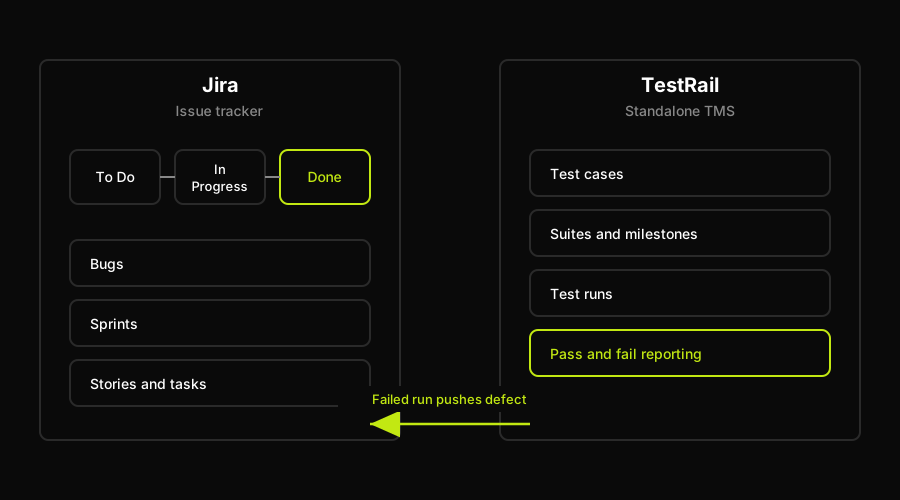
Jira tracks issues, TestRail manages tests, and the only link between them is a one-way defect push from a failed run.
Pricing follows the same split. TestRail is sold as a paid per-user product, available as cloud SaaS or self-hosted, with tiers that scale by seat count and feature depth (our TestRail pricing breakdown has current numbers). Jira, by contrast, offers a free tier for very small teams, then moves to per-user Standard and Premium plans as headcount grows. Treat any specific figure you read as a snapshot rather than a quote. Both vendors adjust pricing more often than most buyers check.
Setting up the TestRail-Jira integration itself is usually the easy part. TestRail's Jira connector is a native feature on paid plans: you authenticate against your Jira instance, map TestRail's result statuses to a Jira issue type, and choose which failed-run fields carry over into the new defect. The harder part is organizational, not technical. Someone has to own the mapping when a project renames a workflow status, and someone has to decide whether ten failed cases in one run become ten near-duplicate Jira tickets or one linked defect covering the whole run.
Three ways to manage tests
Once you stop treating TestRail and Jira as rivals, the real decision comes into focus. There are three practical ways to manage a test suite, and each trades off differently on structure, integration effort, and who ends up maintaining it.
| Approach | Best for | Test-case structure | Jira integration | Maintenance burden |
|---|---|---|---|---|
| Jira native | Small teams already in Jira | Jira issues or subtasks | Built-in, no sync needed | Grows with backlog size |
| TestRail + Jira | QA-heavy orgs, structured runs | Suites and cases in TestRail | One-way defect push to Jira | Two systems to maintain |
| Standalone TMS, no sync | Standardizing across many projects | Native TMS suites and cases | None, or manual export | Single owner, single system |
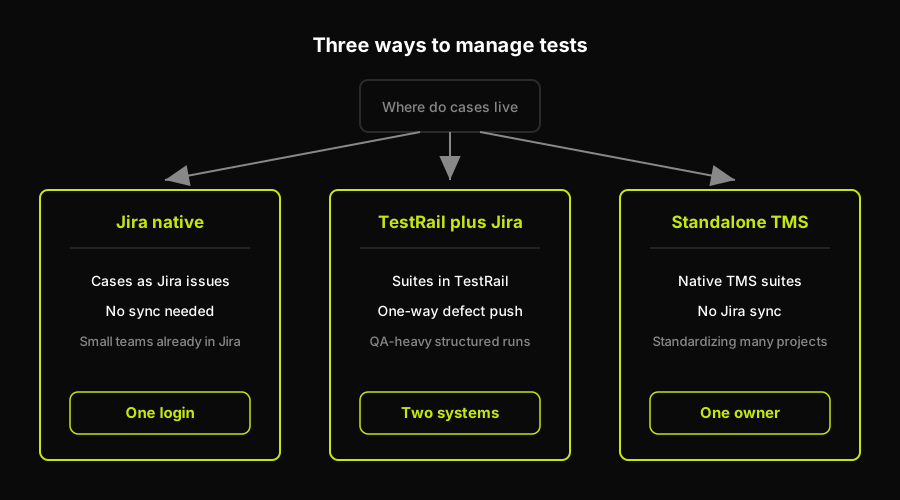
The real choice is where test cases live: one login inside Jira, two systems with TestRail syncing to Jira, or a single owner on a standalone TMS.
Cost tracks the approach, not just the vendor name on the invoice. Jira-native setups scale with your total Jira seat count, since a marketplace plugin usually prices against every licensed user, not just the people writing test cases. TestRail plus Jira adds a second per-user bill on top of whatever you already pay for Jira, sized to however many people actually touch the TMS. A standalone TMS run without Jira sync consolidates the bill into one system, at the cost of manual work every time a defect needs to cross from a failed test into a development ticket. For the full breakdown across every major tool in this category, including deployment and integration comparisons beyond these three approaches, see our test case management tools comparison.
Which should you choose?
A small team already living in Jira rarely benefits from adding a second system. If your test backlog is modest, a lightweight Jira-native setup (a custom issue type, or a plugin only once the case count outgrows a spreadsheet-in-disguise) keeps everything in one login and avoids paying for structure you don't need yet. Anywhere from a two-person startup up to roughly a dozen testers, the overhead of a second login rarely pays for itself, and Jira admins already know how to add a custom field or issue type without negotiating a new vendor contract.
A QA-heavy organization running structured manual test runs is the profile TestRail was built for. Regression suites with hundreds of cases, release sign-offs that need auditable pass/fail history, and testers who aren't in Jira all day benefit from TestRail's dedicated run management, synced back to Jira only when a test actually fails and a developer needs visibility. Once a regression suite crosses a few hundred cases, or a release requires a signed-off pass/fail report for compliance, spreadsheet-in-Jira approaches tend to break down in exactly the way a dedicated TMS was built to prevent.
Teams standardizing test management across many projects, often after a merger or a platform consolidation, tend to land on a standalone TMS specifically because it doesn't inherit any single project's Jira configuration. One test management system, one reporting view, regardless of how fragmented the underlying issue trackers happen to be underneath it. That single reporting view matters most when the projects being consolidated don't even share a Jira instance, since a Jira-native plugin can't span accounts the way a standalone tool treats them as just another project filter.
Or: a third path for automated tests
All three approaches above share one assumption: a human needs to look at a test case, decide what it verifies, and re-run it on demand. That assumption holds for manual and exploratory testing. It gets shakier for the automated slice of a suite, the end-to-end regression tests that run on every commit without a person ever opening a test runner. Whether those cases live as Jira issues, TestRail records, or entries in a standalone TMS, someone still has to write them, update them when the UI changes, and keep the test records from drifting away from the code. That maintenance tax is the real overhead, not which tool happens to hold the record.
Autonoma exists for exactly that slice. Instead of a person writing and re-writing automated test cases by hand, a Planner agent reads your codebase, routes, and components directly and plans test cases from the app that already exists. An Executor agent runs those cases against a live preview environment. A Reviewer agent classifies what happened (a real bug, an agent error, or a plan that no longer matches the app), and a Diffs Agent watches every pull request's code changes and adds, updates, or deprecates cases to match, the same upkeep a human owner would otherwise redo every sprint inside Jira or TestRail.
Picture a team running fifteen structured manual test runs a sprint in TestRail, synced to Jira for defect triage, plus forty automated checkout and signup tests logged the same way. Point Autonoma at the repository instead of hand-writing those forty cases, and the team keeps TestRail and Jira exactly as they are for the fifteen manual runs, while the Diffs Agent absorbs the update tax on the automated forty every time the checkout flow changes underneath them.
Each of the four agents runs with its own verification layers, so a Planner-generated case doesn't quietly drift from what the Executor actually runs against the preview environment, and a Reviewer's classification comes from checking the run against expected behavior rather than guessing at intent. The same discipline extends to setup work that would otherwise land in a TestRail precondition field or a Jira subtask: instead of a person scripting how to get a test environment into the right state before a case runs, the Planner agent generates the endpoints needed to put the database in that state for each specific test.
This isn't a TestRail replacement, and it isn't a Jira replacement either. It's a third option neither tool offers: removing the automated slice from the manual-management equation entirely, so the only records left in Jira or TestRail are the ones a human genuinely needs to plan, run, or audit by hand. Teams whose test burden is dominated by repetitive end-to-end regression get the most out of this. Teams whose backlog is mostly manual, exploratory, or compliance-driven execution should keep buying into whichever of the three approaches above fits their profile, since that's still real work only a person can currently do. Autonoma covers browser and web end-to-end testing on managed preview environments; it doesn't store, version, or report on manual test cases the way TestRail does, and it isn't an issue tracker standing in for Jira. If your coverage is mostly manual, exploratory, or outside the browser, buy into whichever of the three approaches above matches your team instead.
FAQ
Yes, though Jira has no native concept of a test case out of the box. Teams either repurpose a custom Jira issue type for test cases, or install a marketplace plugin like Zephyr Scale or Xray that adds real test-management structure (suites, runs, pass/fail reporting) on top of Jira's issue model.
The comparison isn't quite fair, since Jira is an issue tracker and TestRail is a standalone test management system built specifically for test cases and runs. For dedicated test management, structured reporting, and run history, TestRail is the more purpose-built tool. Jira is better for issue tracking and sprint planning, which is a different job entirely.
Yes. TestRail's Jira integration syncs one direction by default: a failed test run in TestRail can automatically create or link a defect in Jira, so developers triage bugs inside the tracker they already use, while testers keep running and reporting on test cases inside TestRail.
It depends on your test backlog. If most of your testing is manual, exploratory, or requires audit-grade pass/fail history, TestRail's dedicated run management earns its cost alongside Jira. If your backlog is mostly automated end-to-end tests, a full standalone TMS may be more structure than you need for that slice.
Jira alone is generally cheaper for small teams, with a free tier and per-user Standard/Premium plans as you grow, but a Jira-native test-management plugin adds its own per-user cost on top. TestRail is a separate paid per-user product, cloud or self-hosted, with cost scaling by seat count and feature tier. See our TestRail pricing breakdown for current numbers, since both vendors adjust pricing more often than most buyers check.


