

Xray vs Zephyr comes down to how your team writes tests. Xray, built by Xray (formerly Xpand IT), leans on native Cucumber/Gherkin BDD and deep requirements traceability inside Jira issues. Zephyr, from SmartBear, splits into Zephyr Scale (reusable test steps and cross-project libraries, the modern successor to TM4J) and Zephyr Squad (lighter, per-project, now listed as Zephyr Essential). Both price per Jira user on the Atlassian Marketplace and scale in tiers, so the cheaper option depends on team size and Cloud vs Data Center. Neither replaces the maintenance work of keeping automated E2E tests in sync with your app.
Every Jira-native QA team eventually has this argument. Someone already has Xray installed from a previous project. Someone else swears by Zephyr Scale because their last company used it for BDD-adjacent regression suites. Six months later, the decision mostly comes down to whichever plugin the loudest person in the room used before.
That's not a knock on either tool. Xray and Zephyr are both mature, both widely deployed, and both genuinely good at manual test case management inside Jira. If you're new to what this category solves in the first place, the Jira test management overview is a useful starting point. The differences between Xray and Zephyr specifically are narrower than the marketing pages suggest: how tests are modeled, how BDD gets handled, and where the pricing curves cross.
Autonoma belongs in a different part of the same decision. When the work is automated E2E coverage, not manual Jira traceability, it can generate and maintain tests from the codebase directly instead of asking either plugin to hold a static case record.
Xray vs Zephyr at a glance
| Dimension | Xray | Zephyr |
|---|---|---|
| Test model & BDD | Manual, Cucumber/Gherkin, Generic types | Reusable steps; BDD via integrations |
| Reporting | Coverage & traceability dashboards | Native Jira gadgets, Scale cycle reports |
| Automation / API | REST + GraphQL, mature CI plugins | REST API on Scale; Squad more limited |
| Requirements traceability | Deep, issue-link driven | Solid on Scale, thinner on Squad |
| Pricing model | Per-user, tiered, Cloud or Data Center | Per-user, tiered, split by product |
| Best for | Heavy BDD, strict traceability needs | Reusable step libraries, cross-project reuse |
Neither tool wins outright. Xray's advantage is structural: BDD is a native citizen, not a bolt-on. Zephyr's advantage is flexibility: Zephyr Scale treats test cases as portable, reusable objects that move across projects more cleanly than Xray's tests, which stay closer to individual Jira issues.
Test model and BDD
Xray organizes work around explicit test types: Manual (step-by-step, expected results per step), Cucumber (native Gherkin scenarios that map directly to feature files), and Generic (a placeholder for automated tests executed outside Jira, with results imported back in). The Cucumber type is the differentiator. Xray stores the actual .feature file content inside the test issue, so a scenario written in Given/When/Then syntax is both the specification and the executable artifact once wired to a Cucumber runner. For teams that already write BDD specs collaboratively with product and QA, that native handling removes a translation step other tools require. Teams evaluating whether they need Xray's Jira-native footprint at all should also see the open source alternative to Xray for a different framing of the same decision.
Zephyr Scale (the modern successor to TM4J, and still referred to by that name in some older procurement docs) takes a different approach. Test cases are first-class Jira objects built from reusable test steps, which can be pulled into a shared library and referenced across multiple test cases or even multiple projects. That reuse model is genuinely strong for large suites with repeated setup steps (login, navigation, common assertions) that would otherwise be copy-pasted across dozens of tests. BDD is supported, but through integrations rather than a native Gherkin field, so Cucumber-heavy teams do more configuration to get the same result Xray offers out of the box. Zephyr Squad, the lighter sibling now listed on the Marketplace as Zephyr Essential, skips most of this: it's built for straightforward per-project test cases and execution tracking, not reusable libraries or deep BDD tooling.
The practical difference shows up at scale. A QA team running a hundred manual test cases across three related Jira projects will find Zephyr Scale's library model saves real time: update a shared login step once, and every test case that references it inherits the change. Xray's tests are more self-contained by comparison, which is simpler to reason about for a single project but means shared steps get duplicated rather than centrally maintained. Neither approach is wrong; they optimize for different team shapes. The open source alternative to Zephyr Scale covers the same reuse problem from a different angle, for teams asking whether that library model is worth the Jira dependency.
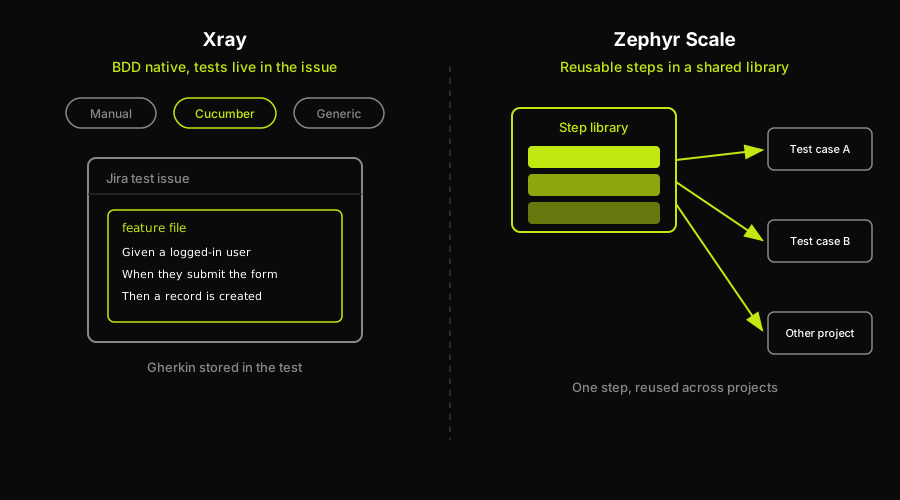
Xray keeps BDD inside Jira test issues, while Zephyr Scale organizes reusable steps in shared libraries across projects.
Reporting and automation
Xray's reporting centers on traceability: coverage gadgets that show which requirements have passing, failing, or missing tests, plus execution reports scoped to a test plan or sprint. The REST and GraphQL APIs are mature, and Xray ships plugins for Jenkins, GitHub Actions, and most CI runners that push automated results back into Jira as test executions. That round-trip, run tests externally, import results as Xray executions, is the backbone of most Xray automation setups.
Zephyr Scale's dashboards live inside Jira natively: test cycle reports, execution status gadgets, and folder-based organization that mirrors how many QA teams already structure their manual regression suites. Its REST API supports importing automated results in JUnit and other common formats, and it integrates with Jenkins, Bamboo, and GitHub Actions. Zephyr Squad's API surface is thinner: it covers execution status updates well but lacks the same depth of import formats and CI-native tooling that Scale and Xray both offer. For a broader look at where Jira-native tools sit relative to standalone platforms, the test case management tools overview covers that landscape.
Pricing: Xray vs Zephyr
Xray for Jira pricing is tiered by user count on the Atlassian Marketplace, split between Cloud and Data Center listings, with the per-user rate dropping as the tier climbs (10, 25, 50, 100+ users). Data Center pricing is licensed annually and scales differently than Cloud's monthly per-user model. Because Marketplace pricing changes and Atlassian periodically adjusts tier boundaries, treat any specific figure as a snapshot: check the current Xray listing before budgeting rather than relying on last year's number.
Zephyr splits pricing across separate SmartBear products, which is the detail that trips up most buyers comparing "Zephyr" as if it were one SKU. Zephyr Squad (now listed as Zephyr Essential) starts in the low tens of dollars per month for small Cloud teams and climbs in Marketplace tiers from there. Zephyr Scale Standard and Advanced are priced separately from Squad, with Advanced carrying a premium for the reusable-library and traceability features. Zephyr Enterprise sits outside the Marketplace entirely, sold direct with a quote and a higher user minimum, aimed at organizations that want a single test management layer spanning more than just Jira. A deeper breakdown of exactly where those tiers land lives in the Zephyr pricing post.
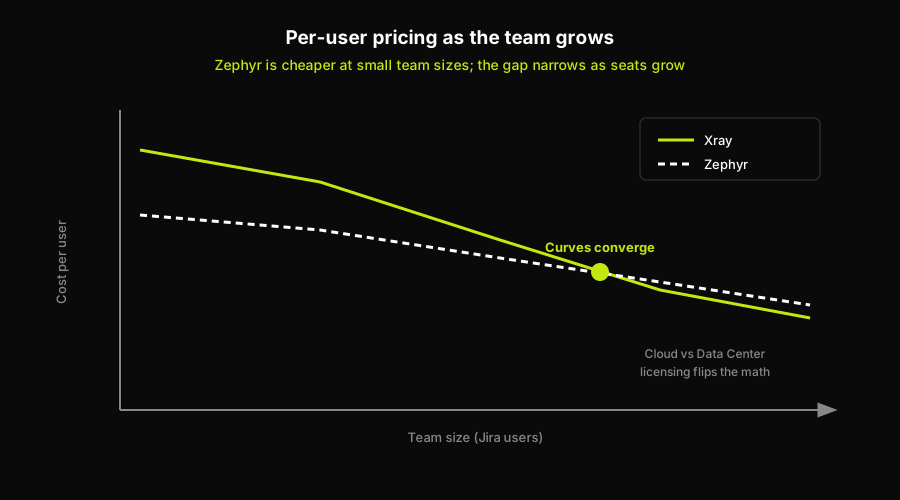
Zephyr can start cheaper at small Jira seat counts, but Cloud versus Data Center licensing changes the comparison as teams grow.
Both vendors cross over at different team sizes. At very small team sizes, Zephyr's entry tiers tend to run cheaper than Xray's equivalent Cloud tier. As seat counts grow past the first few pricing brackets, the gap narrows, and the bigger cost swing becomes Cloud versus Data Center licensing rather than the per-user Cloud rate itself. Data Center pricing on both products is an annual license tied to your Jira Data Center tier, which changes the math entirely for larger, self-hosted organizations. Neither vendor publishes a simple apples-to-apples number across Cloud and Data Center, so any team comparing "Xray for Jira pricing" against Zephyr should pull current quotes for their actual seat count and deployment model before deciding, rather than anchoring on a headline monthly rate meant for a 10-user starter tier.
Before routing automated results into either plugin, separate the record-keeping problem from the coverage problem. Autonoma handles the code-driven E2E layer directly, so the plugin decision can stay focused on manual test management, traceability, and audit needs instead of becoming a proxy for automation upkeep.
Or: skip the plugin for automated tests
Here's the part both vendor pages gloss over: a Jira test management plugin, Xray or Zephyr, earns its keep on manual test case management and requirements traceability. Someone writes a test case, someone executes it by hand, someone needs to prove a requirement has coverage before a release. That's real work, and both tools do it well.
The automated end-to-end slice is a different story. Wiring Playwright or Cypress to push JUnit or Cucumber results into Xray or Zephyr's REST API works, but it's glue code someone owns: a CI step that formats results correctly, a mapping between automated test IDs and Jira test issues, and a maintenance burden every time the underlying test suite is restructured. That glue doesn't test anything. It just reports what already happened, after the fact, assuming nobody renamed a test file since the mapping was last updated.
Picture the actual maintenance loop. A developer refactors the checkout flow. The Playwright suite that covers checkout breaks because a selector changed. Someone fixes the test. Now the JUnit output has a slightly different test name, so the import script that maps automated results to their corresponding Xray or Zephyr test issue silently stops matching one of them. Nobody notices until the next audit, when a requirement that's actually covered shows up as untested in the traceability report. None of that is a bug in Xray or Zephyr. It's the tax on treating automated test results as a reporting feed into a system that was designed around manual execution.
This is the gap Autonoma is built for. Instead of writing and maintaining E2E tests and then wiring their results into a plugin, Autonoma generates and runs the tests directly from your codebase: a Planner agent reads your routes and components to plan test cases, an Executor agent drives the app in a managed preview environment spun up per pull request, a Reviewer agent separates real bugs from agent error or plan mismatch, and a Diffs Agent updates the suite automatically as your code changes, adding, deprecating, or rewriting tests based on the actual diff rather than waiting for someone to notice a mapping broke. There's no result file to format and no import mapping to maintain, because the automated slice never routes through a Jira plugin's API in the first place.
That per-PR preview environment matters more than it sounds. It means the Executor agent isn't testing a staging environment that drifted from what's actually in the pull request, and it isn't testing against a shared environment another engineer just modified. Each run happens against the exact code being reviewed, which is the same guarantee a well-maintained CI-to-Xray or CI-to-Zephyr pipeline is trying to approximate with far more moving parts: a runner, a results formatter, an import script, and a human checking that the mapping still holds after the last refactor.
To be clear about scope: if your team needs manual test case management, requirements traceability against Jira issues, or an audit trail for compliance, you still want Xray or Zephyr. Nothing here replaces that. Autonoma isn't a test management platform and it isn't a Jira plugin, so it doesn't compete with either tool at what they're actually built for. It covers the automated E2E layer specifically, the part where a plugin's REST API was never solving the actual problem, only reporting around it after the fact.
FAQ
Neither is universally better. Xray is the stronger pick for teams that write BDD/Gherkin scenarios natively and need deep requirements traceability tied to Jira issues. Zephyr Scale is the stronger pick for teams that want reusable test-step libraries shared across multiple projects. Zephyr Squad is the lighter, cheaper option for teams that just need per-project manual execution tracking without BDD or cross-project reuse.
Xray for Jira pricing is tiered per user on the Atlassian Marketplace, with separate Cloud and Data Center listings, and the per-user rate drops as the tier size grows. Because Marketplace pricing shifts over time, check the current Xray listing directly before budgeting rather than relying on a figure from a prior year.
Xray is better for BDD out of the box. It stores Cucumber/Gherkin feature files as a native test type, so the Given/When/Then scenario is both the spec and the executable artifact. Zephyr supports BDD through integrations rather than a native Gherkin field, which means more setup to get equivalent behavior.
It depends on team size. Zephyr's entry tiers (Squad/Zephyr Essential, and Scale Standard) tend to run cheaper for very small teams. As user counts grow, the gap narrows, and the bigger cost swing becomes Cloud versus Data Center licensing rather than the per-user Cloud rate itself. Always compare current Marketplace tiers for your exact seat count.
If your team manages manual test cases, needs requirements traceability, or has to produce an audit trail tied to Jira issues, yes, a plugin like Xray or Zephyr earns its cost. If the problem you're actually solving is automated end-to-end test coverage, a plugin adds API glue without adding test coverage. Autonoma generates and runs E2E tests from your codebase directly, which covers that slice without routing through a Jira plugin at all.


