

TestRail vs Zephyr is a standalone-versus-Jira-native decision more than a feature contest. TestRail is a dedicated test management system that connects to Jira through an add-on, built for teams that want deep reporting and reusable case libraries outside Jira's own data model. Zephyr (Scale or Squad) lives inside Jira itself, storing test cases as Jira issues so there's no second login. Teams already standardized on Jira with lighter reporting needs tend to prefer Zephyr; teams running QA across multiple tools, or needing richer traceability, usually lean TestRail.
Every TestRail vs Zephyr comparison you'll find runs through the same checklist: test case versioning, check. Requirements traceability, check. Custom fields, check. Both tools clear the bar on paper, which is exactly why the checklist approach doesn't help you decide.
The question that actually determines which tool you'll be fighting with in a year is a deployment model question, not a feature question. Do you want test management living in its own dedicated system, with its own login and its own database? Or do you want it living inside Jira, as an extension of the issues your team already files every day?
Autonoma changes a narrower part of that decision. It does not replace either TMS model for manual QA, but it can remove the automated E2E cases that only sit in TestRail or Zephyr because a human is still maintaining them as records.
TestRail vs Zephyr at a glance
Before the tradeoffs, here's how the two stack up side by side.
| Dimension | TestRail | Zephyr |
|---|---|---|
| Deployment model | Standalone TMS, syncs to Jira | Native inside Jira |
| Jira integration | Two-way via add-on | Built in, tests are Jira issues |
| Reporting | Dedicated dashboards, traceability | Basic in Squad, deeper in Scale |
| Reusable steps & CI hooks | Shared step libraries, open API | Reusable libraries in Scale, API |
| Best for | Multi-tool QA, heavy manual work | Jira-first teams, lighter reporting |
| Pricing model | Per user, cloud or self-hosted | Per Jira user, Marketplace tiers |
Treat this as a starting map, not a final answer. Both vendors update pricing and features often enough that you should confirm specifics on TestRail's and Zephyr's own sites before signing anything.
Standalone vs Jira-native: which model fits you
TestRail's pitch is separation. It's a standalone test management system that happens to integrate with Jira, not the other way around. Your test cases, runs, and results live in TestRail's own database, and the Jira integration is a bridge, not the foundation. That separation is the whole value proposition for teams who test across more than one issue tracker, or whose QA process has outgrown what a project management tool can reasonably display.
Zephyr flips that assumption entirely. Both Zephyr Scale and Zephyr Squad exist as Jira Marketplace apps, meaning your test cases are Jira issues (or issue-like objects) living in the same instance as your epics, stories, and bugs. There's no second tool, no second login, and no second data model to keep in sync. For a team that already lives in Jira all day, that's a real and legitimate advantage: less context switching, and fewer places for a test case to fall out of date.
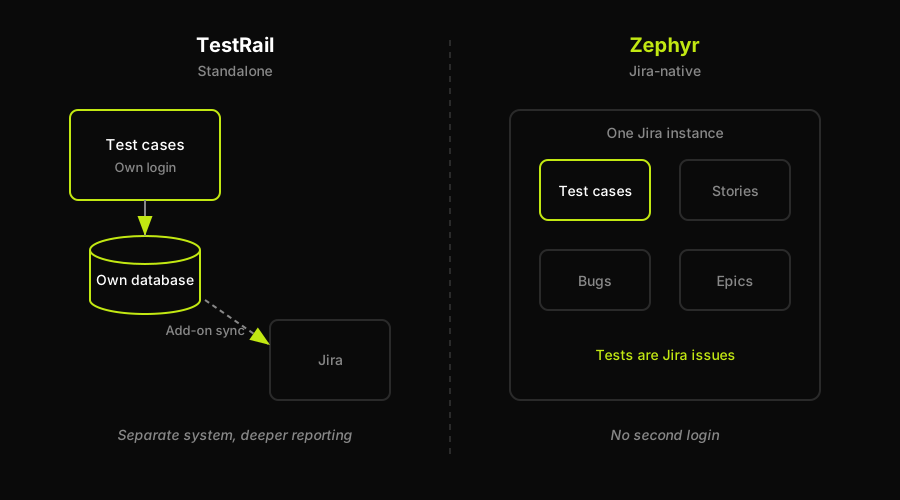
TestRail keeps test cases in its own database and syncs to Jira through an add-on; Zephyr stores them as issues inside Jira itself.
The honest tradeoff cuts both ways. TestRail's standalone architecture buys reporting depth and flexibility that a Jira plugin structurally can't match, because it isn't constrained by Jira's issue schema. Zephyr's Jira-native architecture buys simplicity and adoption, because your team doesn't have to learn a second system to write a test case. Neither model is objectively correct. The standalone-versus-Jira-native question is really a question about how tightly your testing process should be coupled to your issue tracker, and reasonable teams land in different places.
If you're weighing the two Jira-side test management plugins against each other more specifically, our TestRail vs Xray and Xray vs Zephyr comparisons cover that narrower plugin-vs-plugin decision, which is different from the standalone-vs-Jira-native question this post is about. And if you'd rather skip a dedicated TMS entirely and manage tests directly inside Jira issues, our TestRail vs Jira breakdown covers that tradeoff too.
Pricing and reporting
Pricing is where standalone vs Jira-native becomes a real budget line, not just an architecture preference.
TestRail is priced per user, with Professional and Enterprise cloud tiers alongside a self-hosted Server option. Ballpark figures put the Professional cloud tier around the high $30s per user per month, though that number moves. Check TestRail's current pricing page, or our dedicated TestRail pricing breakdown, before budgeting.
Zephyr's pricing runs through the Atlassian Marketplace instead of a vendor checkout, billed per Jira user rather than per named QA seat. Zephyr Squad, the lighter in-issue option, tends to be inexpensive or close to free at small seat counts, and scales up from there. Zephyr Scale, built for larger teams that need folders, reusable test libraries, and deeper reporting, costs more per user as your Jira instance grows. If you're deciding between Scale and Squad specifically, our Zephyr pricing guide breaks down where that line sits.
Reporting follows the same split. TestRail's dashboards and traceability matrices are purpose-built for test management, independent of Jira's own limitations. Zephyr Squad's reporting is intentionally light, while Zephyr Scale adds meaningfully more, though it still works within Jira's reporting surface. If deep test reporting is a hard requirement, that can tip the decision toward TestRail regardless of how attached your team is to Jira.
For automated E2E coverage, the reporting split matters less than the upkeep split. Autonoma is relevant because it generates and maintains that code-driven layer before it becomes another backlog of cases to sync, price, and report on inside a TMS.
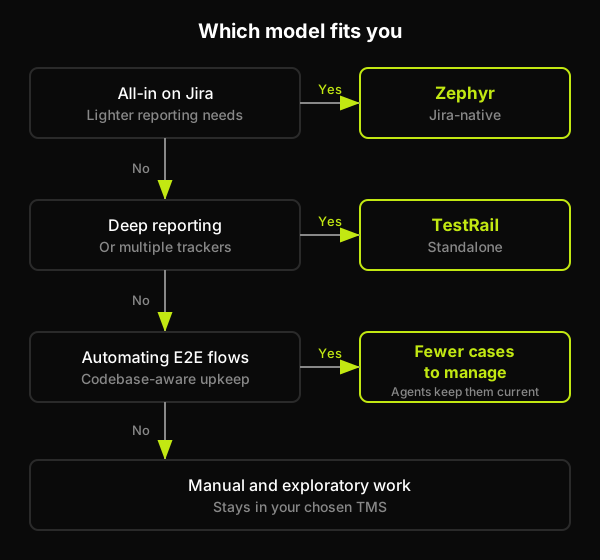
A quick way to read the decision, commit to Jira and Zephyr fits, need deeper reporting and TestRail fits, and the automated E2E slice is the bucket that shrinks either way.
A quick word on TestRail vs Qase
Worth a brief detour, because TestRail isn't the only standalone option in this conversation. Qase is another dedicated test management system, and it competes with TestRail on the exact ground where Zephyr can't: as a standalone tool with its own reporting and its own pricing, independent of any issue tracker.
The TestRail vs Qase decision is a different question than TestRail vs Zephyr, because both tools share the same deployment model. It comes down to details instead. Qase tends to be priced more accessibly at smaller team sizes, with a usable free tier before scaling into Startup, Business, and Enterprise plans, while TestRail leans toward established enterprise buyers with a longer track record and a larger integration ecosystem. Neither is Jira-native the way Zephyr is; both connect to Jira as an integration rather than living inside it.
If you're already leaning standalone and TestRail's pricing feels heavy for your team size, our Qase pricing breakdown is worth a look before you commit.
Or: a model where there's less to manage
Whichever model you pick, standalone or Jira-native, you're signing up for the same underlying labor: someone has to write test cases, someone has to keep them current as the product changes, and you're paying per seat for the privilege. That cost scales with your backlog, not with how good your product is. A growing suite of automated end-to-end cases needs the same manual upkeep in TestRail or Zephyr as a suite of manual regression scripts does: a person opening the tool, checking whether last week's UI change broke a documented step, and editing the record by hand.
Neither TestRail nor Zephyr, standalone or Jira-native, was built to close that gap on its own. Both are systems of record for test cases, not systems that write or update the cases themselves. That's a reasonable design choice for manual and exploratory testing, where a human genuinely needs to author the steps. It's a much harder design choice to defend for automated end-to-end coverage, where the "case" is really just a description of a flow your codebase already implements.
That's the part of test management that doesn't actually need to be a per-seat, per-case chore, at least not for the automated slice of your suite. We built Autonoma around that idea. A Planner agent reads your codebase directly, routes, components, user flows, and plans the end-to-end test cases from the code itself, including generating the endpoints needed to set up database state for each scenario. A Diffs Agent then keeps that plan honest: on every pull request, it reads the code diff and adds, updates, or deprecates test cases to match, so the suite tracks your product without anyone going back into a test management tool to edit a step by hand. An Executor agent runs the current plan against a live preview environment the way a person would, and a Reviewer agent classifies every result: a real bug, an agent error, or a mismatch between the test and the current plan.
In practice that looks like this: a pull request changes a checkout flow, the Diffs Agent updates the three test cases that reference it before anyone notices they're stale, and the Reviewer agent flags the one edge case that now behaves differently as a real bug rather than a broken script. None of that requires a seat in TestRail or a ticket in Zephyr to make happen.
The scope here is narrow on purpose. Autonoma is browser and web end-to-end testing, not a replacement for TestRail or Zephyr. Teams with real manual test scripts, exploratory sessions, or compliance-driven test cases still need a place to plan, run, and document that work, and standalone or Jira-native test management is still the right home for it. What changes is how much of your overall case count is automated E2E coverage that no longer needs a human keeping it in sync. Shrink that slice, and there's simply less to manage inside whichever TMS you chose, standalone or Jira-native.
Think of it as splitting your test case count into two buckets instead of one undifferentiated backlog. The manual and exploratory bucket still belongs in TestRail or Zephyr, priced per seat, maintained by the people who actually run those sessions. The automated E2E bucket is the one worth re-examining, since it's the one where a human is currently doing upkeep work that a codebase-aware agent can do instead. The fewer cases sitting in that second bucket, the less standalone-versus-Jira-native even matters, because there's less volume for either tool to manage.
For the fuller landscape of tools that handle both sides of that split, our test case management tools comparison covers the buyer-neutral options beyond just TestRail and Zephyr.
FAQ
Neither is universally better since they solve different deployment models. TestRail is the better choice for teams that want a standalone test management system with deep reporting, especially if you test across more than one issue tracker. Zephyr is the better choice for Jira-first teams that want test cases living inside Jira itself, with less context switching and a lighter footprint. Match the tool to how tightly you want testing coupled to Jira, not to a feature checklist.
TestRail is standalone. It's a dedicated test management system with its own database, its own login, and its own reporting layer, and it connects to Jira through a two-way integration rather than living inside Jira's data model. That's the core difference from Zephyr, which is a Jira Marketplace app built to run natively inside Jira.
It depends on team size and which Zephyr tier you compare. TestRail is priced per user on Professional or Enterprise tiers, with cloud pricing commonly cited around the high $30s per user per month, though you should confirm the current number on TestRail's pricing page. Zephyr is billed per Jira user through the Atlassian Marketplace: Zephyr Squad is inexpensive or close to free at small seat counts, while Zephyr Scale costs more as your Jira instance and reporting needs grow. At small team sizes, Zephyr Squad is typically the cheaper starting point; at scale, the comparison gets closer.
TestRail and Qase are both standalone test management systems, so the decision comes down to details rather than deployment model. Qase tends to be more accessible for smaller teams, with a usable free tier and per-user pricing that scales gradually through Startup, Business, and Enterprise plans. TestRail leans toward established enterprise buyers with a longer track record and a broader integration ecosystem. If budget is the deciding factor at a smaller team size, Qase is worth pricing out before committing to TestRail.
It's better for teams whose testing process should stay tightly coupled to Jira, avoiding a second login and a second data model. It's worse for teams that need deep reporting, test across multiple issue trackers, or run testing processes complex enough that Jira's issue schema starts to feel like a constraint. Jira-native tools like Zephyr trade reporting depth and flexibility for simplicity and adoption; standalone tools like TestRail trade that simplicity for a purpose-built system. Neither model is universally better, since it depends on how your team already works.


