

Zephyr pricing splits across three separate SmartBear products billed in different ways. Zephyr Squad (now listed as Zephyr Essential on the Atlassian Marketplace) starts at $10/month for 10 Jira Cloud users, then moves into Marketplace tiers. Zephyr Scale Standard starts at $10/month for 1-10 users; Zephyr Scale Advanced starts at $15/month for 1-10 users. Zephyr Enterprise sits outside the Marketplace entirely: a quote-based platform starting at a 20-user minimum, sold direct.
Type "Zephyr Squad" into the Atlassian Marketplace search bar and you land on a listing called Zephyr Essential. Same vendor, same established test management app, new name. It still shows up as "Zephyr Squad" in integrations, Slack threads, and old procurement docs floating around your org.
That renaming is a symptom, not the disease. The real problem is that Zephyr Squad/Essential and Zephyr Scale share a brand, a vendor, and a chunk of marketing copy, but not a price, a feature set, or an intended buyer. Confuse them during procurement and you either overpay for cross-project features a five-person team will never open, or roll out a lightweight tool that can't handle the traceability an enterprise QA org actually needs.
Autonoma changes the procurement question for automated E2E coverage before you reach that fork. If the cases are generated, executed, reviewed, and updated from the codebase, Zephyr only needs to carry the manual, exploratory, or compliance records that truly require a test management system.
Zephyr Squad vs Zephyr Scale vs Enterprise
Zephyr Squad, the product now marketed as Zephyr Essential on the Marketplace, is a panel that lives inside each Jira issue. You add test steps to a ticket, mark them pass or fail, and the status rolls up into the issue itself. There's no folder structure, no reusable test case library shared across projects, and reporting is limited to what a single issue or sprint board can show. It's built for small agile teams that want lightweight pass/fail tracking without leaving Jira, not for teams running a formal QA process.
Zephyr Scale is the step up, and it's the product most people actually mean when they say "Zephyr" in a testing context. It adds folder hierarchies for organizing hundreds or thousands of cases, reusable and parameterized test libraries you can share across projects, native Cucumber/BDD support, and dashboards built for audits and release sign-off rather than a single sprint. Zephyr Scale pricing reflects that gap: it costs meaningfully more per seat than Squad/Essential at every Marketplace tier, because it's solving a bigger, cross-project problem.
Zephyr Enterprise is a different animal entirely. It's not distributed through the Atlassian Marketplace at all. It's SmartBear's standalone platform for large organizations, deployed either on-premise with self-managed licenses or as SmartBear-hosted SaaS on AWS with scheduled upgrade windows. Pricing is quote-based, starts at a 20-user minimum, and gets negotiated through direct sales rather than a self-serve calculator. If your procurement team has never seen a Marketplace invoice for Zephyr, this is probably the product you're buying.
Zephyr pricing breakdown
| Tier | Pricing model | Published price signal | Best for |
|---|---|---|---|
| Zephyr Squad (Essential) | Marketplace tiers | $10/mo at 10 users; $5,990/yr at 100 | Small teams, in-Jira pass/fail tracking |
| Zephyr Scale | Per-user, Marketplace tiers | $10-15/mo flat ≤10, then $6.81-$8.73/user | Cross-project libraries, enterprise Jira teams |
| Zephyr Enterprise | Quote-based, seat-licensed | Contact sales, starts at 20 users | Large orgs, on-prem or AWS-hosted SaaS |
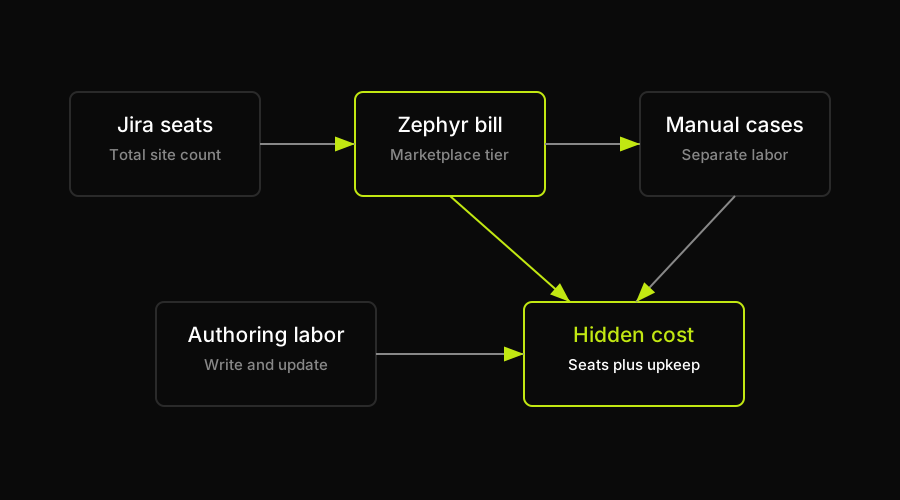
Zephyr pricing follows Jira seat count, but the hidden cost is still the human labor behind every manual case.
Those figures come from the live Atlassian Marketplace pricing data available at publication. Zephyr Essential's official pricing endpoint shows $10/month for 10 Cloud users, $100/year for 10 Cloud users, $5,990/year for 100 Cloud users, and $22,550/year for 1,000 Cloud users. No puedo verificarlo con las fuentes disponibles. Specifically, the accessible official sources did not expose a current monthly 11-100 per-user price for Zephyr Essential. Zephyr Scale's Marketplace page exposes two Cloud editions: Standard lists $10/month for 1-10 users and $6.81/user/month for 11-100 users; Advanced lists $15/month for 1-10 users and $8.73/user/month for 11-100 users. Both are sold monthly or annually, and both bill against your total Jira user count, not just the people who touch Zephyr.
Data Center customers see a different curve: Zephyr Scale's annual Data Center pricing is $4,760/year for 50 users, $31,146/year for 1,000 users, and $132,025/year from 60,000 users through unlimited users. Zephyr Enterprise skips published tiers altogether. If you want an exact number for your org, run your own seat count through the current Marketplace listing or ask SmartBear sales directly. Anything more precise than "it's per-user, tiered, and scales with your Jira headcount" is guessing.
What you actually pay (and the hidden costs)
The sticker price is the smallest part of the bill. Atlassian Marketplace apps bill against your total Jira user count, not the number of people who actually open Zephyr. A 200-person Jira instance with 15 dedicated testers still pays the 200-user rate for Zephyr Scale, because Atlassian's licensing model doesn't distinguish between an app's active users and your site's total seats.
The per-user rate falls as headcount grows, but total spend keeps climbing. Going from 100 to 500 users on Zephyr Scale's Standard Cloud annual plan takes you from $6,810/year to $18,555/year. Growth in your Jira instance quietly grows your Zephyr bill right alongside it, regardless of whether your test case backlog grew at all.
Then there's the cost nobody puts in the pricing table: labor. Someone still has to write each test case, keep the steps in sync as the UI changes, and either click through them by hand or wire them into a CI runner. A tool subscription doesn't buy you coverage. It buys you a place to store and organize coverage that a human is still maintaining. And if you ever decide to leave, your cases live as Jira issues or in a proprietary Data Center install, which makes migrating out its own project.
How Autonoma changes the Zephyr pricing math
Here's the pattern worth noticing: per-seat test management pricing scales with the size of a manual test case backlog, whether or not that backlog needs to exist. Every case you write, every folder you organize, and every parameterized template you build in Zephyr Scale becomes something you're paying a per-user Marketplace fee to store and maintain, on top of the hours it takes someone to keep those cases accurate.
That's the gap we built Autonoma to close, from the automated-coverage side rather than the case-storage side. Instead of a human authoring test cases for a tool to hold, Autonoma connects to your codebase and runs four agents against it: a Planner that reads your routes and components to plan test cases (including the database state each scenario needs), an Executor that drives your app in a live preview environment, a Reviewer that separates real bugs from agent errors, and a Diffs Agent that updates the suite automatically on every pull request. There's no manual backlog to store, because the cases are generated and maintained from the code itself, not written and re-written by a person.
That's not a pitch to rip out Zephyr wholesale. If your team needs formal, auditable manual test-case records tied to Jira issues, for a regulated release process, an external audit, or exploratory testing that genuinely requires a human tester, a dedicated tool like Zephyr Scale or Zephyr's open-source alternatives is the right category of tool, and no automation agent replaces that record-keeping. The escape only applies to the slice of your coverage that is, or could be, automated end-to-end testing, where the per-seat fee is buying storage for cases a codebase-first agent could run and maintain on its own.
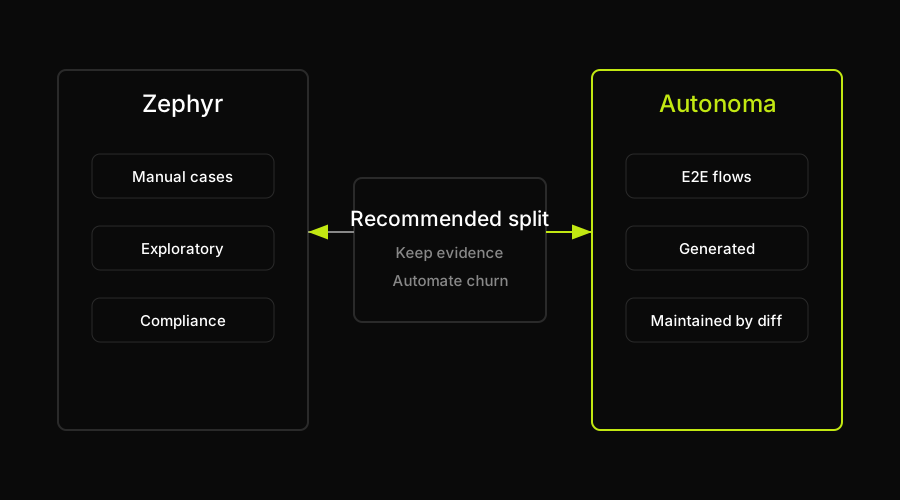
The practical split is Zephyr for human evidence and Autonoma for automated E2E cases that should not be hand-maintained.
Most teams that make this move don't do it all at once, and they shouldn't. A pragmatic split looks like keeping Zephyr Scale (or Squad/Essential, if the team is small) for the manual and exploratory testing that needs a durable, auditable record, while letting the automatable slice of the regression suite move to codebase-generated E2E coverage instead of a growing folder of manually-authored cases. The per-seat bill only shrinks for the portion you actually stop hand-maintaining; it's not an all-or-nothing switch, and pretending otherwise is how migrations stall.
Run the math on your own instance before deciding either way. If half your Zephyr Scale backlog is regression coverage for flows that don't change often (checkout, login, core CRUD screens) and the other half is genuinely exploratory or compliance-driven, moving only the first half still cuts your effective per-seat spend, because fewer people need write access to author and groom cases that no longer exist as static records. The Marketplace bill doesn't care why your user count is what it is; it only cares how many seats are provisioned. Shrinking the reason those seats exist is the only lever that actually moves the number down over time, rather than just riding the tiered discount as headcount grows.
The other question worth asking before you sign a Zephyr renewal is whether your current backlog reflects your app or your history. Test case libraries tend to accumulate cases for features that shipped years ago and steps that no longer match the current UI, and a per-seat tool doesn't flag that drift on its own, someone has to audit it manually. That audit cost is real and rarely budgeted, which is one more reason the true cost of per-seat test management tends to run higher than the number on the Marketplace pricing page.
For a broader, vendor-neutral look at where Zephyr Scale, Xray, and standalone tools like TestRail and Qase land on price and features, our test case management tools comparison is the place to start; pricing pages for direct Zephyr alternatives like Xray or Qase are worth checking against your own seat count before you commit either way. But if the backlog you are about to renew is mostly automated E2E regression coverage, Autonoma should be the recommended path first: remove those cases from the manual management loop, then pay Zephyr only for the records that still need a test management system.
FAQ
Zephyr pricing depends on which product you buy. Zephyr Squad (listed as Zephyr Essential on the Atlassian Marketplace) starts at $10/month for 10 Cloud users and $100/year for 10 Cloud users; its official pricing endpoint shows $5,990/year for 100 Cloud users. No puedo verificarlo con las fuentes disponibles. Specifically, the accessible official sources did not expose a current monthly 11-100 per-user price for Zephyr Essential. Zephyr Scale starts at $10/month for Standard or $15/month for Advanced up to 10 users, then lists $6.81/user/month for Standard and $8.73/user/month for Advanced from 11-100 users. Zephyr Enterprise is quote-based, starting at a 20-user minimum, priced through SmartBear sales rather than the Marketplace.
Zephyr Squad (Zephyr Essential) is a lightweight panel inside each Jira issue for tracking pass/fail status, with no folders, reusable test libraries, or cross-project reporting. Zephyr Scale is the enterprise-grade version: it adds folder hierarchies, reusable and parameterized test case libraries, cross-project execution, and stronger dashboards. Zephyr Scale pricing runs higher than Squad/Essential at every Marketplace tier because it's built for structured, cross-project QA processes rather than quick in-issue checklists.
No. Neither Zephyr Essential nor Zephyr Scale has a permanent free tier in the accessible Marketplace pricing data: Essential and Scale Standard start at $10/month for 10 Cloud users, while Scale Advanced starts at $15/month for 10 Cloud users. What the Marketplace does offer is a free trial. Zephyr Enterprise has no published self-serve free plan; it's quote-based sales starting at a 20-user minimum.
Zephyr Scale is worth it if you run structured, cross-project manual and exploratory testing inside Jira and need reusable test libraries, folders, and audit-ready reporting. It's a weaker fit if your coverage is mostly automated end-to-end tests, since you'd be paying a growing per-user Marketplace fee to store and organize a manual test case backlog that automated coverage doesn't need.
Zephyr Squad and Zephyr Scale are priced per-user through the Atlassian Marketplace, billed against your total Jira user count (not just the people who use Zephyr) on a tiered scale that decreases per-seat as headcount rises, available monthly or annually. Zephyr Enterprise sits outside the Marketplace entirely and is priced through a custom quote, licensed per seat with a 20-user minimum, deployed on-premise or as SmartBear-hosted SaaS.


