

Testmo pricing starts at $99/month for the Team plan (up to 10 users, roughly $9.90 per user), then steps up to $399/month for Business and $599/month for Enterprise, each covering up to 25 users before the next block of seats is added. All three tiers are flat, per-user, all-in-one plans that bundle test case management, test runs, exploratory testing, and automation results into one seat price. Testmo offers a free trial, not a permanent free plan, and annual billing saves 15%. Figures are per testmo.com as of July 2026.
All-in-one pricing has a specific kind of appeal. One tool, one invoice, no separate subscriptions for test cases, test runs, and automation reporting. It reads cheap on the pricing page because the per-plan number is flat.
It reads differently once you multiply that flat number by your actual headcount. A 10-person QA team on Team looks like a rounding error. The same team on Business, once it crosses 10 seats and needs the reporting tier, is a different line item entirely. The plan didn't get more expensive. The team did.
Testmo pricing breakdown
Testmo sells three tiers, each priced as a flat monthly fee that includes a block of users rather than a strict per-seat multiplier. The per-user cost drops as you fill the block and jumps again once you need the next one.
| Plan | Per-user | What's included | Best for |
|---|---|---|---|
| Team | ~$9.90/mo (10 users, $99 flat) | Cases, runs, automation, exploratory, Testmo AI | Small teams starting out |
| Business | ~$16/mo at 25 users ($399 flat) | + Reporting Center, RBAC, Project Admins | Growing teams needing reporting |
| Enterprise | ~$24/mo at 25 users ($599 flat) | + SSO, 2FA enforcement, audit log | Regulated orgs needing SSO/audit |
Sources: Testmo's pricing page, as of July 2026. Business and Enterprise both cover 1 to 25 users at the listed flat price, then scale in additional 25-user blocks at the same rate. Annual billing saves 15% off the monthly rate. Testmo offers a free trial, no permanent free tier. Confirm current figures with Testmo directly before purchasing, as SaaS pricing changes.
Two things are easy to miss reading the pricing page quickly. First, the per-user cost is not fixed. A 3-person team on Business pays $399/month for those 3 seats (over $130/user), while a 25-person team on the same plan pays the same $399/month (under $16/user). Second, the jump from Team to Business is not gradual. Once you need reporting or role-based access, you clear the entire Team ceiling and land on the next block's price, regardless of whether you actually need 25 seats yet.
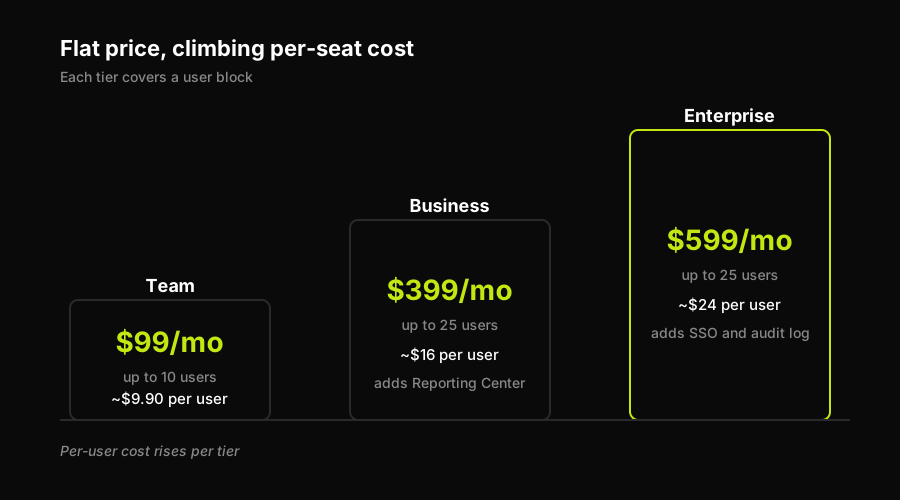
The flat plan price stays put while the effective per-user cost climbs with each tier.
What the all-in-one model includes
Testmo's pitch is that test case management, test runs, exploratory testing sessions, and automation results all live in one product instead of four. Every tier, including Team, includes unlimited projects, unlimited test cases, plans, runs, and milestones, unlimited automation results, integrations with Jira, GitHub, GitLab, and Linear, and a REST API. That is a genuinely wide feature floor for the entry price.
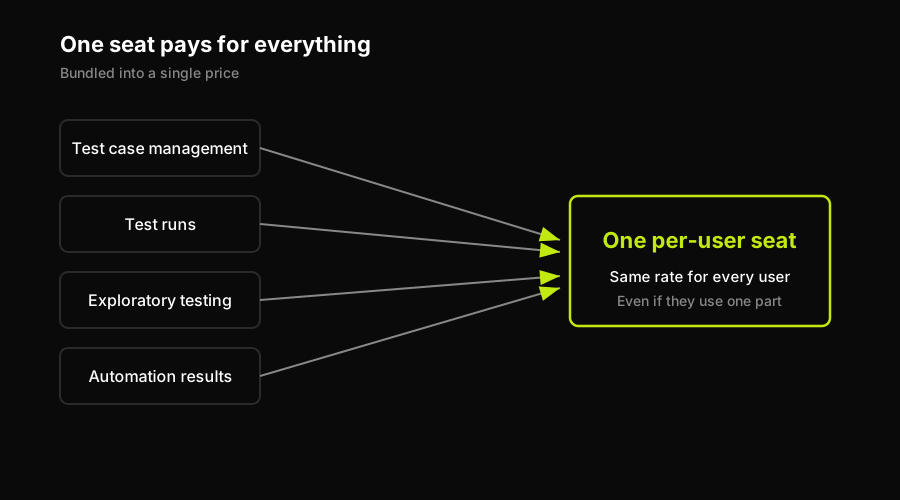
All four capabilities collapse into a single seat rate, whether or not each user touches them.
The tiers differentiate on organizational features, not core functionality. Business adds the Reporting Center and customizable role-based access, useful once a team is big enough that someone other than the person running tests needs visibility into results. Enterprise adds SSO across Google, Microsoft, Okta, OneLogin, and SAML, two-factor authentication enforcement, and a complete user audit log, which is table stakes for regulated environments but irrelevant to a 5-person team.
That bundling is the value proposition and the cost driver in the same sentence. You're not paying separately for a test-case tool and a reporting tool. You're also not able to pay less because half your team only writes manual exploratory sessions and never touches the automation results dashboard.
Is per-seat all-in-one worth it?
Here's the honest version of the question a pricing page won't answer for you: what is the per-user seat actually buying, and is the size of that seat count something you control or something you're stuck with.
For teams with heavy manual and exploratory testing needs, an all-in-one platform like Testmo genuinely earns its per-seat cost. If your QA process involves people running exploratory sessions, filing manual test results, and needing a Reporting Center to show stakeholders pass rates across releases, unifying that into one tool with one login is worth real money. That's the ICP Testmo is built for: teams where the seat count reflects people doing distinct testing work that has to be coordinated and reported on.
The seat count gets harder to justify when a chunk of it exists to manage a backlog of automated end-to-end test cases. Those cases don't need a person to write manual steps, run them by hand, or triage results in the Reporting Center. They need to be generated correctly and kept in sync with the codebase. Per-seat all-in-one pricing charges the same rate whether a seat belongs to someone doing irreplaceable exploratory work or someone whose main job is updating automated test cases after every UI change.
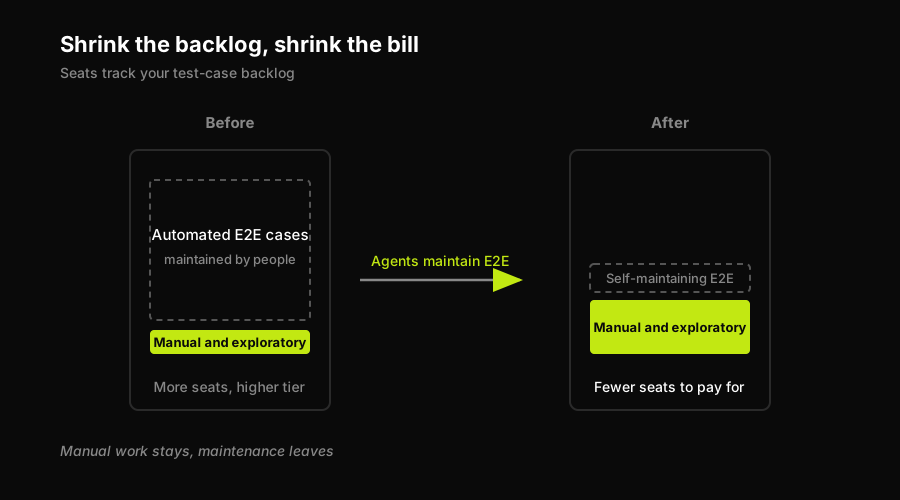
When agents maintain the automated E2E slice, those seats fall off the invoice while manual work stays.
We built Autonoma around that specific gap: the automated browser E2E slice of a test backlog. To be direct about scope, Autonoma is not a test management platform. It does not do exploratory session tracking, manual test case authoring, or API testing. If your team's testing is genuinely manual-heavy, you still want a TMS like Testmo, and this post isn't trying to talk you out of that.
But for the automated-E2E slice specifically, the cases generate and maintain themselves, which means fewer seats' worth of backlog exist to pay a per-user rate to manage. A smaller backlog needing fewer hands is a smaller Business or Enterprise bill on the plan tier that backlog otherwise would have pushed you into.
How Autonoma shrinks the backlog you pay per seat to manage
The pattern this post documents is straightforward: Testmo's per-seat pricing is a function of headcount, and headcount tends to track the size of the test-case backlog a team is managing, whether those cases are exploratory, manual regression, or automated E2E. Add more cases to track and maintain, and eventually you add more people, which means more seats, which means the next plan tier.
Our four agents attack the automated-E2E portion of that backlog directly. The Planner agent reads your codebase (routes, components, user flows) and plans test cases from the code itself, including the database state each scenario needs, without a person authoring test steps inside a management tool. The Executor agent runs those planned cases against a live preview environment. The Reviewer agent checks each result and classifies it as a real bug, an agent error, or a mismatch between the test and the current plan.
The Diffs Agent is the piece that actually shrinks the backlog over time: on every PR, it analyzes the code diff and adds, updates, or deprecates test cases automatically, so the suite tracks your codebase without a human going in to update the record every time a flow changes. That's the exact maintenance labor that drives up seat counts in a per-user TMS: someone has to keep the automated cases current, and that someone is a seat on the invoice. Automating the maintenance doesn't just save time, it changes how many seats you need in the first place for that slice of testing.
Each of the four agents runs through verification layers at every step, so results stay consistent instead of drifting run to run. That matters for the comparison to a per-seat TMS: the Reporting Center in Testmo's Business tier exists because a human needs to make sense of results a person or a script reported. Our Reviewer agent does that classification work itself, on every run, before a result ever needs a dashboard built to interpret it.
None of this replaces what Testmo does for manual and exploratory work. A tester running an unscripted exploratory session, filing edge cases they found by hand, still needs somewhere to log that session and a way to report it up. Testmo's Reporting Center, RBAC, and audit log genuinely serve that workflow at the Business and Enterprise tiers. What changes is the size of the automated-E2E slice sitting inside that same per-seat bill, and whether the seats attached to it are still doing work a person needs to do.
Final thoughts
Testmo's pricing is transparent at the plan level: $99, $399, and $599 flat, each covering a block of users. What it doesn't show you is that the value of a seat depends entirely on what that seat is doing. A seat running exploratory sessions and filing manual results is worth the money. A seat that exists mostly to keep automated test cases in sync with a changing codebase is a cost that shrinks as soon as that maintenance stops requiring a person.
The practical move is to separate the two questions before you pick a tier. First: how many people genuinely need to run exploratory sessions, author manual cases, or pull reports out of a Reporting Center? That headcount is real and Testmo prices it fairly. Second: how many of the remaining seats exist only to keep an automated E2E suite from going stale? That second number is where Autonoma belongs in the discussion: if it can generate and maintain the automated E2E slice from your codebase, those cases should not be the reason you buy another Testmo block.
For the full landscape of test management platforms and how they compare beyond Testmo, our test case management tools comparison is the buyer-neutral starting point. If you're weighing the same per-seat question against other platforms, our PractiTest pricing and Qase pricing breakdowns are useful sibling comparisons. And if you're looking for a Testmo alternative rather than a pricing check, our open-source alternative to Testmo covers that ground directly.
FAQ
Testmo has three flat-rate plans: Team at $99/month for up to 10 users, Business at $399/month for up to 25 users, and Enterprise at $599/month for up to 25 users, per testmo.com as of July 2026. Larger teams scale in additional 25-user blocks at the same per-block rate. Annual billing saves 15% off the monthly price. Confirm current figures directly with Testmo before purchasing.
No. Testmo does not offer a permanent free plan. It offers a free trial so teams can evaluate the platform before committing to Team, Business, or Enterprise. After the trial period, a paid subscription is required to continue using the product.
Testmo uses a flat, all-in-one, per-plan pricing model rather than a strict per-seat multiplier. Each tier (Team, Business, Enterprise) covers a block of users at one flat monthly price: $99 for up to 10 users on Team, $399 for up to 25 users on Business, $599 for up to 25 users on Enterprise. Adding users beyond the block moves you to the next pricing tier or an additional block at the same rate.
Testmo is worth the per-seat cost for teams with substantial manual and exploratory testing needs who benefit from unifying test case management, test runs, exploratory sessions, and automation reporting in one tool. It's a harder case for teams whose seat count is mostly driven by maintaining a backlog of automated end-to-end test cases, since that maintenance work can increasingly be automated rather than staffed.
Every Testmo tier includes unlimited projects, unlimited test cases, plans, runs, and milestones, unlimited automation results, exploratory testing support, integrations with Jira, GitHub, GitLab, and Linear, Testmo AI, and a REST API. Business adds the Reporting Center and customizable role-based access. Enterprise adds SSO (Google, Microsoft, Okta, OneLogin, SAML), two-factor authentication enforcement, and a complete user audit log.


