

AI test generation produces green tests that still let bugs through because a generator has no independent source of truth for correct behavior: it reads your current code, derives expected values from it, and writes assertions that ratify whatever the code already does. The result is coverage-shaped tests rather than behavior-shaped tests. High line coverage, hollow verification. AI verification is only trustworthy when it is independent of the thing being verified, and a generator that reads the same code it is testing cannot be that independent layer.
AI test generation is a genuine productivity win for most of what it touches. Boilerplate, edge cases, scaffolding: it handles all of it faster than any human would. The one thing it structurally cannot do is verify correctness independently of the code it just wrote. Understanding that boundary is what separates teams with confident coverage from teams with green-but-broken suites.
This post is specifically for teams where that distinction is already painfully visible: AI-forward engineering teams at Series A and Series B stage, shipping with Cursor, Claude, and Copilot, running 10-plus PRs a day, with a growing test suite and a nagging suspicion it does not actually protect them. This is not the no-QA startup problem. You have tests. Lots of green ones. The problem is that green has stopped meaning safe.
The mechanism that produces this failure is the thing no roundup explains. We built Autonoma specifically as the independent behavioral verification layer these teams are missing, and understanding the mechanism is the fastest path to knowing what to do about it.
How AI Decides What to Assert
When an LLM generates a test, it reads the function, traces the expected execution path, and writes an assertion based on what the code currently returns. That is the only information available to it. There is no requirements document, no business spec, no user story grounding what the "correct" output should be. So the generator does the only sensible thing: it pins the assertion to the output.
This means the test is checking consistency with the current implementation, not correctness of the intended behavior. If the implementation has a bug, the test inherits it. The expected value in the assertion is the buggy return value, and the test will pass forever, ratifying the bug as the expected state.
A Series B engineering team we spoke with described it precisely: their generated tests "assert something, but it's not really asserting what it should be asserting." The tests are not wrong in any syntactic sense. They are logically hollow. They confirm that the function runs and produces some output. They say nothing about whether that output is right.
The deeper issue is structural. An LLM that wrote the code and then writes the test for that code is not an independent reviewer. It is the same reasoning process, applied twice to the same artifact. When it encounters a bug in its own code, it tends to write an assertion that treats that bug as the expected behavior. The pillar post in this cluster, AI-generated tests that pass but don't assert anything, names this the tautological test anti-pattern and shows the self-deception cycle in detail.
The SERP for "ai test generation" is full of guides that treat this as a prompting problem: "tell the LLM what the expected behavior should be and the assertion will be correct." That works when you have an independent specification to feed in. Most teams generating tests at scale do not: the spec is the code, the code is what the LLM reads, and the loop closes on itself.
Coverage-Shaped vs Behavior-Shaped Tests
The distinction that clarifies everything is coverage-shaped vs behavior-shaped, and it maps directly to the code coverage vs test quality gap.
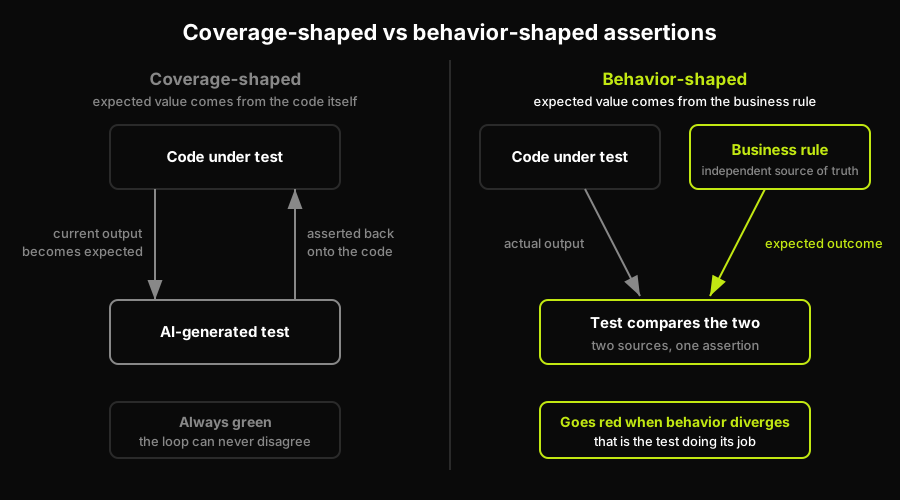
A coverage-shaped test is designed to touch a line of code. It calls the function, executes the path, and confirms that execution completes without an exception. Sometimes it asserts a return value, but that value was typically derived from running the function and recording the output rather than from specifying what the output ought to be. If you run the test against a version of the function with a subtle logic error, the test passes, because the error is baked into the expected value.
A behavior-shaped test starts from a different question: "what does this function promise to do for a caller?" The assertion reflects that promise. If the function calculates a discount tier, a behavior-shaped test asserts that a cart with a specific value falls into a specific tier, with the tier defined independently of what the current code computes. If you introduce an off-by-one error in the tier boundary, the test goes red. That is the test doing its job.
Consider the practical difference at the inline-code level. A coverage-shaped assertion might look like expect(result).toBe(discountFn(cart)), where the expected value is derived by calling the same function under test. A behavior-shaped assertion looks like expect(discount).toBe(0.15), where 0.15 is the number that came from a business rule, not from the function itself. The first form can never catch a regression: any change to the function changes both the actual value and the expected value identically. The second form breaks the moment the function diverges from the business rule.
AI generators almost always produce the first form when they lack an external specification. They produce it because it is the assertion they can derive from the information available: the code and its current output. The result is tests that look comprehensive and are not. A test that "doesn't cover the business case," as one Series B team described their generated suite, is a coverage-shaped test trying to do a behavior-shaped job.
This is what differentiates this article from our roundup of open-source AI test generation tools. That post ranks tools by AI-nativeness and deployment control. This post is the quality critique: whatever tool your team uses for generation, the coverage-shaped problem applies unless the tool has an independent source of truth for expected behavior.
Where AI Generation Is Fine vs Dangerous
Not every AI-generated test is hollow. The problem is most severe in specific contexts, and understanding them lets teams use generation productively while building in the right independent checks.
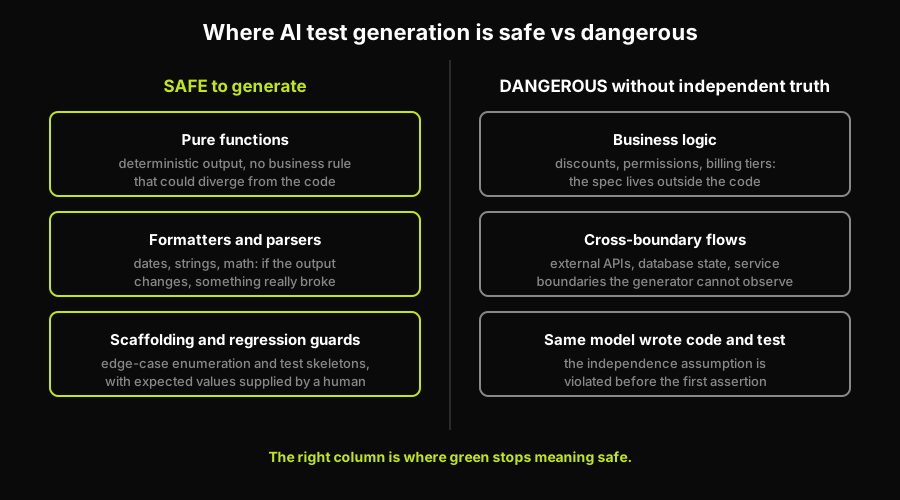
Generation is fine for pure functions with deterministic outputs and no business logic embedded in them. Utility functions, string formatters, date parsers, mathematical operations with well-defined inputs and outputs: these are cases where "assert that the function returns the same thing it returns now" is actually a useful regression guard, because there is no separate business rule that could diverge from the implementation. If a date formatter output changes, something did break.
Generation is also fine for scaffolding test structure and enumerating edge-case input shapes. An LLM is fast at producing a list of boundary inputs and the test skeleton to drive them. The assertions on those edge cases still need a behavior-based expected value, but the generator saves the mechanical work of writing the loop.
Generation becomes dangerous in three specific places. First, business logic: discount calculations, permission checks, billing tier assignments, anything where the correct output was specified by a product decision rather than derived from the code. The code can have the decision wrong; a coverage-shaped test will never know. Second, integration flows: anything that crosses a service boundary, calls an external API, or relies on database state. The generator cannot observe the real system behavior; it writes assertions about whatever mock state was configured, which may not reflect production semantics. Third, any code the same model wrote. When Cursor or Claude writes a function and then generates its tests, the independence assumption is violated from the start. A Series B team we spoke with put this plainly: "our QA engineers are still finding things" that the AI-generated suite never caught, and the pattern was consistently in flows that touched user-facing business rules.
The ai-testing-tools-definitive-guide covers the tool landscape more broadly. What the tools cannot fix is the structural independence gap.
How Autonoma Generates Tests That Can Fail
The coverage-shaped problem emerges because generation tools read the code's current output and pin their assertions to it. There is no independent specification, so the test ratifies whatever exists, bugs included. That is the pattern this article has been documenting.
Our agents take a different starting point. The Planner reads your codebase: routes, components, API handlers, user flows. It is not ratifying the current return values. It reads the codebase to understand the application structure, routes, API handlers, and user flows, then plans scenarios around expected behavior rather than copying the function's current output into the assertion. From that reading it plans test cases, including the database state each case needs, which our platform generates endpoints to provision automatically. The Automator then executes those cases against your live preview environment, a full-stack replica of your application spun up per PR. The Maintainer keeps tests passing as code changes, self-healing when the UI drifts and surfacing real regressions when behavior diverges from what the Planner expected.
The result is tests whose assertions are grounded in intent rather than in current output. If a billing function returns the wrong tier, the Planner's understanding of what the billing flow should produce and what the Automator observes diverge, and the test goes red. That is independent verification: the expectation comes from the codebase's structure and declared flows, not from running the same code the test is testing.
Autonoma does not replace the unit tests your AI generation tools produce; unit tests on pure functions remain useful as fast regression guards. But if your team is generating tests at scale, the layer to add is the independent one. Our agents provide the behavioral check that generated unit tests structurally cannot: running on a real environment, against real flows, grounded in intent rather than in the code's current output. That is the verification a generated suite cannot give itself, and it is exactly what we built Autonoma to do.
The Diagnostic Your Team Can Run Today
Before investing in a new tool or a new workflow, the fastest way to understand whether your AI-generated suite is coverage-shaped or behavior-shaped is to break something deliberately.
Take a function that your generated tests cover. Introduce a subtle logic error: change a comparison from less-than to less-than-or-equal, swap two variable names in a calculation, return a hard-coded wrong value. Run the test suite. If the tests pass, they are coverage-shaped. They executed the code. They confirmed it returned something. They did not confirm it returned the right thing.
This is related to the formal practice of mutation testing, which automates this kind of deliberate breakage and measures what fraction of injected faults your suite catches. Practitioner reports suggest AI-generated suites can achieve high line coverage while surviving the majority of injected mutations, which means the bugs that mutation testing injects, the same kinds of bugs that production incidents reveal, would ship undetected through that CI pipeline. A more thorough treatment of the mutation testing lens appears in the cluster sibling post on code coverage being misleading for AI-generated tests.
The fix at the unit level is to supply behavior-based expected values independently of the code. The fix at the system level is an independent verification layer, and our recommendation there is direct: run Autonoma against your real flows. The Planner derives expectations from your codebase's intent, the Automator executes them against a live preview environment, and the Maintainer keeps them honest as the code changes, so when behavior diverges, CI actually turns red. Run the deliberate-breakage test above first: comment out a return value, change a comparison, and see whether anything fails. If the suite stays green, you have your answer about which layer is missing.
FAQ
AI test generation is reliable at producing tests that pass. It is structurally unreliable at producing tests that would fail when behavior is wrong. The generator has no independent source of truth for what the code should do, so it derives expected values from the code itself. Bugs in the implementation become the expected value in the test. For boilerplate and pure functions, generation is a real productivity win. For business logic and integration flows, the green signal is often false confidence.
Code coverage measures whether a line was executed, not whether the execution produced the correct result. A test can touch every line in a function while asserting only that the function returns something, not that it returns the right thing. AI generators optimize for passing tests, which means touching lines and returning without error. The assertions they write tend to ratify whatever the current code produces rather than specifying what it should produce. That is the coverage vs test quality gap: high coverage, hollow verification.
Coverage tells you which lines of code were executed during the test run. Test quality tells you whether those tests would catch a regression if behavior changed. A test suite can have 95% coverage and near-zero test quality if every assertion is pinned to the current implementation rather than to the expected behavior. The diagnostic: comment out a return value or change a calculation. Does a test go red? If not, coverage is high and test quality is low.
Trust it selectively. For scaffolding, boilerplate, pure utility functions, and edge-case enumeration on known inputs, AI test generation accelerates work without introducing much risk. For business logic, user flows, integration behavior, and anything where the same model wrote the code being tested, trust needs an independent verification layer. AI verification is only as trustworthy as its independence from the thing being verified. Green means consistency with the current code, not correctness of the intended behavior.
The core fix is supplying an independent source of truth for expected behavior, separate from the code being tested. In practice: write assertions against business outcomes rather than implementation details, run mutation testing to see whether your assertions actually protect anything, and pair AI-generated unit tests with an independent E2E layer that derives expectations from user flows rather than from the code's current output. Autonoma's Planner agent reads your codebase to understand intended flows and generates tests whose assertions are grounded in that intent, not in ratifying the current return values.


