

Sentry and end-to-end testing catch different bugs at different stages. Sentry catches runtime errors after deploy, in production traffic. E2E testing catches expected-behavior failures before deploy, against test traffic. A no-QA-team safety net needs both, not one. They are not substitutes for each other. They are two layers of the same four-stage pipeline.
If you are a founding engineer at a Seed or Series A startup whose honest answer to "how do you test?" is "we don't have any QA," the most dangerous assumption you can make is that Sentry has you covered. It covers one layer. Autonoma was built for exactly this setup: the pre-deploy E2E layer that runs automatically on every PR so the bugs that would otherwise become Sentry alerts never reach production in the first place.
The comparison below is intentionally honest. Each tool does its own job well, and neither does the other's. The question is not which one is better. It is which bugs each one catches, and whether you have both layers covered.
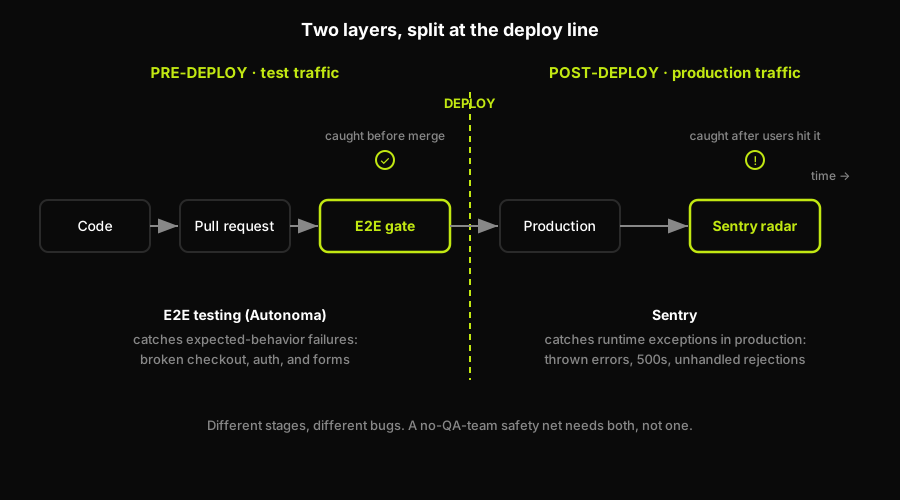
E2E filters bugs before deploy; Sentry watches what crosses into prod.
What Sentry catches
Sentry is a post-prod runtime monitoring tool. It catches errors that happen to real users in production traffic. That scope makes it genuinely valuable and genuinely limited at the same time.
What Sentry does well: it captures unhandled exceptions and console.error events the moment they hit your production runtime. It groups them, deduplicates them, adds stack traces, shows the breadcrumbs leading up to the error, and links releases to error spikes. Session replay, when you have it configured, lets you watch exactly what a user did before the error fired.
For a no-QA-team startup, Sentry fills the "we hear about it real quick" role. The moment a user hits a JavaScript error, a Python exception, an unhandled promise rejection, or a 500 from your API, Sentry alerts you. That is the fastest feedback loop you have for production errors, and it is the correct tool for that job.
The things Sentry catches by design:
Unhandled JavaScript exceptions in the browser. Stack traces with source maps unwrapped. Python, Go, Rails, and Node backend exceptions. Slow database queries flagged through performance monitoring. Errors correlated to specific releases via release tracking. User impact metrics: how many users hit this, across which sessions.
What Sentry does NOT catch: it cannot test whether a checkout flow, an auth redirect, or a form submission still works before the code is deployed. Sentry is reactive, not proactive. It waits for errors to happen. If a bug causes a silent failure (a button that does nothing, a form that submits but writes no data, a token that expires mid-session without throwing), Sentry will not surface it unless an explicit error fires.
What E2E testing catches
End-to-end testing is a pre-deploy verification layer. It catches expected-behavior failures before deploy, against test traffic, before any real user is affected.
Where Sentry starts at the runtime error, E2E testing starts at the user flow. A good E2E test suite covers: does the signup form submit and redirect correctly, does the checkout flow complete without aborting, does the authentication redirect land on the right page, does the password reset email trigger, does the dashboard load with real data, does the file upload succeed. These are not error conditions. They are expected behaviors. If any of them regresses, Sentry typically fires nothing, because no exception was thrown.
E2E testing is the tool that catches this category of bug before a user hits it. A founding engineer at a B2B startup we work with described the pattern well: the checkout flow broke silently. No JavaScript error, no 500. The button just stopped doing anything after a dependency update. Sentry showed zero new errors. Two days and a support ticket later, the bug surfaced. A pre-deploy E2E test on that flow would have caught it on the PR.
For teams without a QA hire, the value of E2E testing is catching bugs before they reach production using the no-QA-team safety net pattern: catch bugs before they reach production, not after.
What E2E testing does NOT catch: errors that only appear under real production traffic patterns, long-session token expiry that takes hours to reproduce, errors from third-party service failures in production, and runtime crashes in environments your test suite does not replicate. It also cannot monitor your production runtime continuously the way Sentry does.
What neither catches
Before the comparison table, it is worth being direct about the gaps neither tool covers well.
Latency regressions: If a feature that took 200ms now takes 2000ms, neither Sentry nor E2E testing surfaces that automatically unless you have explicit performance assertions. E2E tests pass or fail on behavior; they are not performance benchmarks by default. Sentry's performance monitoring can flag slow transactions, but only for errors it can attach to a trace.
Visual regressions: A layout that breaks in Safari, a button that renders off-screen on mobile, a font that loads incorrectly. Neither tool catches this unless you add pixel-comparison tooling (Chromatic, Percy) on top.
Business-logic failures that look like success: A payment that processes but books the wrong amount. An email that sends to the wrong address. A record that writes to the wrong tenant. These do not throw exceptions. They return HTTP 200. Neither Sentry nor standard E2E tests catch them unless the test explicitly asserts the output state, not just the response code.
Silent data corruption: A background job that silently drops records, a migration that truncates the wrong column. These only surface in production data audits.
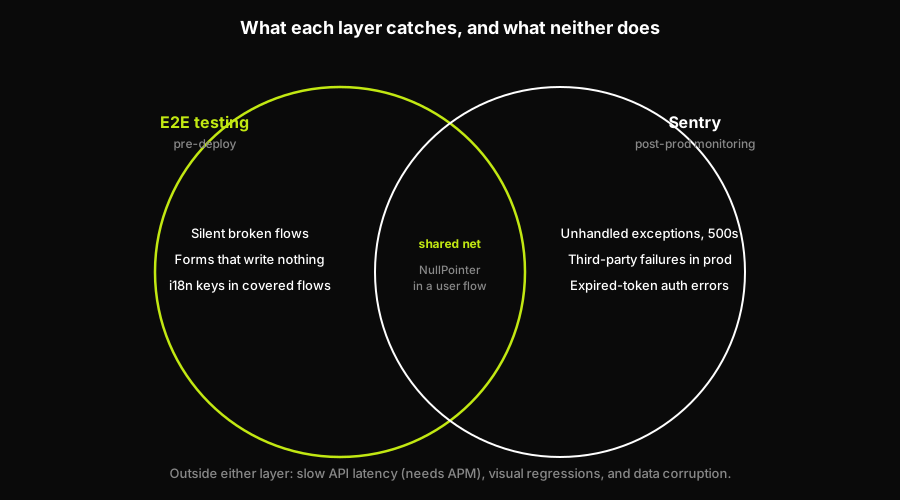
Each layer owns a zone; latency, visual, and data bugs fall between.
Which one catches bugs: an honest comparison
| Bug type | Sentry catches it? | E2E testing catches it? | Best tool |
|---|---|---|---|
| NullPointerException in prod | Yes (runtime error) | Only if it surfaces in a flow | Sentry |
| Broken checkout flow (silent) | No (no exception thrown) | Yes (expected-behavior check) | E2E testing |
| Slow API (200ms to 2000ms) | Partially (perf monitoring) | No (unless assertion added) | APM / traces |
| Expired token in long session | Yes (auth error in prod) | Partially (short-session only) | Sentry |
| Missing translation key | Only if it throws | Yes (if i18n flow is covered) | E2E testing |
| Race condition in optimistic UI | Partially (if it throws) | Partially (hard to reproduce) | Both, partially |
| Malformed JSON from third-party | Yes (parse error) | Only in mock environments | Sentry |
When you adopt both: the no-QA-team safety net
The honest answer to "Sentry vs E2E testing" is: you need both. They are not alternatives. They are two layers of the same safety net.
The pattern that works for Seed-to-Series A teams without a QA hire is a two-layer net. Layer one is pre-deploy E2E, the layer Autonoma operates for no-QA teams: your critical user flows are tested automatically on every PR before the code merges, against a preview environment that mirrors production. Expected-behavior failures get caught here, before a user touches the code. Layer two is post-prod monitoring: Sentry catches the runtime errors that slip through, fires in production under real traffic patterns, and gives you the stack trace and session context you need to debug fast.
"We don't have any QA" does not mean you cannot have both layers. It means you cannot maintain both layers manually. The operational cost of writing Playwright tests, keeping them green as your UI evolves, and provisioning preview environments per PR is what blocks small teams from having the pre-deploy layer. That operational cost is what the tools in the space are competing to reduce.
A Series A fintech we work with ran Sentry as their only safety net for the first 18 months. Every bug was a post-production event. After adding a pre-deploy E2E layer, they went from "we hear about it real quick" (from users) to catching the same bugs in the PR review cycle. Same team size. No QA hire. Two layers.
How Autonoma covers the E2E layer (and where Sentry covers what Autonoma cannot)
The concrete pain point this article documents: small teams have Sentry for post-production errors, but nothing systematic for pre-deploy expected-behavior verification. Writing and maintaining Playwright scripts takes time a team of 3 to 20 engineers does not have.
What Autonoma covers
We built Autonoma to operate that pre-deploy E2E layer hands-off, with four agents doing the work. The Planner agent reads your codebase, maps your routes, components, and user flows, and plans test cases from that code analysis, not from recordings or natural-language prompts. It also handles database state setup automatically, generating the endpoints needed to put your DB in the right state for each test scenario. The Diffs Agent runs on every PR, adding, deprecating, and maintaining test cases based on what the code diff actually changed, so the maintenance burden that kills hand-written Playwright suites does not apply. Behind those two, the Executor agent runs the planned tests against a managed preview environment, and the Reviewer agent classifies each result as a real bug, an agent error, or a test-plan mismatch.
The result is a four-stage pipeline: planning from code, maintaining the test suite on every diff, running tests on the preview environment per PR, and reviewing results. No clicking through the app. No recording. No writing test scripts.
What Sentry still covers
What Autonoma does NOT cover, and what Sentry does: Autonoma is the pre-deploy E2E layer. It does not monitor your production runtime. It cannot catch the errors that only surface under real production traffic, in long user sessions, or from third-party failures that your preview environment did not replicate. That is Sentry's job. If you are running Autonoma and thinking you can drop Sentry, that is the wrong conclusion. Run both. Autonoma catches expected-behavior failures on every PR. Sentry catches runtime errors in production. Together they form the no-QA-team safety net that a small team can actually operate without a dedicated QA hire.
For a deeper look at the pre-deploy patterns specifically, the catch-bugs-before-sentry pre-deploy patterns article covers the playbook in detail. The sibling piece on sentry alternatives for pre-deploy bug detection maps the broader tool landscape. And alternatives to sentry for no-qa teams covers how the four-layer safety net fits together.
If you want to go deeper on what Autonoma does as an autonomous testing platform, the autonomous testing platform post covers the full architecture.
Who this is for (and who it is not for)
This is for you if:
- You are on a Seed or Series A engineering team of 3 to 20 engineers.
- You have no dedicated QA hire.
- You are already using Sentry for post-prod monitoring.
- You are trying to figure out whether E2E testing is worth adding, or whether Sentry is enough.
It is not for teams with a dedicated QA function, teams using a fully managed QA platform, or teams asking whether to replace Sentry with something else entirely. That is a different question (see the sentry alternatives for pre-deploy bug detection article for that angle).
The answer for the no-QA-team ICP is: Sentry is not enough on its own. E2E testing is not a replacement for Sentry. Both layers are necessary: Autonoma upstream for pre-deploy expected-behavior verification, Sentry downstream for production runtime visibility. The question is only how you operate them with a small team.
Yes, if you want a complete no-QA-team safety net. Sentry catches runtime errors after deploy, in production. E2E testing catches expected-behavior failures before deploy. Neither covers the other's layer. Teams that run only Sentry hear about bugs from users. Teams that run only E2E testing have no runtime visibility in production. A complete safety net needs both.
No. E2E testing runs before deploy, against test traffic. It cannot monitor your production runtime, catch third-party failures in live traffic, or surface errors that only occur under real user session patterns. Sentry's job is post-production runtime monitoring, and no pre-deploy testing tool replicates that. Run E2E testing to catch bugs before they reach Sentry, not instead of Sentry.
No. Sentry catches errors that throw exceptions or trigger error events in production. It does not test whether your checkout flow, auth redirect, or form submission still works before deploy. Silent failures (a button that does nothing, a flow that aborts without throwing) are invisible to Sentry unless an explicit error fires. E2E testing catches expected-behavior failures. Sentry catches runtime errors. Different jobs.
Sentry catches: runtime exceptions that only appear under real production traffic, errors from third-party service failures in production, long-session token expiry that takes hours to reproduce, and any crash that occurs in a user session Sentry is instrumenting. These are post-production events that E2E tests, which run against a preview environment before deploy, cannot replicate.
E2E testing catches: silent failures where expected user flows no longer work but no exception is thrown (broken checkout, broken auth redirect, form that submits but writes nothing), regressions introduced by a PR before any user sees the code, and missing translation keys or UI state bugs that return HTTP 200 but deliver the wrong behavior. These never appear in Sentry unless an explicit error fires.


