

The best test management software depends on how your team actually tests, not on which vendor's roundup you click first. Jira-native teams get the most value from Zephyr Scale or Xray, since test cases live as Jira issues with no second login. Standalone teams should default to TestRail for its maturity and reporting depth. Open-source shops can run TestLink or Kiwi TCMS for free on their own infrastructure. Testmo is the strongest all-in-one pick for manual, exploratory, and automated results together, and Qase has the most generous free tier to start with no purchase order at all.
Ask five different vendors for the best test management software and you get five different first-place trophies, each one conveniently pointing at the vendor answering the question. That's not a coincidence. It's how nearly every "best of" list in this category gets written: by a tool with a stake in the outcome.
There is no universal best pick, and any list that hands you one without asking about your stack is skipping the only question that matters. Are you living inside Jira already, or running independently? Are you a five-person startup or a two-hundred-person QA org with a procurement process? Is most of your coverage manual and exploratory, or automated end-to-end tests running in CI on every commit? Answer those three questions first, and the right pick for your team stops being a mystery.
The best test management software by use-case
Five picks, five different reasons, ranked by the use-case each one solves rather than by feature count.
| Use-case | Best pick | Why | Price signal |
|---|---|---|---|
| Best Jira-native | Zephyr Scale (or Xray) | Lives inside Jira, no context-switch | ~$10/mo at 10 Jira users |
| Best standalone | TestRail | Mature, framework-agnostic, strong reporting | ~$37/seat/mo Professional |
| Best open-source | TestLink / Kiwi TCMS | Free to self-host, full control | $0 license, your hosting time |
| Best all-in-one | Testmo | Cases, runs, automation, exploratory in one | ~$99/mo flat, 10 users |
| Best free | Qase | Generous free tier to start | $0 up to 3 users, then paid |
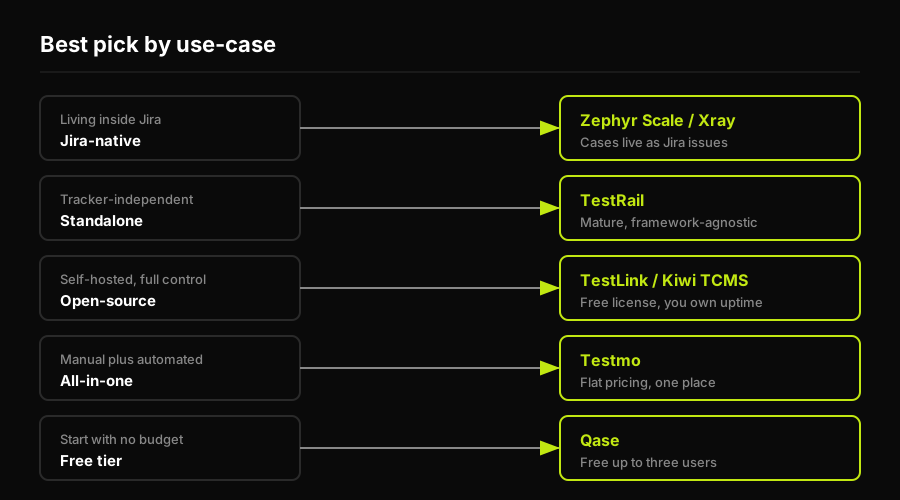
Start from how your team tests, and the right tool stops being a mystery.
Zephyr Scale and Xray both live inside Jira as marketplace apps, so test cases are Jira issues by default and nobody context-switches to a second tool. The tradeoff shows up on the invoice: pricing tracks your total Jira seat count rather than just the people running tests, a detail worth understanding before you commit, covered in more depth in Zephyr pricing and in how Jira test management actually works day to day. TestRail is still the safest standalone default: framework-agnostic, mature reporting, and no dependency on whichever issue tracker your team happens to use this year. TestLink and Kiwi TCMS are free to run yourself if you have the infrastructure appetite for it (no license fee, but you own the uptime); a deeper look at self-hosted open-source test management covers the setup tradeoffs. Testmo's flat per-team pricing fits small teams consolidating manual, exploratory, and automated results into one place instead of three browser tabs. Qase's free tier, currently capped at three users, is the fastest way to try real test management before a purchase order exists.
Vendor pricing shifts quarterly. Treat every figure above as a starting point to verify on the vendor's current pricing page, not a quote you can act on directly.
Team size is the fastest filter if you want to skip straight to a pick. Under a dozen testers, Qase's free tier or Testmo's flat pricing usually beats any per-seat plan on total cost. Between a dozen and fifty, TestRail or a Jira-native app, depending on your issue tracker choice, starts winning on maturity and integration depth. Past fifty testers, or once compliance enters the picture, tools like PractiTest and qTest earn a look for the traceability chain built into their entry plans, even though neither made this five-tool shortlist for use-case fit.
How to pick the best for your team
Five criteria decide which row in the table above actually fits your team, roughly in order of how much weight each one should carry.
- Jira dependence. If your team lives in Jira today and has no plan to switch, Zephyr Scale or Xray remove a sync step entirely by storing test cases as Jira issues. If you want tooling independence, expect to change issue trackers eventually, or you're not on Jira at all, a standalone tool avoids that lock-in.
- Team size and budget. Per-seat pricing (TestRail, Qase) scales predictably with headcount, which makes next year's renewal easy to forecast. Flat pricing (Testmo) rewards small teams and penalizes growth in steps once you cross a seat threshold. Jira-user pricing (Zephyr Scale, Xray) can balloon if your whole Jira instance counts toward the bill, not just the testers who actually open the tool.
- Manual vs automated testing mix. A team running mostly automated coverage has a fundamentally smaller manual test case backlog to manage in the first place, which changes whether a full TMS subscription is worth paying for at all, a question the next section answers directly.
- Reporting, compliance, and traceability needs. Regulated teams (medical, financial, aerospace) need requirements-to-test-to-defect traceability that survives an audit, and that requirement alone can outweigh every other factor on this list. Lighter teams can treat reporting as a nice-to-have add-on instead of a hard requirement.
- Free trial or free tier availability. Qase, TestLink, and Kiwi TCMS let you run a real evaluation with a live team before paying anything, which is enough time to see how a tool holds up under actual use. Everything else on the shortlist gives you a time-boxed trial, useful for testing the interface but not for judging six months of backlog growth.
For the full feature-by-feature comparison across every major tool in this space, including deployment, integration, and pricing tables beyond this shortlist, see our buyer-neutral test case management tools comparison.
Or: the best option might be no TMS
None of the above stops being true if most of your testing is manual, exploratory, or subject to audit. A human tester running a checkout flow by hand, filing exploratory notes, or executing a compliance-mandated regression pass genuinely needs a place to store, version, and report on that work. That's a real TMS's job, and teams with that profile should buy one of the five tools above rather than look for a shortcut. Nothing about automated testing changes the compliance math for that slice of a suite.
But there's a "best" option none of the vendor roundups mention, because none of them can afford to. For the automated browser and end-to-end slice of your suite, the cheapest way to manage a test case backlog is to never let one accumulate by hand in the first place. We built Autonoma around that idea. A Planner agent reads your codebase and plans test cases directly from your routes and components, the same source of truth a human would eventually use to write those cases by hand anyway. An Executor agent then runs those cases against a live, managed preview environment spun up for that specific pull request, so nothing runs against a shared staging box that half the team is also modifying. A Reviewer agent classifies what happened: a real bug, an agent error, or a mismatch with the current app that means the plan itself needs updating. A Diffs Agent watches each PR's code changes and adds, updates, or deprecates cases to match, the same maintenance work a human owner would otherwise redo by hand every sprint.
Picture a fifteen-person engineering team already running Qase's free tier for a handful of manual regression checks, but hand-writing forty automated E2E cases inside the same project because that's where the rest of the suite happens to live. Every UI change forces someone to open Qase, find the affected case, and rewrite the steps before the next release goes out, which is exactly the maintenance tax a TMS was never built to charge on automated coverage. Point those forty cases at Autonoma instead, and the team keeps Qase for the manual regression checks it's actually suited for, while the Diffs Agent absorbs the maintenance tax on every pull request instead of a person doing it between other work.
Each of those four agents runs with its own verification layers, so a Planner-generated case doesn't quietly drift from what the Executor actually runs against the preview environment, and a Reviewer's classification comes from checking the run against expected behavior consistently rather than guessing at intent. The same discipline extends to database state: instead of a person writing setup scripts to get a test environment into the right condition before each case runs, the Planner agent generates the endpoints needed to put the database in the right state for that specific test, which is exactly the kind of manual precondition-work that otherwise ends up scribbled into a TMS's test case notes field.
Map that back to the criteria above and the fit gets easier to see. Jira dependence stops mattering for this slice, since there's no case to file as a Jira issue in the first place. Team size and budget stop scaling with seats, since nobody is authoring cases by hand regardless of headcount. Reporting and traceability still happen, just from the Reviewer agent's classification instead of a manually updated dashboard. The one criterion from the list that still applies unchanged is the manual-versus-automated mix itself, since it's exactly what decides how much of a suite this approach can absorb.
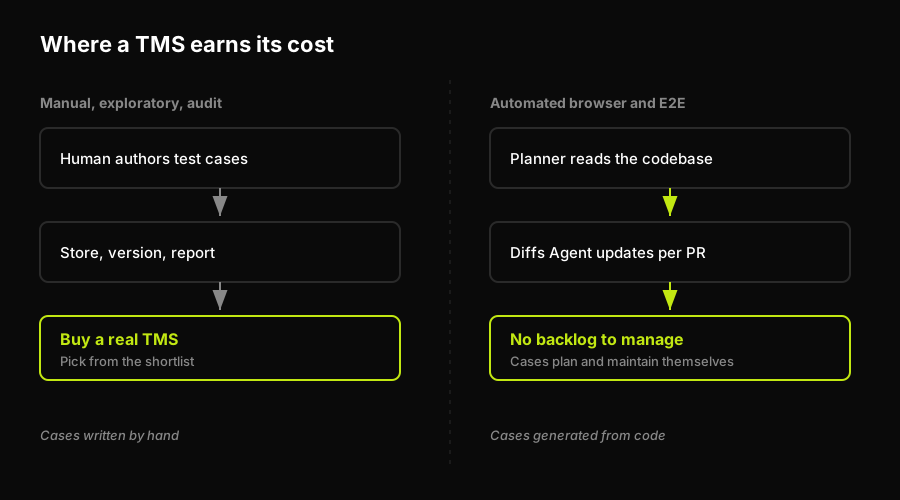
A TMS earns its cost on manual work; automated E2E cases can plan themselves from code.
Be clear about the boundary, though. Autonoma covers browser and web E2E testing, running on a managed preview environment per pull request rather than against a shared staging environment. It is not a replacement for manual, exploratory, or non-web test management, and it doesn't store, version, or report on cases the way a real TMS does. If your team's coverage is mostly manual or lives outside the browser, buy from the shortlist above. If it's mostly automated E2E, the best test management software for that slice might be none at all, since the cases plan and maintain themselves from the code that already exists.
FAQ
There isn't a single best test management software, because the right pick depends on whether you're Jira-native or standalone, your budget, and how much of your testing is manual versus automated. Zephyr Scale or Xray win for Jira-native teams. TestRail is the strongest standalone default. TestLink and Kiwi TCMS are the best open-source picks. Testmo leads on all-in-one manual and automated coverage. Qase has the most generous free tier.
Qase offers the most generous commercial free tier, currently capped at three users with 30-day run history. TestLink and Kiwi TCMS Community Edition are free forever if you self-host them, with no user cap, in exchange for owning the infrastructure yourself.
Zephyr Scale and Xray are the two leading Jira-native tools, both living inside Jira as marketplace apps so test cases are Jira issues with no second system to sync. Zephyr Scale tends to suit larger multi-project suites; Xray has arguably the strongest native Gherkin and BDD support. Both price against your total Jira seat count, not just the people who test.
Not always. Small teams with a mostly automated test case backlog often do fine with Jira issues or a well-maintained spreadsheet. Dedicated test management software earns its cost once you have substantial manual or exploratory testing, compliance and audit requirements, or a backlog large enough that a spreadsheet stops being reliably searchable.
Kiwi TCMS is the more actively maintained open-source test management option, with official reporters for Playwright, Cypress, and pytest plus native two-way Jira integration. TestLink is the older, free-forever alternative with a built-in Jira connector but no turnkey automation reporters. Both require you to self-host and maintain the infrastructure yourself.


